Sign in. It’s quick, free and it’s up to you.
An account is an optional way to support the work we do. Find out more.
Sign in. It’s quick, free and it’s up to you.
An account is an optional way to support the work we do. Find out more.
EXPERTS ARE INVESTIGATING the site of a Ukrainian cargo plane crash in northern Greece today to determine whether any dangerous chemicals or explosive cargo remains.
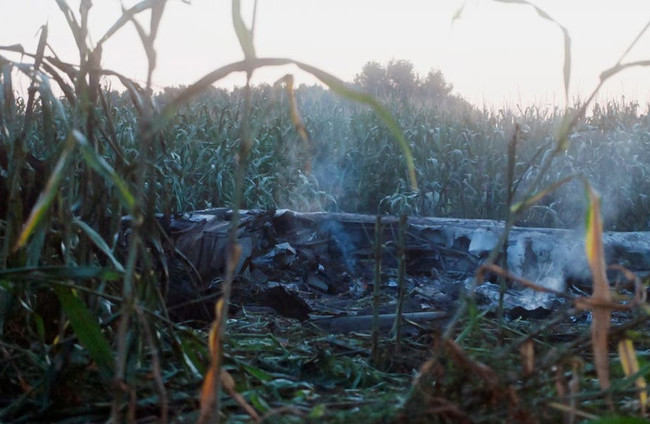
The Antonov An-12 cargo plane, which was bound for Bangladesh, smashed into fields between two villages late last night.
The eight crew members who were on board have died.
Local residents reported seeing a fireball and hearing explosions for two hours afterwards.
A plume of white smoke was still rising from the front end of the plane this morning.
Authorities said they did not know if there were dangerous chemicals on the plane, including those contained in batteries.
A special army unit that looks for nuclear, biological and chemical substances has been called in to comb the site.
The fire service has cordoned off the area at a radius of about 400 metres.
The mayor of the municipality of Paggaio, to which the two villages close to the crash belong, has banned vehicle movements on nearby roads.
Serbian defence minister Nebojsa Stefanovic told a news conference on thatall eight crew members were killed.
He said the plane was carrying 11.5 tons of Serbian-made mortar ammunition to Bangladesh, which was the buyer. It had taken off from the Serbian city of Nis and had been due to make a stopover in Amman, Jordan.
The plane was operated by Ukrainian cargo carrier Meridian, and the Ukrainian consul in Thessaloniki, who has arrived at the crash site, told local officials that the crew were all Ukrainian.
Stefanovic said: “These were illuminating mortar mines and training (mines) … This flight had all necessary permissions in accordance with international regulations.”
The plane crashed shortly before 11pm local time about 25 40km west of Kavala International Airport.
Minutes earlier, the pilot of the plane had told air traffic controllers there was a problem with one of his engines and that he had to make an emergency landing. He was directed to Kavala airport but never made it.
The plane was a Soviet-era four-engine turboprop cargo carrier.
Drone footage showed that small fragments are all that is left of the plane.
Firefighters who rushed to the scene overnight were prevented from reaching the crash site by smoke and an intense smell which they feared might be toxic.
Nearby residents were told to keep their windows shut all night, not to leave their homes and to wear masks.

To embed this post, copy the code below on your site














have your say