Sign in. It’s quick, free and it’s up to you.
An account is an optional way to support the work we do. Find out more.
Sign in. It’s quick, free and it’s up to you.
An account is an optional way to support the work we do. Find out more.
LAST UPDATE | 23 Sep 2020
HEALTH OFFICIALS HAVE confirmed a further 234 new cases of Covid-19 in Ireland.
103 of the new cases are in Dublin. There have now been a total of 33,675 cases of Covid-19 confirmed in Ireland.
In a statement, the department also said there have been two further deaths of people who were confirmed to have Covid-19.
The death toll from Covid-19 in Ireland is 1,794.
A breakdown of the figures:
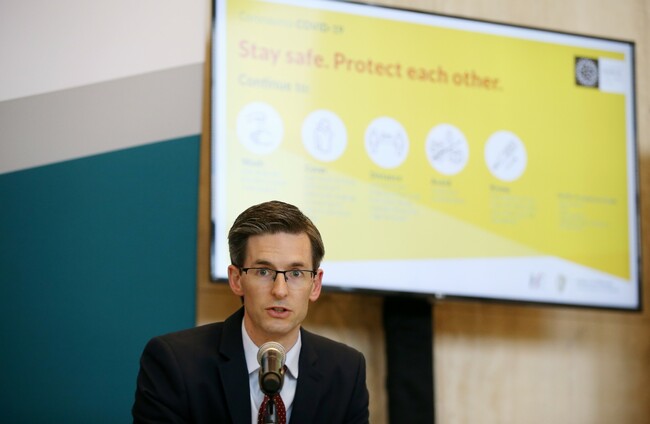
Dr Ronan Glynn, Acting Chief Medical Officer, said: “The single most important thing that people all across the country need to do now is to reduce their social contacts.
We all need to cut down on discretionary social activities. Meeting fewer people means fewer opportunities for the virus to transmit. Please prioritise who you choose to meet and try to keep your social network as small as possible.
Professor Philip Nolan, Chair of the NPHET Irish Epidemiological Modelling Advisory Group, said: “While 14-day incidence and daily incidence have stopped rising in the last few days, it is too early to conclude that there has been any change in the pattern of disease.”
At tonight’s briefing, public health officials warned that a significant number of counties are now seeing worrying numbers.
While Dublin remains the worst-hit, with an incidence of 3-4 times higher than the rest of the country, there are particular concerns about Louth, Waterford and Donegal.
“Over one in three cases in Donegal are in people aged 15 to 24 years of age,” Dr Glynn said. “There are a large number of family and extended family outbreaks.”
But he added that “people in all counties should be worried”.
“The single most important thing that people all across the country need to do now is to reduce their social contacts,” he said.
“It’s vital over the coming days, weeks that people across the country reduce their social contacts.
“We all quite simply have to cut down the number of people we meet otherwise we will not get this under control.”
Dr Glynn said a huge emphasis is on individual choices.
He said: “Go to your football match but then don’t go to the pub. Or go to the pub but don’t go to the football match. Bring your children to the playground but not to your neighbour’s house down the road.
These are choices we all have to make. We can’t have everything that we had eight months ago. It’s not the time for house parties. It’s not the time for big communion celebrations. It’s not the time for big family gatherings.
He again stressed the need for a small social bubble, and said this must be the case all around the country.
Examples were cited of those who didn’t restrict their movements. In one instance a person who was a close contact of a case didn’t restrict their movements and went to a party. The endpoint of that was 20 new cases.
Professor Nolan said the growing number of cases among older people was a cause of “grave concern” and it was a trend that could be traced back to late June.
“We started to mix more than was safe and in an unsafe manner going back several weeks now, and the transmissions that occurred then are catching up with us now,” he said.
He described the reproduction number for Covid-19 as “worryingly” high but he said it did not take account of the new restrictions introduced last week.
It now sits between 1.5 to 1.7.
“That is far too high, that will lead to exponential growth in cases, hospitalisations, and ultimately deaths, so the objective remains as it did last week that both the restrictions and the advice are designed to bring the reproduction rate back below one,” he said.
With reporting by Garreth MacNamee, Sean Murray

To embed this post, copy the code below on your site














have your say