Sign in. It’s quick, free and it’s up to you.
An account is an optional way to support the work we do. Find out more.
Sign in. It’s quick, free and it’s up to you.
An account is an optional way to support the work we do. Find out more.

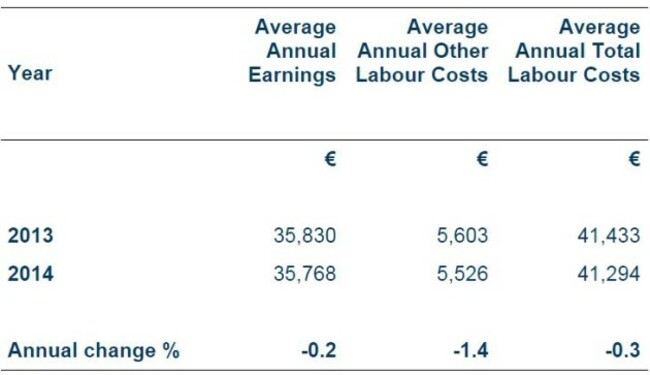
IRISH WAGES ARE still decreasing despite the economic recovery the country is currently experiencing.
The average national wage in 2014 fell to €35,768, a decrease of 0.2% from 2013, according to the latest release from the CSO.
However, while the figures are lower the rate of decrease is definitely slowing also (it was 0.7% in 2013) suggesting the light at the end of the tunnel is in sight.
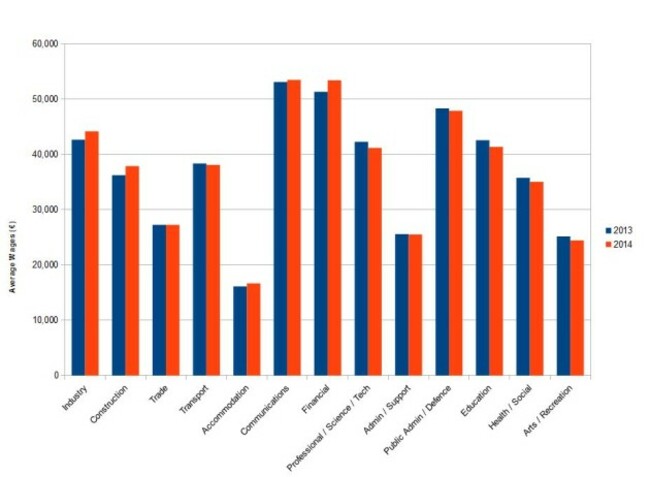
Similarly, not all industries are doing badly, with several definitely on the up from the point of view of average wages.
Click here to view a larger image.
5 of the 13 sectors accounted for have seen an increase in average annual wages, with the Construction industry seeing the greatest increase – up to €37,884 from €36,230.
The greatest decreases seen were in the Education and Arts / Recreation sectors, falling by 2.9% from €42,554 to €41,332 and €25,158 to €24,438 respectively.
Labour costs meanwhile were up 2.7% in 2014 to €66.6 billion. They remain a deal shy of their high water mark in 2009 of €68.9 billion.
The greatest labour costs at present are being seen in the Industry sector, with 16.1% of the country’s total costs in 2014.
Unsurprisingly, Construction has seen the greatest fall in such costs since the height of the recession.

Reacting to the CSO release, Mark Fielding, CEO of the Irish Small and Medium Enterprises association (ISME), drew attention to the respective plights of public sector workers and the self-employed and called for the establishment of an Independent Commission to examine public sector pay and recommend changes:
“The pay increases awarded in the new Lansdowne Road Agreement make no sense economically.”
It was merely a vote garnering exercise by a government who should really have known better. The public sector is paid far more than their private sector counterparts and excuses about differing education levels etc. simply do not wash.
Sinn Féin meanwhile said that the fall in average earnings is evidence that “Fine Gael and Labour are failing to deliver a fair recovery”.
“Time and again Fine Gael and Labour claim that the recovery is ‘all about jobs’, yet what we see from the CSOs figures is that people are working harder for less with a fall in average earnings in 2014,” said the party’s employment spokesperson Peadar Tóibín.
In fact average earnings are less now than they were when government entered office in 2011.
“This is one of the factors behind the crisis in our health system and the challenges facing the education sector,” Tóibín added.

To embed this post, copy the code below on your site














have your say