Sign in. It’s quick, free and it’s up to you.
An account is an optional way to support the work we do. Find out more.
Sign in. It’s quick, free and it’s up to you.
An account is an optional way to support the work we do. Find out more.
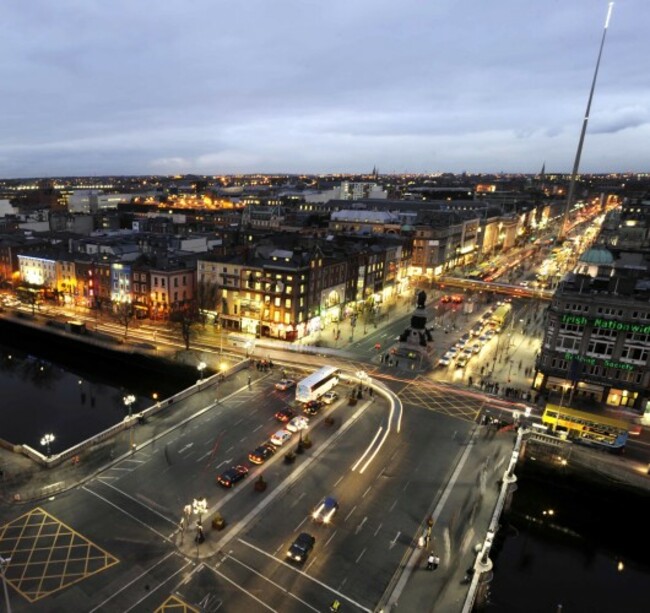
NEWLY RELEASED DATA suggests that rents across Ireland are now rising at their fastest ever rate.
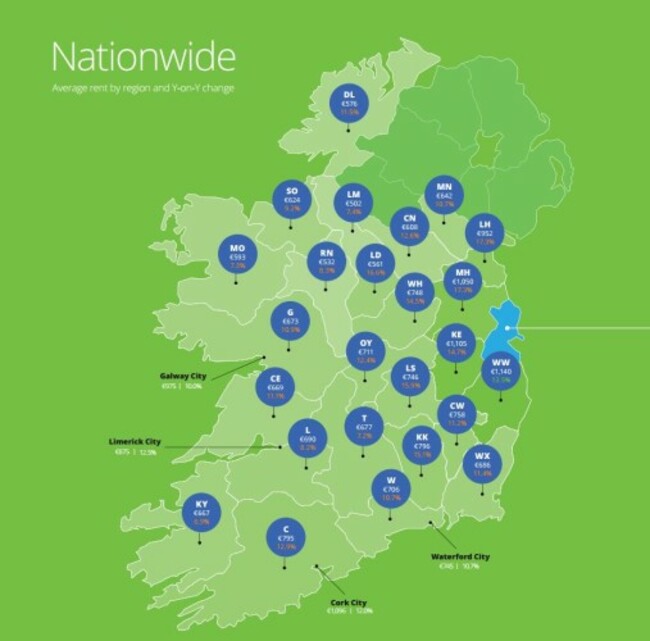
In the final quarter of 2016 the rate of inflation of rents across Ireland was 13.5% according to Daft.ie’s latest rental price report, which is conducted using properties advertised for rent on that website.
The average rent being seen nationwide is now €1,111 per month.
In Dublin rents are now rising by 15% per year, the highest rate seen since mid-2014.
Those same rents are now 65% greater than those seen at their lowest ebb in 2010.
Perhaps more significantly, rents in the capital are now a full 14% greater than at their previous peak, seen during the pre-crash days of early 2008.
In Ireland’s four other cities things are not quite so dramatic, if far from ideal.
In Cork, Waterford, Limerick, and Galway inflation has receded slightly but remains between 10% and 13%.
Click here to view a larger image
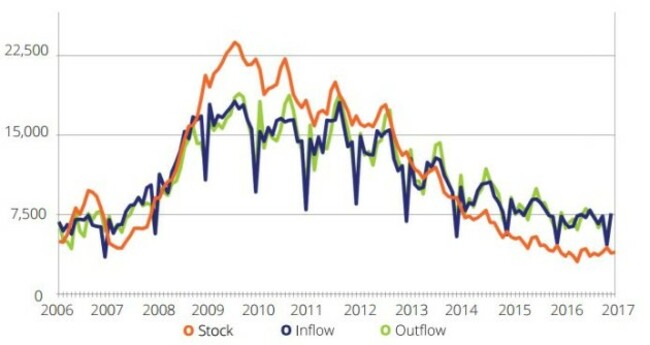
Daft.ie economist Ronan Lyons describes the problem as “a severe imbalance between supply and demand”, with just 4,000 homes available to rent across Ireland on 1 February.
By contrast, availability in April 2007, the lowest such point during the Celtic Tiger years, was about 4,400 homes.
The report is harshly critical of Dublin’s sprawl suggesting that “Greater Tokyo, with a population of over 27 million people, fits into 9,000 square kilometres”.
Greater Dublin, with a population of less than 2 million people, takes up almost 6,000 square kilometres.
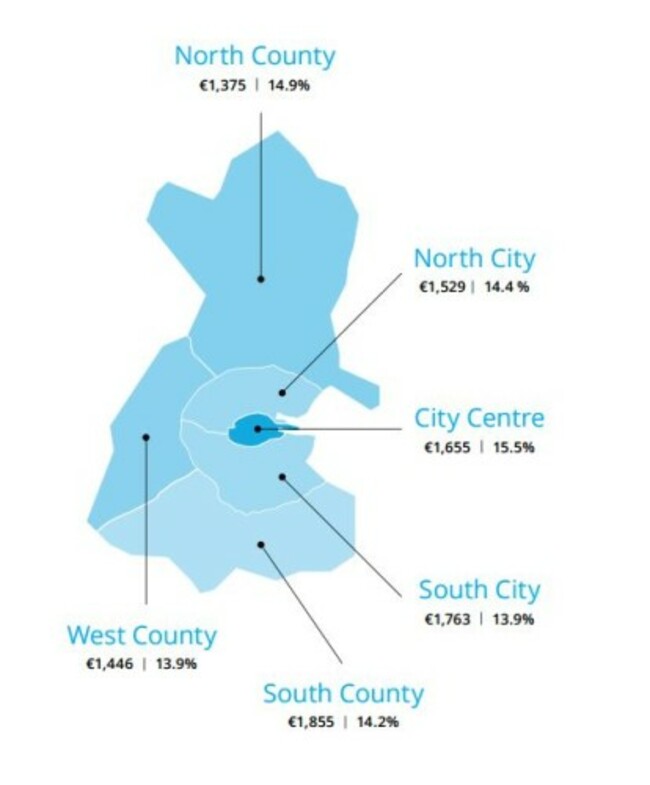
In Dublin, city centre rents now stand at €1,655 (an annual increase of 15.5%), while the north of the city stands at €1,529 and the south city at €1,763.
Rents in Dublin as a whole rose an average of 4% in each of the last three months, the largest three-month increase on record.
Click here to view a larger image
While rents are rising across the country, the trend is to be seen most acutely in the counties surrounding Dublin with Meath, Louth, and Dublin showing yearly rental increases of 17.3%, 17.3%, and 14.7% respectively.
The phenomenon is also being seen further afield however: Longford (16.6%) and Westmeath (14.5%) for example are also showing large increases, suggesting the rental trap is becoming more of an acute problem outside the capital.
Grow up
Lyons describes the report’s findings as making “grim reading not only for tenants but for policymakers also”.
The solution for driving population growth across the country without Dublin gradually ‘eating up’ the countryside requires several things to happen according to the economist.
“Dublin needs to be allowed to grow up. Height limits of between four and six storeys in one of Europe’s fastest growing cities merely translate into lost jobs and higher rents,” he said.
Click here to view a larger image
Secondly, homes need to be built on brownfield, as well as greenfield, sites. Looking around Dublin, it is littered with grossly underemployed land, in the form of army barracks, golf clubs and bus depots, built on the fringes of the city in the past but now in prime central locations. A land tax would help achieve this reuse of our scarce and valuable urban land.
Lyons contends that the biggest problem facing the rental sector however is “the extremely high cost of construction in Ireland, compared to other high-income countries”, and that until this is addressed the apartments needed to address the supply issue simply won’t be built.
Reaction
The Simon Communities in Ireland have described the released figures as “extremely worrying”.
“The spiralling rents and dwindling supply that have characterised the private rented sector in recent years must be addressed. Increasingly, these issues are preventing people from finding and sustaining affordable homes within the rental market,” said the community’s national spokesperson Niamh Randall.
Many people entering into homelessness are coming from the private rental sector where they have been unable to maintain their tenancy. Keeping people in the homes that they already have is key to stopping the flow of people into homelessness.
In light of this, Randall said that “the designation of rent pressure zones and the extension of these zones beyond Dublin and Cork to the fifteen new areas announced by the Minister last month are welcome”.
Sinn Féin’s housing spokesman Eoin O’Broin meanwhile said that in light of the figures “rent certainty is urgently needed”.
“Daft’s figures for the final quarter of 2016 are hugely concerning. This Government is continuing to fail renters,” he said.
Minister Coveney had an opportunity before Christmas to halt unaffordable rent increases. Instead, he gifted landlords with a 4% year on year rent increase for the next three years. The minister’s failure to get to grips with the crisis in the rental sector continues to heap pressure on struggling renters and effectively locks low income earners out of the rental market.
TheJournal.ie publisher Journal Media Ltd has some shareholders in common with Daft.ie.

To embed this post, copy the code below on your site






have your say