Sign in. It’s quick, free and it’s up to you.
An account is an optional way to support the work we do. Find out more.
Sign in. It’s quick, free and it’s up to you.
An account is an optional way to support the work we do. Find out more.
A CLAIM HAS been made on social media that gardaí asked off-licences to open later on St Patrick’s Day to help minimise social gatherings and prevent the spread of Covid-19.
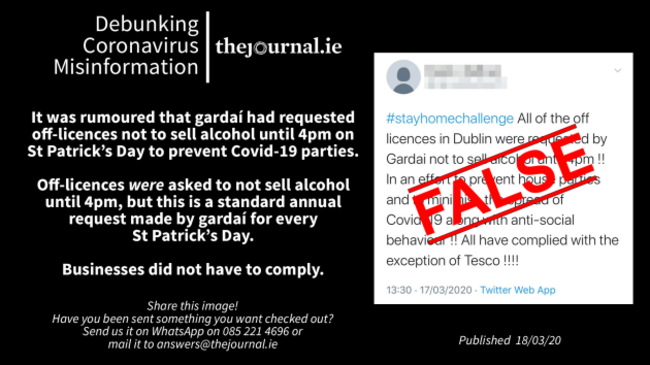
This claim is not true.
The claim was shared on Twitter on Tuesday afternoon, and was accompanied by the hashtag #stayathomechallenge, which is currently being used by soccer players as part of viral social media challenge during the global pandemic.
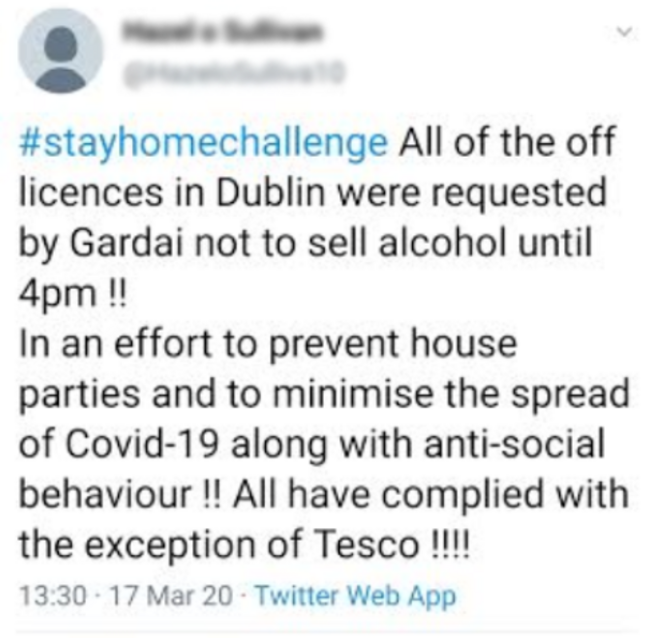
It says that off-licences in Dublin were asked by gardaí not to sell alcohol until 4pm:
It states:
All of the off licences in Dublin were requested not to sell alcohol until 4pm!! In an effort to prevent house parties and to minimise the spread of Covid-19 along with anti-social behaviour…
The headline of a piece on news website Dublin Live also linked coronavirus with a garda request to open off-licences in the capital later yesterday, although the body of the piece did not mention Covid-19.
The headline read: “Coronavirus: Off Licences and shops in west Dublin ‘restrict’ alcohol sales for St Patrick’s Day at local Gardaí’s recommendation”.
In a statement, a garda spokesman confirmed that although some off-licences in Dublin were asked to open later yesterday, this was nothing to do with the outbreak of Covid-19.
Under a voluntary code, off licences in the city have agreed with gardaí for a number of years not to sell alcohol before 4pm every St Patrick’s Day.
“In recent years as part of local policing arrangements on St Patrick’s Day, off-licences are asked adhere to a voluntary request from local gardaí not to engage in the sale of alcohol until after 4pm,” a garda statement said.
“Similar requests were in process in the planning in the lead up to St Patrick’s Day this year, and some businesses continued to comply in a voluntary capacity.
“This request, where complied with, has nothing to do with Covid-19.”
****
There is a lot of false news and scaremongering being spread in Ireland at the moment about coronavirus. Here are some practical ways for you to assess whether the messages that you’re seeing – especially on WhatsApp – are true or not.
STOP, THINK AND CHECK
Look at where it’s coming from. Is it someone you know? Do they have a source for the information (e.g. the HSE website) or are they just saying that the information comes from someone they know? A lot of the false news being spread right now is from people claiming that messages are from ‘a friend’ of theirs. Have a look yourself – do a quick Google search and see if the information is being reported elsewhere.
Secondly, get the whole story, not just a headline. A lot of these messages have got vague information (“all the doctors at this hospital are panicking”) and don’t mention specific details. This is often – but not always a sign – that it may not be accurate.
Finally, see how you feel after reading it. A lot of these false messages are designed to make people feel panicked. They’re deliberately manipulating your feelings to make you more likely to share it. If you feel panicked after reading something, check it out and see if it really is true.
TheJournal.ie’s FactCheck is a signatory to the International Fact-Checking Network’s Code of Principles. You can read it here. For information on how FactCheck works, what the verdicts mean, and how you can take part, check out our Reader’s Guide here. You can read about the team of editors and reporters who work on the factchecks here.

To embed this post, copy the code below on your site














have your say