Sign in. It’s quick, free and it’s up to you.
An account is an optional way to support the work we do. Find out more.
Sign in. It’s quick, free and it’s up to you.
An account is an optional way to support the work we do. Find out more.

RESEARCHERS HAVE OBSERVED a new record for the world’s deepest living fish, found at the bottom of the Mariana Trench, the deepest site on earth.
The new species (bottom right in compilation below) was recorded at a depth of 8,145 metres, breaking the previous depth record set in 2008 by nearly 500 metres, researchers said in a statement.
“This really deep fish did not look like anything we had seen before, nor does it look like anything we know of,” Alan Jamieson from the University of Aberdeen said.
“It is unbelievably fragile, with large wing-like fins and a head resembling a cartoon dog.”
The Mariana Trench sits nearly 11,000 meters (7 miles) below sea level in the Pacific Ocean, where very few large animals are found. It’s too cold and dark for most. However, new robotic technology is allowing researchers to explore the relatively barren environment, long thought too harsh for any life to exist at all.
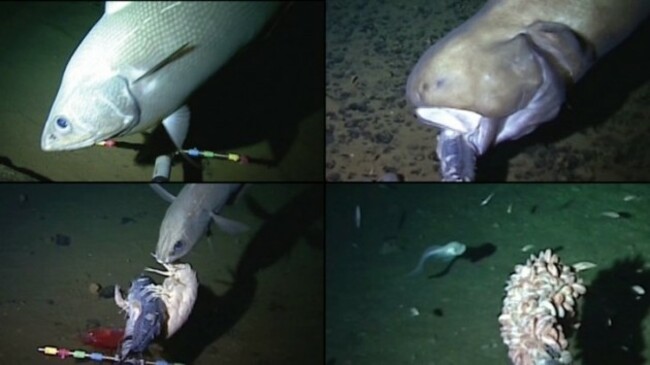
The footage was captured by a team of Scottish scientists from the University of Aberdeen during their 30-day expedition using the Hadal-Lander ocean vehicle.
Along with the new species of snailfish, researchers filmed several other rarely-seen sea creatures. That includes supergiant amphipods, crustaceans that can measure a foot or more in length and are often referred to as the “insects of the sea.”
The video footage below shows sea creatures at different depths. Larger animals, such as rat-tails and cusk eels live in shallower depths of 5,000-6,500 metres (16,404-21,325 feet). Supergiant amphipods live at mid-depths of 6,500-8,000 metres (21,325-26,246 feet). The newly-found, fragile snailfish lives at depths greater than 8,000 metres. It’s shown in the video around the 1:40-minute mark, swimming in from the bottom-left corner.
In 2012, director James Cameron became the first person to visit the bottom of the trench in more than 50 years. A year later, scientiststs published research indicating that the trench is thriving with microbes that are able to survive on the remains of dead animals, algae, and other microbes that float down the trench slopes.

To embed this post, copy the code below on your site














have your say