Sign in. It’s quick, free and it’s up to you.
An account is an optional way to support the work we do. Find out more.
Sign in. It’s quick, free and it’s up to you.
An account is an optional way to support the work we do. Find out more.
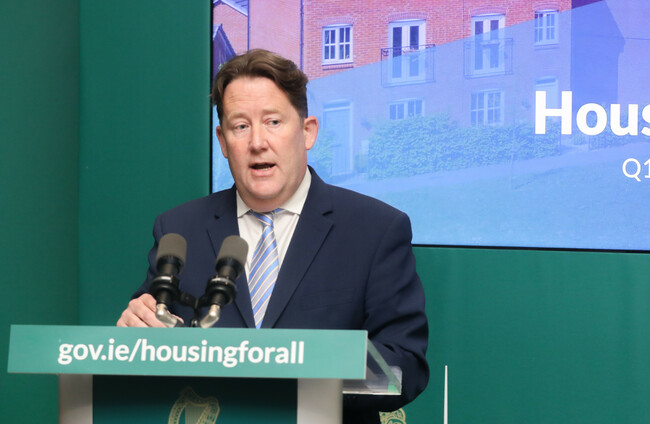
MINISTER FOR HOUSING and Local Government Darragh O’Brien has written to the Electoral Commission askinging it to consider undertaking research into limiting election posters, getting rid of by-elections and reviewing the voting age.
As first reported in The Irish Times, the Minister wrote to the Commission on July 19 and asked that it consider a number of research topics for inclusion in its annual research programme which will be published at an unknown date later this year.
The Commission is under no obligation to include any of the requested topics in its research programme and has not yet signalled whether it will do so.
Among his proposals in the letter seen by The Journal, the Minister asked that the Commission examine the use of posters at elections and referendums.
In the Government’s programme for government, it has committed to tasking the Commission to look into this area and consider whether limitations should be placed on the number of posters that can be used in certain locations.
In his letter, Minister O’Brien told Commission chair Ms Justice Marie Baker that he would support early consideration of this issue.
He also asked the Commission to examine the replacement of by-elections with an alternate list system.
By-elections are currently held when a TD vacates a seat outside of a general election.
By comparison, an alternate list system is one where any candidate in an election is required to provide a list of people who could be co-opted to fill a vacancy should it arise.
This is the system used to fill vacancies in the European Parliament.
The Minister also recommended that the Commission include a review of the voting age in its first research programme.
In the programme for government, the Government committed to an examination of the Scottish experience of reducing the voting age.
The voting age in Scotland was lowered to 16 in the 2016 Scottish parliamentary elections.
O’Brien also asked the Commission to examine the use of postal voting, with a view to expanding its use.
The use of postal voting was expanding somewhat in the Electoral Reform Act 2022 to include people with mental health difficulties.
As a result, people with physical difficulties or mental health difficulties which preclude them from attending a polling station on polling day can avail of a postal vote.
O’Brien asked the Commission to examine the use of postal votes “more generally” with a view to expanding its use.
The Minister’s final research recommendation related to residency and examining the time limitation on people who are temporarily living outside the State to remain on the voting register.
Under the Electoral Act 1992, a person is entitled to be registered in a constituency if they are ordinarily resident there.
Under the act, a person is deemed not to have given up ordinary residency if they intend to return within 18 months after leaving.
O’Brien said he would welcome research that considers the appropriateness of the current 18 month provision.

To embed this post, copy the code below on your site









have your say