Sign in. It’s quick, free and it’s up to you.
An account is an optional way to support the work we do. Find out more.
Sign in. It’s quick, free and it’s up to you.
An account is an optional way to support the work we do. Find out more.
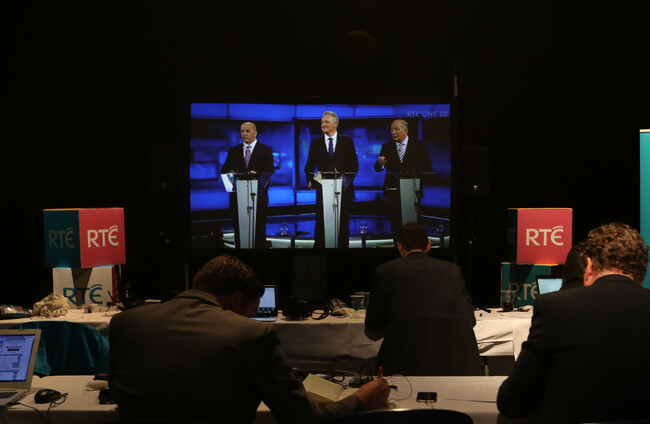
OVER THE COURSE of the last week, RTÉ has faced criticism from some candidates in the upcoming European elections for being excluded from the national broadcaster’s televised debates.
The first RTÉ debate is set to take place tonight during Upfront with Katie Hannon at 10.35pm, and will focus on the Midlands North-West constituency.
Eight of the 27 candidates running in the constituency will take part in the debate.
Following this, RTÉ will hold another two candidate debates for the remaining two constituencies ahead of the European elections – one for Dublin and one for Ireland South.
On Monday we will host the first of RTÉ's European election debates.
— Upfront with Katie Hannon (@RTEUpfront) May 17, 2024
Eight candidates from the Midlands–North-West constituency join us.
Tune in at 10.35pm.
For details on the candidate selection criteria, see here:https://t.co/tmkBuf8i5f#rteupfront | @RTENews pic.twitter.com/6c2rhcvUxU
Social Democrats candidate Rory Hearne and Independent Ireland candidate Ciaran Mullooly have been vocal in the criticism of RTÉ over their exclusions.
Mullooly, a former RTÉ correspondent, has accused the national broadcaster of not following guidance from Coimisiún na Meán on the selection of candidates for debates.
While Hearne and Social Democrats party leader Holly Cairns argue that his exclusion does not reflect the Social Democrats’ increased mandate since 2019.
RTÉ however, maintains that its participation criteria are set out openly and transparently.
RTÉ says its approach to covering the elections takes account of past court and regulatory decisions as well as the updated guidance issued by Coimisiún na Meán.
This approach for the 2024 elections is outlined by the broadcaster’s election steering group here.
Under Coimisiún na Meán’s guidance, broadcasters are told that a proportional allocation of air time is appropriate and that they may give reasonable consideration to “contextual factors”.
These may include: current elected representatives; first preference votes in a prior election; current support via opinion polls; the number of candidates running; and a diversity of political perspectives.
The updated guidance from Coimisiún na Meán also says that broadcasters have a duty to protect audiences from content that is harmful, or which may pose legal or liability issues to the broadcaster.
Coimisiún na Meán also acknowledges that decisions on editorial coverage of elections “rest solely” with the broadcasters.
This acknowledgement of editorial freedom has long been acknowledged, with the former Broadcasting Authority of Ireland (BAI) also pointing to it in 2019 after a complaint was brought by a candidate who was not included in a Prime Time debate.
In the document published by RTÉ’s election steering group, it says RTÉ uses past electoral record as one of the key metrics guiding its electoral coverage of parties, groups and candidates.
RTÉ maintains that the obligation to be “fair to all interests” does not mean that every view has to be covered.
Instead it says that a wide range of views are given to its audience across its coverage.
The steering group document notes that the courts and the regulator have both acknowledged that it is not possible, nor is it a requirement to provide airtime to every candidate or to include every candidate in any debates being held.
For example, in 2016 when the Green Party challenged RTÉ’s decision not to include them in a leaders’ debate, the courts held that no individual has a constitutional right to participate in a tv debate and that it was “not in question” that RTÉ was entitled to draw up participation criteria.
Meanwhile, RTÉ says practical issues such as studio capacity and the requirement to “devise and produce a meaningful and informed debate” place limitations on the number of participants.
For the TV debates, RTÉ has set out five criteria it considers:
The remaining RTÉ debates will be held during Prime Time on May 30 and June 4.
—
This work is co-funded by Journal Media and a grant programme from the European Parliament. Any opinions or conclusions expressed in this work are the author’s own. The European Parliament has no involvement in nor responsibility for the editorial content published by the project. For more information, see here.

To embed this post, copy the code below on your site















have your say