Sign in. It’s quick, free and it’s up to you.
An account is an optional way to support the work we do. Find out more.
Sign in. It’s quick, free and it’s up to you.
An account is an optional way to support the work we do. Find out more.
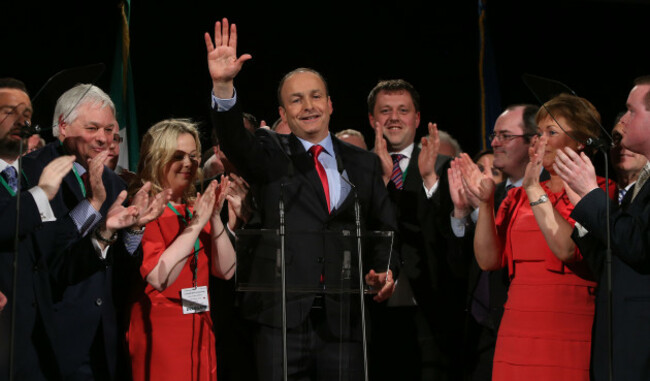
FIANNA FÁIL HAS managed to definitively bounce back from its electoral wipeout in 2011, clawing back a presence in crucial constituencies across the country, and throwing off its reputation as “male, stale and outside the Pale.
First, here are the basic facts of Fianna Fáil’s recovery.
Between 2011 and 2016, Fianna Fáil increased their first preference votes by 34%, from 387,358 to 519,356.
And their share of first preference votes went up by almost seven percentage points, from 17.5% to 24.3%.
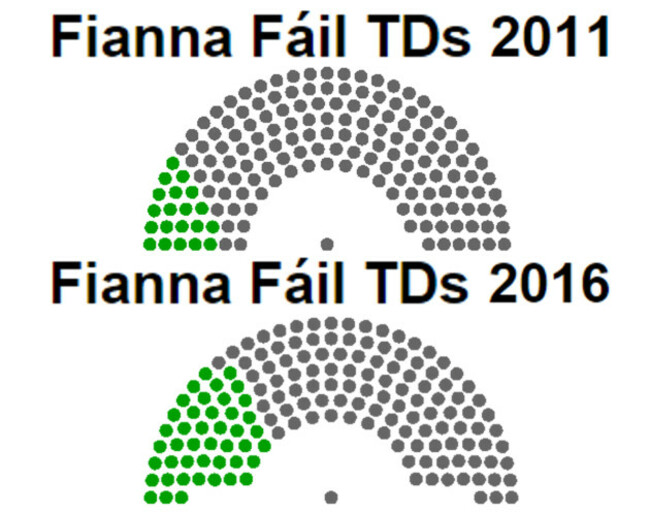
They have more than doubled their number of seats, from 20 to 44. And their share of seats in the Dáil is up by more than 15% – from 12% to 27.8%.
This suggests that Fianna Fáil candidates were relatively transfer-friendly last Friday.
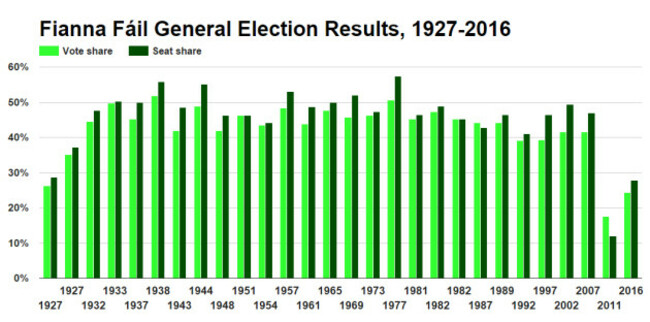
Of course, if we place the party’s performance this year in historical context – it is their second-worst ever, after 2011.
Setting aside the unprecedented Fianna Fáil armageddon of 2011, the party hasn’t achieved a share of seats in the Dáil this low since their first general election in 1927.
Throughout the 20th Century, they banked on vote shares of between 40% and 50% – a monopoly which has been the rival of most European political parties.
In 2016, they got 24% of votes and 28% of seats.
But let’s be fair. Increasing the number of your TDs by 120% in five years is, by any standards, a huge achievement, especially after losing 74% of them the last time around.
And Fianna Fáil’s comeback is perhaps even better than the sheer numbers suggest.
They have clawed their way back into whole swathes of the country from which they were exiled five years ago, maintained whatever presence they kept in 2011, and in some cases strengthened it.
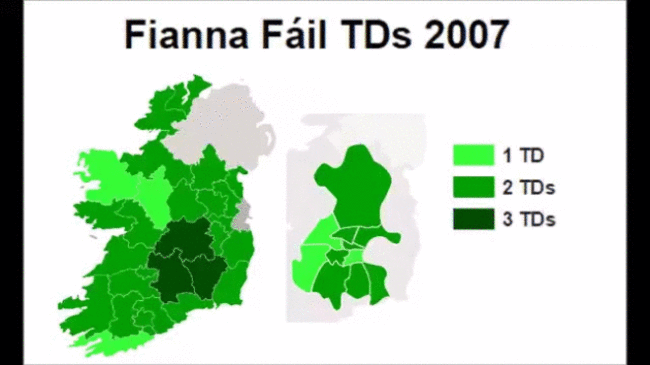
There were 23 constituencies (in today’s terms) where Fianna Fáil had at least one TD in 2007, but lost all representation in 2011.
Notably, the four areas in which they haven’t bounced back are all in the capital.
They still haven’t found a way to break back into Bertie’s heartland of Dublin Central, where they had held two seats from 1997-2011.
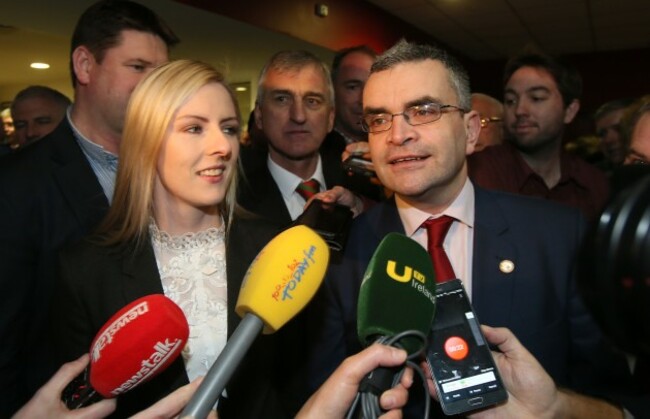
In particular, the election of 29-year-old Lisa Chambers in Mayo is an extraordinary development, meaning Fianna Fáil now have a presence equal to Fine Gael’s in the Taoiseach’s own backyard.
This would have been hard to imagine in 2011, when Fine Gael took four of the five seats on offer in Mayo.
That’s 35 constituencies – 19 more than in 2011, and not far off their distribution in 2007, when they had at least one Dáil deputy in all 43 constituencies.
In Galway East, the retiring Michael Kitt – who had held the seat on and off since 1975 – was replaced by Anne Rabbitte.
However, this success was offset by the fact that ex-Labour TD Colm Keaveney lost his seat in the constituency – the only Fianna Fáil deputy to do so in 2016.
In Louth, former Ceann Cómhairle Seamus Kirk was replaced by Declan Breathnach. And in Wexford, long-standing TD John Browne passed the baton on to his son James.
Of course, what they’re lacking in 2016 is many constituencies where they hold two and three seats, the norm as recently as eight years ago.
In short, Fianna Fáil now have footholds across the country, where once they had strongholds.
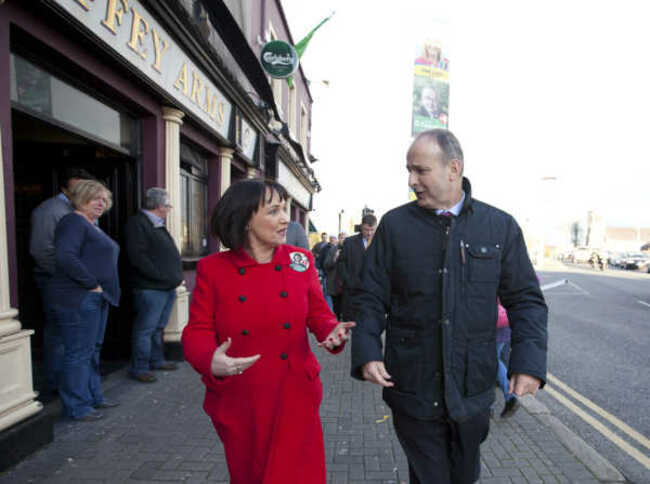
The two biggest catastrophes of 2011 are widely understood to have been the party’s lack of a TD from Dublin, containing as it does 28% of the population, and no TD representing 51% of the Irish people – women.
After Senator Averil Power left the party following the same-sex marriage referendum last year, this prompted Clare TD Timmy Dooley to admit, in the words of one reporter, that the Fianna Fáil parliamentary party looked distinctly “Male, pale and outside the Pale.”
Their contingent of female TDs was savaged at the polls in February 2011, with all six losing their seats, including the then Tánaiste Mary Coughlan.
Well before election day, however, plenty of high-profile and senior Fianna Fáil figures had seen the writing on the wall, and the party was denied two retiring female incumbents – Beverly Flynn and Mary Wallace.
Despite this wholesale clear-out, however, in 2016 the party put forward a raft of able female candidates, many of them young, and almost all of them without any link to the party’s recent past.
The result was that Fianna Fáil elected six women last weekend, second only to Fine Gael’s 11, and achieved some striking breakthroughs.

In all, Fianna Fáil ran 22 female candidates, second only to Fine Gael’s 27.
Of those, 16 were running in a general election for the first time – the highest among any party – and five of those were elected, the highest success rate of any party.
In fact, despite fears that Fianna Fáil would jeopardise their seat numbers by carelessly adding inexperienced “token” women to tickets across the country, it was their female candidates with previous Dáil election experience that had a lower success rate – 16.7%.
By contrast, the newcomers were almost twice as successful, with an election rate of 31.2%.
This suggests the party will be rewarded in future elections by giving prominence to what appears to be a new generation of Fianna Fáil women. The composition of Micheál Martin’s new front bench could be an interesting marker, in this respect.
One glaring negative point, however, is that Fianna Fáil has no female TDs in Dublin.
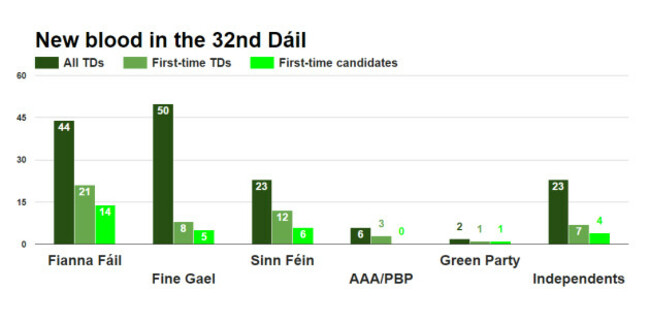
In all, there were 52 candidates elected to the Dáil for the first time over the weekend. 21 of those came from Fianna Fáil.
And 30 members of the new Dáil had never been Dáil candidates before. 14 of those came from Fianna Fáil.
However, first-time TDs make up a larger proportion of Sinn Féin and AAA/PBP’s total number of TDs (52% and 50% respectively), with Fianna Fáil not far behind on 48%.
So Fianna Fáil is responsible for the largest single infusion of new blood into Dáil Éireann, although a higher proportion of Sinn Féin’s deputies are new.
At 25, Fianna Fáil’s Jack Chambers is the youngest member of the 32nd Dáil. However, only eight of the party’s 44 TDs are aged under 40, as opposed to Fine Gael’s 11.
The party also has five deputies aged 60 or older, as opposed to Fine Gael’s nine.
Based on 149 TDs for which information was available, the average age of the 32nd Dáil is 49.7. Fianna Fáil comes in under that, at 47.9.
In case you’re curious, the “oldest” grouping in the Dáil are the Independents, 11 of whom are over 60, and who have an average age of 56.
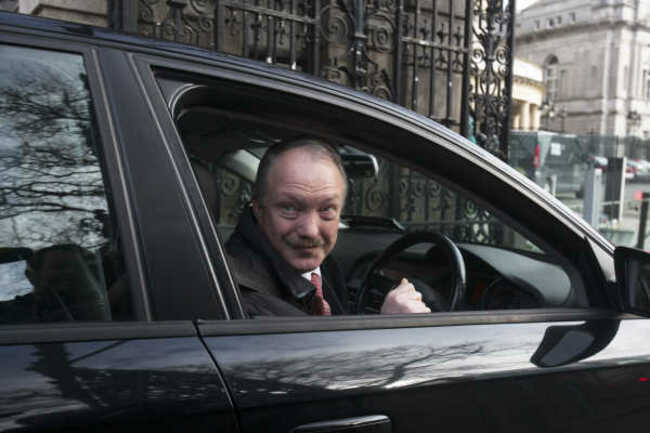
In 2011, Fianna Fáil were effectively exiled from the capital city, winning only one seat, in Dublin West. With the death of Brian Lenihan just a few months after the election, they were left without a single Dublin TD.
Last weekend, they managed to very firmly re-establish a presence in the capital, taking six seats, but being kept out of five others.
In Dublin Central, once home to the “Drumcondra Mafia”, and a Fianna Fáil stronghold during the Ahern era, Mary Fitzpatrick came third on first preference votes, out of 15 candidates.
However, she didn’t get the transfers she needed, and was eliminated on the second-last count.
Among the party’s six Dublin TDs, there were some significant comebacks and resumptions of political legacies.
Lahart was unsuccessful in the 2014 by-election, but pulled off a significant turnaround, topping the poll last Friday.
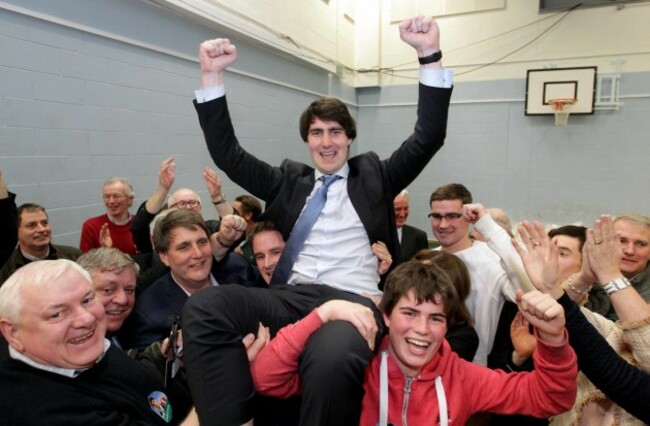
He survived a selection convention furore, and managed an impressive second place in the poll.
Haughey originally lost the Dublin Bay North selection convention to Clontarf Councillor Deirdre Heney, but was controversially added to the ticket by Fianna Fáil headquarters.
Any seat the party could get in Dublin would have been gladly accepted, but the overshadowing of a young female candidate by a man from a divisive political family may not do Fianna Fáil any favours in the long term.

To embed this post, copy the code below on your site












have your say