Sign in. It’s quick, free and it’s up to you.
An account is an optional way to support the work we do. Find out more.
Sign in. It’s quick, free and it’s up to you.
An account is an optional way to support the work we do. Find out more.
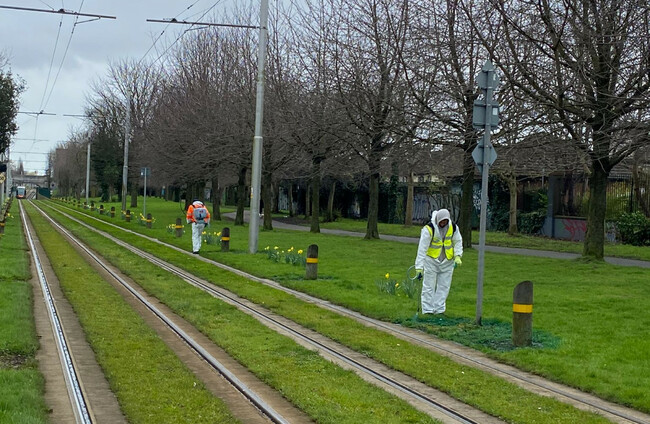
TRANSPORT INFRASTRUCTURE IRELAND (TII) has sprayed pesticides including glyphosate along Luas lines running through a Dublin park popular with dog walkers, families going to school and other pedestrians.
A cocktail of three herbicides, two of which are classed as very toxic to aquatic life with long lasting effects, has been used by TII in the park between Rialto and Suir Road Luas stops, close to the Grand Canal.
A photo taken by a concerned local earlier this month shows workers in personal protective equipment (PPE) spraying a few metres from a public footpath, at a location less than 100 metres from the canal.
In recent years, Dublin City Council has stopped using glyphosate – better known by the brand name Roundup – due to the potential risks it poses to the environment and human health, after the World Health Organization deemed it a “probable carcinogen” in 2015. The only exception is in the treatment of invasive species such as Japanese knotweed.
However, other public bodies, including TII, have given no such commitment.
TII told The Journal it sprayed Rambo XL (in which the active ingredient is glyphosate) “for the control of broadleaf weeds” and Dicophar “for control of grasses”.
It also used Clayton Apt, a “weed suppressant which stops weeds from germinating and growing for the next few months or so”.
Both Dicophar and Clayton Apt are very toxic to aquatic life with long lasting effects.
TII said spraying these chemicals “is normal practice within the landscaping industry”.
“This treatment is approved for weed control in amenity areas,” it said.
“Removal by hand is impractical across the Luas because of the size and number of areas to be covered. What you weed today would need to be visited again, to get the new growth within days or weeds.”
It added that the use of PPE “is the standard uniform which these workers always use when carrying out spraying activities and should not be seen as anything out of the ordinary for this activity”.
Glyphosate’s European licence was renewed for 10 years late last year, a policy supported by the Irish government.
The licence renewal followed a recent assessment of the evidence on glyphosate by the European Food Safety Authority, one of the EU’s scientific agencies, which did not identify concerns that would prevent reauthorisation. This scientific advice was criticised by environmental groups, which noted gaps in the data.

To embed this post, copy the code below on your site
















have your say