Sign in. It’s quick, free and it’s up to you.
An account is an optional way to support the work we do. Find out more.
Sign in. It’s quick, free and it’s up to you.
An account is an optional way to support the work we do. Find out more.
HOUSE BUYERS ARE now once again willing to accept work-commutes of more than an hour according to a new survey.
The survey, commissioned by the Real Estate Alliance (REA), has found that a lack of affordable properties is once more driving would-be house buyers further outside Dublin in their search for a place to call their own.
The phenomenon is eerily reminiscent of the wave of buyers who migrated many hours from Dublin at the height of the Celtic Tiger.
A long commute
Around 2006 it was not uncommon for people to leave their homes at 5am in order to make a commute of two hours or more to the capital.
Click here to view a larger image
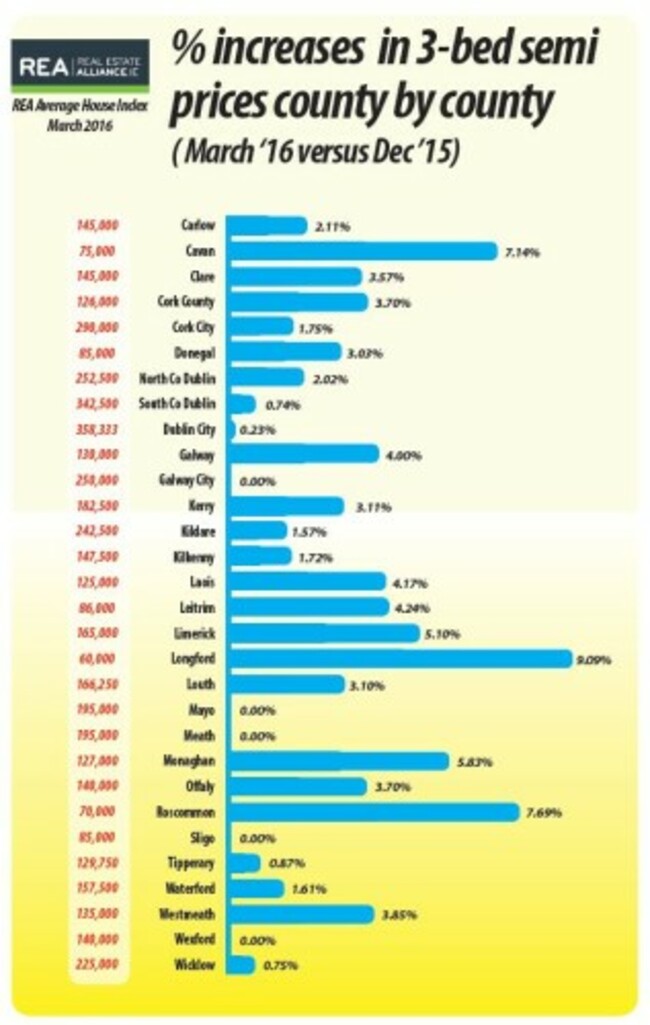
The new house price survey shows that price rises in outer commuter ring areas like Laois and Offaly are being driven by Dublin-workers who cannot afford to buy in the capital under the Central Bank’s current mortgage rules, which came into effect in January 2015.
Average prices for three-beds have risen slightly in the rural cities and Dublin’s main commuter counties by 1.31% to €209,559.
However, in the towns in the rest of the country prices have risen by almost 10% in the past year, and almost 3% since December, with the average price of a three-bed in those areas now €125,321.
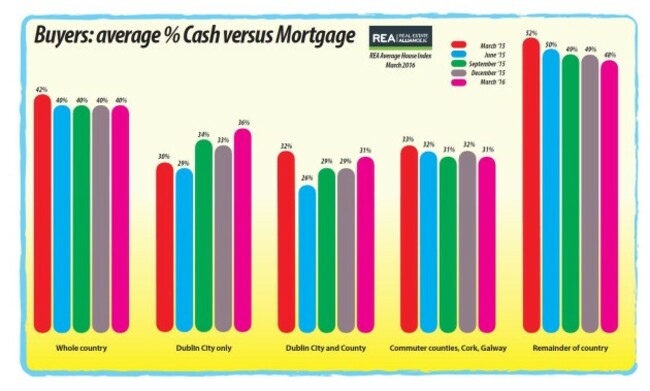
The survey also reveals that the number of cash buyers has risen for the first time in two years. 36% of buyers are now working on a cash-only basis, particularly in affluent areas in Dublin like Dublin 6 and Dun Laoghaire.
Click here to view a larger image
Younger buyers driven out?
The majority of younger buyers are now being forced outside Dublin however it seems.
“We are seeing a marked absence of the 25-40 year olds at viewings in the capital over the past few months as, under the current Central Bank restrictions, they are finding it impossible to raise the deposits needed to purchase houses over the €220,000 limit,” Michael O’Connor, chairman of the REA.
Conversely, we are seeing growth in commuter interest in counties previously considered at the edge of the daily travelling limits simply because the price is right, such as Laois, where the average price for a three-bed semi is now up 4.17% to €125,000, and Offaly, where the average price is now €140,000, up 3.7%.
O’Connor says that, while supply is extremely limited, properties are now being bought in these outer-ring commuter areas by buyers who are willing to submit to an extended commute of over an hour each morning.
“Louth is the perfect example of this trend in commuter migration,” he says.
Drogheda prices remained static at €197,500 in the first quarter of 2016 while commuter interest caused prices to rise by €10,000 to €135,000 in Dundalk, which is 35km further away from Dublin but over €60,000 cheaper on average.
The property bubble being seen in Dublin is set to spread much further afield it seems.

To embed this post, copy the code below on your site











have your say