Sign in. It’s quick, free and it’s up to you.
An account is an optional way to support the work we do. Find out more.
Sign in. It’s quick, free and it’s up to you.
An account is an optional way to support the work we do. Find out more.
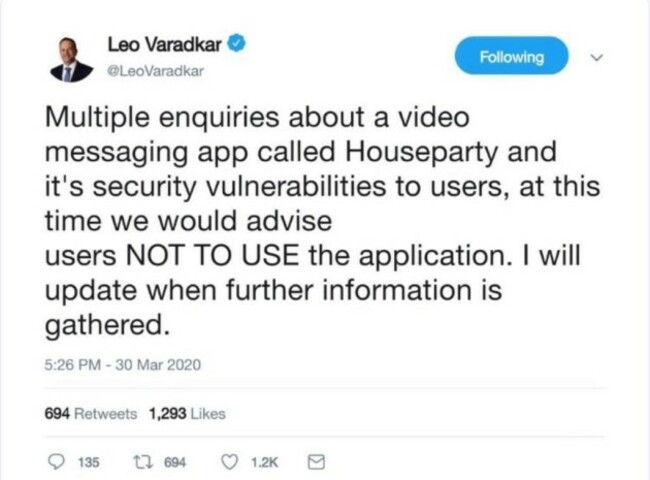
AN IMAGE OF a tweet from Leo Varadkar telling people to avoid using a video messaging app because of “security vulnerabilities” has been shared on social media and on WhatsApp in recent days.
The screenshotted tweet contains a warning from the Taoiseach for members of the public not to use Houseparty, and was purportedly sent from his official account on Monday evening.
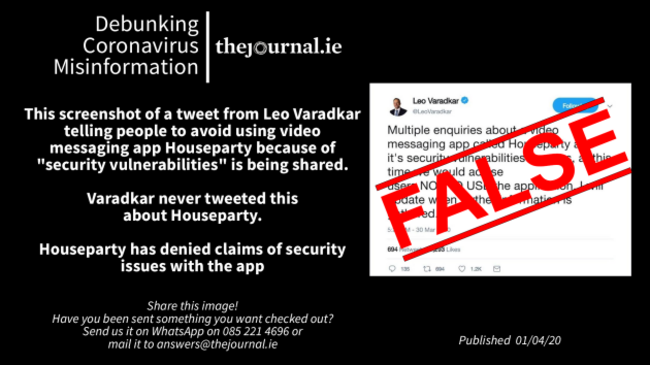
However, this image is fake.
The doctored tweet reads:
Multiple enquiries about a video messaging app called Houseparty and it’s [sic] security vulnerabilities to users, at this time we would advise users NOT TO USE the application. I will updated when further information is gathered.
It also appears to have been sent at 5.26pm on Monday 30 March.
That would have followed viral rumours over the weekend that Houseparty – which has surged in popularity since the beginning of Covid-19 restrictions across the world – was accessing its users’ social media accounts.
A large number of people shared messages online based on these rumours telling others to delete the app as a precaution.
However, Houseparty refuted the claims yesterday. In a tweet of its own, the company said it was investigating the possibility that the rumours were part of a smear campaign designed to harm them.
An examination of Leo Varadkar’s Twitter account shows that no tweet was sent at 5.26pm on 30 March or any other time in reference to Houseparty.
The Taoiseach did send a tweet about Ireland’s planning system at 5.22pm, but the next original tweet he sent was not sent until 9.10pm that evening.
Asked whether Varadkar may have sent the tweet but subsequently deleted it, a source close to the Taoiseach confirmed that this did not happen.
The image is a hoax. To repeat: Leo Varadkar did not tell people to avoid using Houseparty because of “security vulnerabilities”.
****
There is a lot of false news and scaremongering being spread in Ireland at the moment about coronavirus. Here are some practical ways for you to assess whether the messages that you’re seeing – especially on WhatsApp – are true or not.
STOP, THINK AND CHECK
Look at where it’s coming from. Is it someone you know? Do they have a source for the information (e.g. the HSE website) or are they just saying that the information comes from someone they know? A lot of the false news being spread right now is from people claiming that messages from ‘a friend’ of theirs. Have a look yourself – do a quick Google search and see if the information is being reported elsewhere.
Secondly, get the whole story, not just a headline. A lot of these messages have got vague information (“all the doctors at this hospital are panicking”) and don’t mention specific details. This is often – but not always a sign – that it may not be accurate.
Finally, see how you feel after reading it. A lot of these false messages are designed to make people feel panicked. They’re deliberately manipulating your feelings to make you more likely to share it. If you feel panicked after reading something, check it out and see if it really is true.
TheJournal.ie’s FactCheck is a signatory to the International Fact-Checking Network’s Code of Principles. You can read it here. For information on how FactCheck works, what the verdicts mean, and how you can take part, check out our Reader’s Guide here. You can read about the team of editors and reporters who work on the factchecks here
Have you gotten a message on WhatsApp or Facebook or Twitter about coronavirus that you’re not sure about and want us to check it out? Message or mail us and we’ll look into debunking it. WhatsApp: 085 221 4696 or Email: answers@thejournal.ie

To embed this post, copy the code below on your site














have your say