Sign in. It’s quick, free and it’s up to you.
An account is an optional way to support the work we do. Find out more.
Sign in. It’s quick, free and it’s up to you.
An account is an optional way to support the work we do. Find out more.
A SUGGESTION FOR a tunnel to be dug between Northern Ireland and Scotland was raised several times in the 1960s, newly declassified files have revealed.
The idea, which some believed would boost connectivity and tourism, even reached the desk of Northern Ireland’s Prime Minister at the time, Terence O’Neill, who was approached for a meeting.
However, the idea was met with scepticism with one Stormont official stating: “Homo sapiens does not like tunnels – even short ones.”
The state papers at the Public Record Office in Belfast show that discussions over a tunnel more 32km long between Donaghadee and Portpatrick continued for several years during the decade.
In 1961, the former Moira Rural District Council adopted a resolution advocating the construction of a tunnel and sent a letter stating its support to the Ministry of Commerce in Belfast.
It stated: “It is felt that such a connection would be of inestimable value to Ulster in view of the high cross channel freight rates and the numbers of tourists which would be attracted to the Province in this way.”
Several other local district councils then wrote to the ministry express their support for the idea.
However, the papers reveal scepticism in the Ministry of Commerce, with one official stating he hoped the department had enough information to provide a “killing” answer in response to the council’s letter.
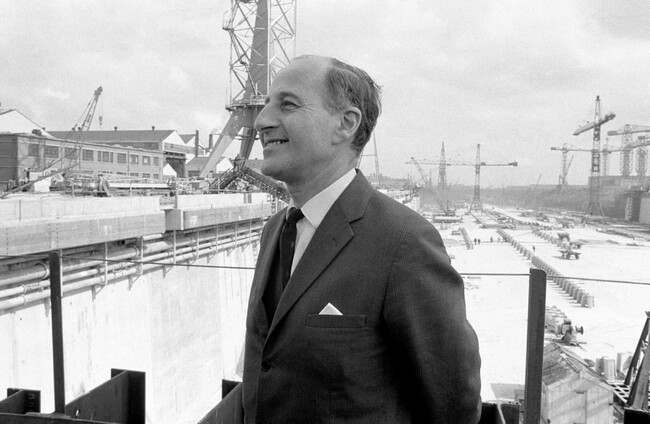
The idea resurfaced in 1964 when Frank Davidson, President of Technical Studies Inc (USA), wrote to O’Neill asking for a meeting about the prospect of a tunnel.
He said: “As a matter of personal interest, I would be very pleased indeed to have the opportunity of speaking with you, perhaps in the latter part of September or during October.
“I might be able to suggest some steps that could be taken in order to obtain reliable advice and without great expense.”
Attached to the letter is a note from an engineer which states: “The difficulties in draining, ventilating and lighting a tunnel 28 miles long could probably be overcome at a high cost, but the problem of obtaining accurate information of the strata below the sea bed, at a depth of at least 450ft and possibly 900ft below sea level has not yet been solved.”
In response to Davidson’s letter, a government official wrote an internal memo suggesting he should be granted a meeting with another minister, rather than O’Neill.
It stated: “Although the whole idea of a tube link between Northern Ireland and Scotland seems to the layman to be rather far-fetched, the firm of Technical Studies Inc, seems from the brochure which Mr Davidson has sent us, to be backed by a number of reputable American financial and other organisations.
“In the circumstances it might not be a complete waste of time to hear what Mr Davidson has to say.”
However, in a handwritten note, another official was scathing of the idea, stating it was a “non-starter”, due to the cost and effort required.
The note says: “I believe that not enough thought has been given to the human side of the proposition.
“Homo sapiens does not like tunnels – even short ones.
“Given the choice of air or sea borne ferry service, would you use a 25-mile sub-marine tunnel, with the additional nuisance that you would be (required) to load your car or lorry on to a special train?”
In February 2020, it was reported that UK officials were examining the potential for a bridge linking Scotland and Northern Ireland, an idea championed by Boris Johnson.
A year later, in February 2021, the Sunday Telegraph published a story saying an under-sea tunnel between Great Britain and Northern Ireland could get the green light as soon as the following month.
The claim was based on the expected completion of a feasibility study that’s being undertaken about linking Scotland and Northern Ireland by bridge or tunnel.
But despite the ambitious prediction at the time that such a huge project could get the go-ahead, there wasn’t much of a rush from politicians on either side of the Irish Sea to get on board.
It was reported in The Guardian in September 2021 that the plans to build the tunnel were being scrapped.
BBC News reported the results of the feasibility study the following November, which concluded that the tunnel would be technically possible, but would cost a minimum of £209 billion.
Peter Hendy, who oversaw the review, said a link would have “transformational” economic effects, but added that the costs would be impossible to justify.
With reporting by Hayley Halpin

To embed this post, copy the code below on your site














have your say