Sign in. It’s quick, free and it’s up to you.
An account is an optional way to support the work we do. Find out more.
Sign in. It’s quick, free and it’s up to you.
An account is an optional way to support the work we do. Find out more.
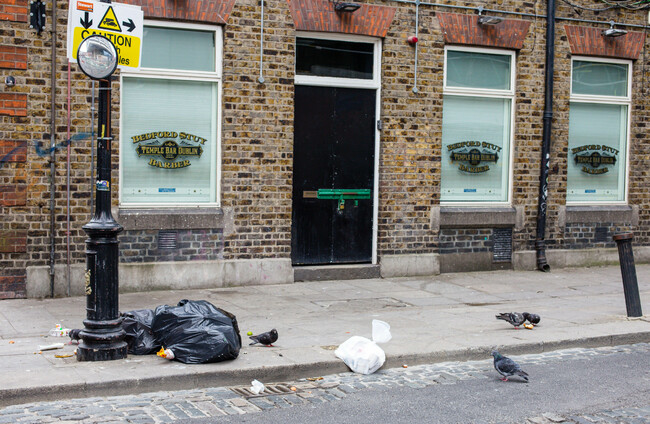
A NEW SURVEY has found that the number of litter blackspots in towns and cities around Ireland has dropped by 50%.
The latest survey from Irish Business Against Litter (IBAL) shows Dublin, Limerick and Galway all making significant progress tackling rubbish.
Two-thirds of the 40 towns and cities surveyed were found to be clean. Naas retained its position at the top of the rankings, ahead of Letterkenny and Cavan.
Dublin’s North Inner City registered its best result in years after consistently being among Ireland’s worst litter black spots. There was further improvement for Limerick South (Galvone), though it was again deemed ‘littered’.
Only two areas – Drogheda, Co Louth and Ballybane on the outskirts of Galway city – were categorised as ‘seriously littered’.
The survey found “all manner of litter (and) a mountain of black sacks” in Ballybane and cited “an incredible air of neglect” at Ballybane Industrial Estate, which was used as a dumping ground.
The survey recorded a fall in Covid-19 related litter, with fewer face masks found discarded compared to last year, and a drop in alcohol-related waste. Recycling centres were also found to be cleaner.
However, IBAL says that the prevalence of coffee cup litter on streets warrants action such as a levy. The findings come as the government is expected to introduce a 20c levy on disposable coffee cups later this year.
“The findings bear out the need for action on coffee cups,” IBAL spokesperson Conor Horgan said.
“We must disincentivise the use of paper cups – even compostable or recyclable ones – as too many of them are ending up on the ground. In the light of our survey, the Government move towards a levy makes a lot of sense.”
The survey is carried out by An Taisce on behalf of IBAL and the environment and heritage organisation receives funding from the Department of the Environment, Climate and Communications to carry out the initiative.
IBAL also has a number of prominent members including the GAA, Kerry Group, DAA, KPMG and the Irish Hotels Federation.

To embed this post, copy the code below on your site









have your say