Sign in. It’s quick, free and it’s up to you.
An account is an optional way to support the work we do. Find out more.
Sign in. It’s quick, free and it’s up to you.
An account is an optional way to support the work we do. Find out more.
MATHS WEEK KICKED off at the weekend and as is our annual tradition here, we’re setting you a puzzle a day with all answers published on site tomorrow morning.
Get puzzling!
THIS EVENING’S Q:
PART ONE
Three-dimensional thinking is something many of us find difficult if we’re not practised at it.
Builders, architects, some engineers and many artists are skilled at it. Leonardo da Vinci famously could see and move complex three-dimensional shapes in his mind – something most engineers today would need 3-D computer modelling to achieve. Here are two puzzles to test your ability to think three-dimensionally.
A Platonic Solid is a solid shape where each face is made up of the same regular two-dimensional shapes. A triangular-based pyramid has four faces and a cube has six faces. An octahedron has 8 faces and looks like two square-based pyramids stuck together at the squares.
These shapes were of great fascination to the Pythagoreans and of course Plato himself.
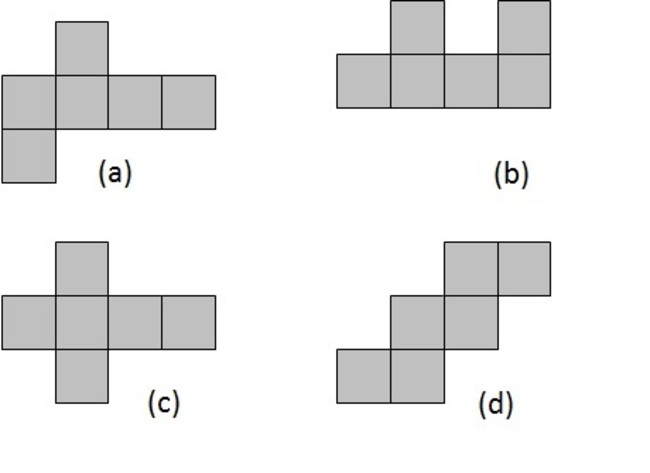
The following diagram shows possible nets of a cube. A net is like a pattern for a cube – it can be folded into a cube. One of the following figures is not the net of a cube so can’t be folded into a cube. Which one is it?
PART TWO
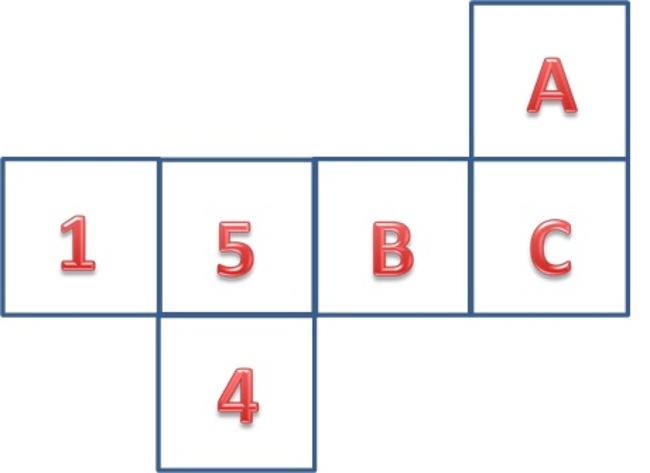
The diagram below shows layout for a cubic playing die. It is a net of a cube as it can be folded into a cube.
A cubic die has 6 faces and opposite faces add up to 7. Can you tell what missing numbers are represented by the letters A,B,C?
All answers will be published on TheJournal.ie tomorrow morning.

To embed this post, copy the code below on your site











have your say