Sign in. It’s quick, free and it’s up to you.
An account is an optional way to support the work we do. Find out more.
Sign in. It’s quick, free and it’s up to you.
An account is an optional way to support the work we do. Find out more.
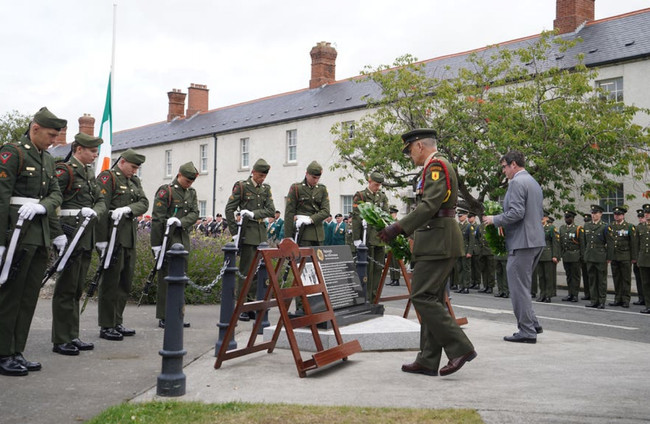
MEMBERS OF THE Defence Forces have been joined by some of Michael Collins’ family at an event to mark the centenary of the death of the revolutionary leader.
The event, held at Cathal Brugha Barracks in Dublin, came 100 years after Collins was shot and killed during an ambush by anti-treaty forces near Béal na Bláth, Co Cork, during the civil war.
Some of his relatives visited the Defence Forces Military Archives at the barracks and the museum which is home to Collins’ death mask.
Also on display are his desk, the flag that was draped on his coffin, and his Colt 45 pistol.
Brigadier General Tony Cudmore and Mary Clare O’Malley, grandniece of Collins, gave addresses during the event.
The speeches were followed by a wreath-laying ceremony, a minute’s silence, the playing of the national anthem, and an Air Corps flypast.
Brig Gen Cudmore and Angus Collins O’Malley, great-nephew of Collins, laid wreaths.
O’Malley told the crowd: “General Collins’ history is intertwined with that of the barracks itself, a testament to the turbulence of Irish history.”
“Collins was to establish his home and office here during 1922. The barracks became a refuge for him from the war-ravaged streets of Dublin city.”
He left the barracks two days before he was killed.
“Collins is perhaps the most analysed and debated individual of the 20th century Irish history,” O’Malley said.
“We can’t let sentiment overpower accuracy but he bequeathed to posterity a considerable body of writing, essays, speeches and articles.
“His legacy is formulated in his letters and, of course, his diaries. Recently his diaries were donated to the National Archive by the Collins family.”
Yesterday, Taoiseach Micheál Martin told a commemoration that Collins’ death deprived Ireland of its best hope of reconciliation. Collins was part of the delegation that signed the Anglo-Irish Treaty in 1921, leading to a split in the Irish Parliament and to the Irish civil war.
Martin became the first Fianna Fáil Taoiseach to speak at a commemoration for Collins.
Thousands of people attended the ceremony in Collins’ native West Cork.

To embed this post, copy the code below on your site





have your say