Sign in. It’s quick, free and it’s up to you.
An account is an optional way to support the work we do. Find out more.
Sign in. It’s quick, free and it’s up to you.
An account is an optional way to support the work we do. Find out more.
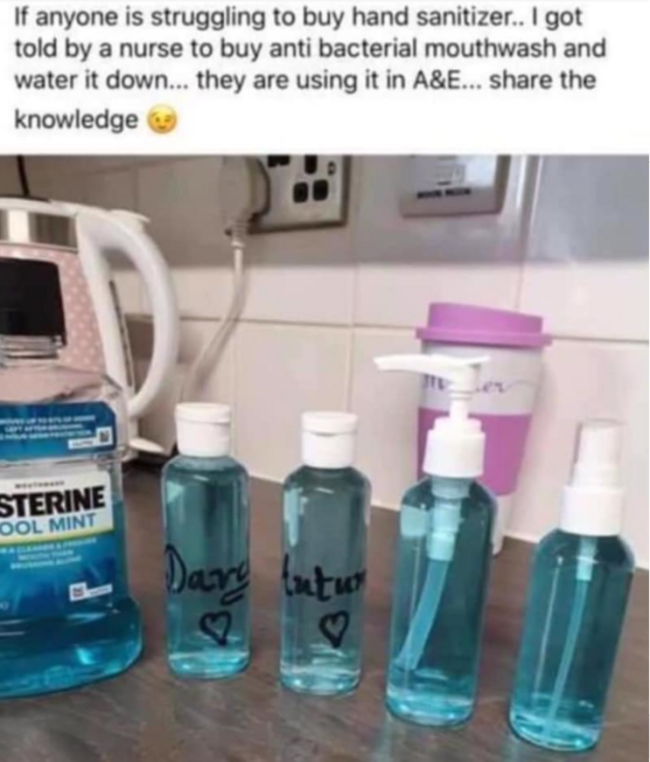
A POST SHARED on Facebook has claimed anti-bacterial mouthwash can be watered down and used as a hand sanitiser.
The message suggests that a nurse advised them to use this solution if they were struggling to find hand sanister.
It says healthcare workers are using this combination in Emergency Departments.
The post includes a picture of Listerine (cool mint) mouthwash, and a number of smaller bottles that appear to contain this recommended mixture. Although the post does not state that this is happening in Ireland, it has been shared in Ireland.
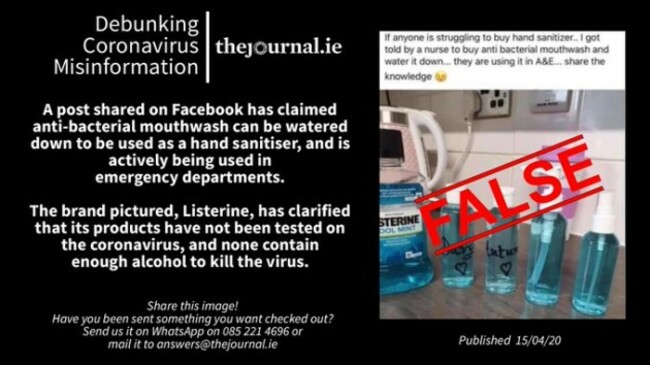
Listerine itself has clarified the situation, explaining that its mouthwash has not been tested on any strains of the coronavirus and does not claim to kill germs that cause Covid-19.
The company also pointed out that only some of its mouthwash formulations contain alcohol and if present, is only around 20% alcohol.
It is recommended that people use hand sanitisers with more than 60% alcohol content in order for it to be effective.
Even if it was not watered-down, as the post suggests, the mouthwash mixture would not have a high enough alcohol content to be considered effective.
Listerine also advised consumers that rinsing with the product will not kill the virus and advised that it is not an effective surface disinfectant.
****
There is a lot of false news and scaremongering being spread in Ireland at the moment about coronavirus. Here are some practical ways for you to assess whether the messages that you’re seeing – especially on WhatsApp – are true or not.
STOP, THINK AND CHECK
Look at where it’s coming from. Is it someone you know? Do they have a source for the information (e.g. the HSE website) or are they just saying that the information comes from someone they know? A lot of the false news being spread right now is from people claiming that messages from ‘a friend’ of theirs. Have a look yourself – do a quick Google search and see if the information is being reported elsewhere.
Secondly, get the whole story, not just a headline. A lot of these messages have got vague information (“all the doctors at this hospital are panicking”) and don’t mention specific details. This is often – but not always a sign – that it may not be accurate.
Finally, see how you feel after reading it. A lot of these false messages are designed to make people feel panicked. They’re deliberately manipulating your feelings to make you more likely to share it. If you feel panicked after reading something, check it out and see if it really is true.
TheJournal.ie’s FactCheck is a signatory to the International Fact-Checking Network’s Code of Principles. You can read it here. For information on how FactCheck works, what the verdicts mean, and how you can take part, check out our Reader’s Guide here. You can read about the team of editors and reporters who work on the factchecks here
Have you gotten a message on WhatsApp or Facebook or Twitter about coronavirus that you’re not sure about and want us to check it out? Message or mail us and we’ll look into debunking it. WhatsApp: 085 221 4696 or Email: answers@thejournal.ie

To embed this post, copy the code below on your site

















have your say