Sign in. It’s quick, free and it’s up to you.
An account is an optional way to support the work we do. Find out more.
Sign in. It’s quick, free and it’s up to you.
An account is an optional way to support the work we do. Find out more.
First published 09.12am
THIS BEAUTIFUL MURAL of women from the 1916 Rising has appeared overnight on George’s St in Dublin.
The 35-feet street art installation – titled ‘Le Chéile I nGruaig’, which translates as ‘Together in the hair’ - is the work of artist Gearoid O’Dea and features three women who each played an important role in the Easter Rising: Countess Markievicz (left), Margaret Pearse (right) and Grace Gifford-Plunkett (bottom).
With today being International Women’s Day, O’Dea has taken the opportunity to celebrate the role the women played in a pivotal moment in Irish history:
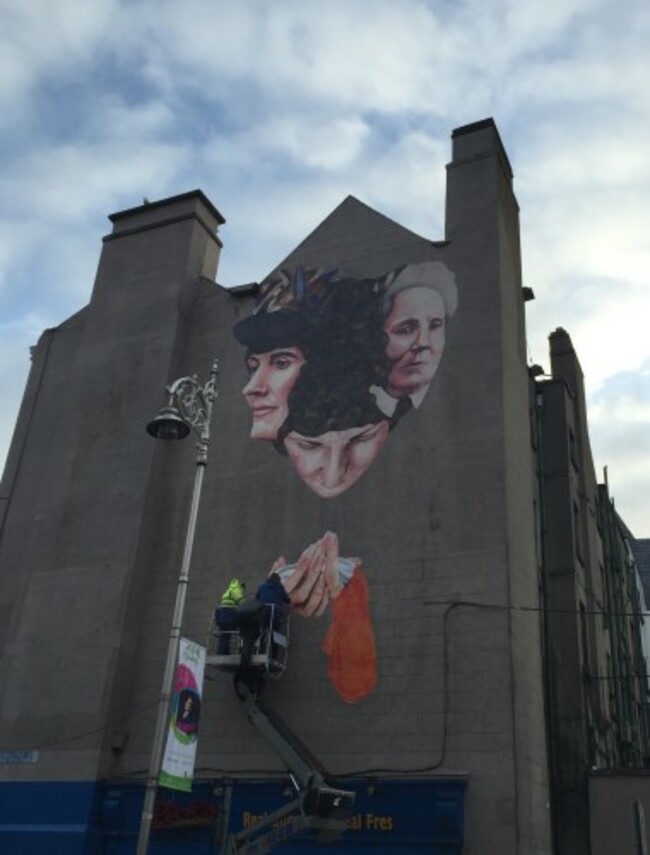
O’ Dea said that his piece was drawn in full colour using colouring pencil and gouache, “with a focus on meticulous detail”. It was then scanned and digitally reproduced on a large scale.
“This 1916 Easter Rising centenary year seems like a great opportunity to re-imagine the kind of Ireland we could live in,” said the artist. “Following the example of the drafters of the Proclamation and their landmark declaration of equal rights for men and women, I want to explore the role that women played in the 1916 Rising.”
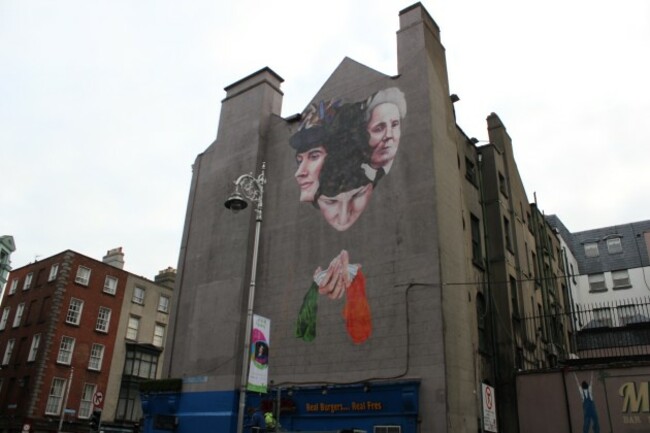
Countess Markievicz is the icon. She is often depicted as a revolutionary gure (having taken an active role in the Rising as second in command to Michael Mallin at St Stephen’s Green), but I wanted to portray her in contemplative passivity.
Margaret Pearse gave her son, Patrick to the Rising. Her sacrifice might have been greater than his, her sense of loss more enduring. She had to witness the Civil War, and see an Ireland emerge that fell far short of the Rising’s ideals.
Grace Gifford-Plunkett was a political cartoonist. Her husband Joseph was executed in Kilmainham Gaol on the day of their marriage. His execution began to turn the public in favour of the rebels.
He said that he feels that taken together, “each of these women strike a balance”.
“Each played a different kind of role in the Rising. Some are well remembered, others not. These portraits will be woven together by strands of hair,” said O’Dea. “For me, the texture of the hair suggests a toughness, a gentleness, and something more mysterious. Hair was an important symbol in Celtic mythology, empowering and magical. As a composing element in this piece, it feels right.”
The spot at the Mercantile where the mural is based was also where Joe Caslin put his marriage equality mural last year.
Today also saw the release of a thought-provoking video drawing parallels between the women of 1916 and modern-day Ireland. It recalls the sacrifice of nurse Margaret Kehoe, who left her home on 24 April 1916 but never returned – she was fatally injured during the Rising while tending Dan McCarthy, who survived.
There is a special programme of events and commemorations around the women involved in 1916, few of whose names rose to prominence in the aftermath. Details are here - they include lectures, exhibitions, digital storytelling and a major tribute event today at Royal Hospital Kilmainham/IMMA presented by President Michael D Higgins.

To embed this post, copy the code below on your site












have your say