Sign in. It’s quick, free and it’s up to you.
An account is an optional way to support the work we do. Find out more.
Sign in. It’s quick, free and it’s up to you.
An account is an optional way to support the work we do. Find out more.
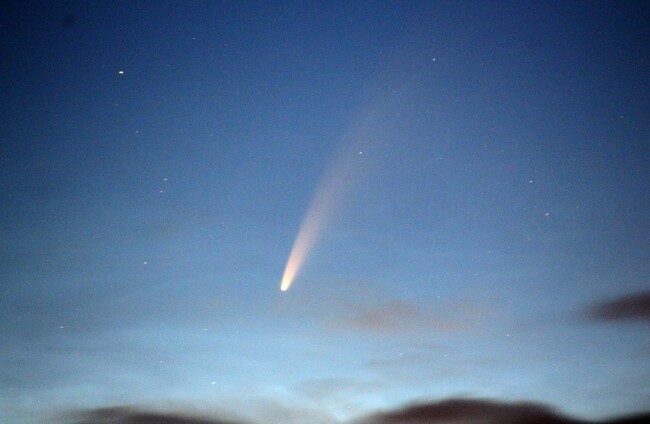
THE NEOWISE COMET is set to reach its closest point to Earth over the next week, allowing viewers to enjoy it around the country with the naked eye.
The newly discovered comet is bright enough to be viewed over Ireland in both rural and urban areas, and can currently be seen without equipment.
“Now is the time to watch it before it gets too dim to see,” Chair of Astronomy Ireland David Moore told TheJournal.ie.
“Yesterday morning, there it was, just sitting over the house,” he said. “Naked eye, no binoculars.”
He confirmed that the comet is visible over Dublin, as well as “everywhere on the island” – and elsewhere in the Northern Hemisphere, including Europe, Asia, and North America.
Viewers can “take pictures of it over cities, that’s how bright it is, through city lights”.
The Neowise comet was discovered by a Nasa mission – the Near-Earth Object Wide-field Infrared Survey – on 27 March. It was named after the Nasa project.
Scientists involved in the mission say the comet is nearly 5km across. Its nucleus is covered with sooty material dating back to the origin of our solar system 4.6 billion years ago.
The comet will be visible until after mid-August, when it heads back towards the outer solar system.
Its expected to reach its closest point to Earth next Thursday 23 July. Once it disappears, it is unlikely to be seen again for another 6,800 years.
The comet can be seen in Ireland after sunset once the sky becomes dark and stars are visible, with peak visibility in the hours just after midnight.
“The place to look is in the north to north west, very low on the horizon,” Moore said. “You can’t mistake it.”
Moore recommends finding an area where there are no buildings or trees that could block the view of the comet, such as a local park – “somewhere you can see pretty low down”.
“Although you don’t need a pair of binoculars to see it, bring your binoculars as you will get a better view.”
After the comet reaches its closest point, it will begin to move away again. Moore expects that interested viewers will be able to see comet without binoculars until around early August, and that those who know where to look for it will be able to follow it with binoculars until late August.
Currently, the comet is approximately 111 million kilometres from Earth, and moving at a pace of around 231,000 kilometres per hour
Spotting the comet
Additional reporting by Nicky Ryan.

To embed this post, copy the code below on your site















have your say