Sign in. It’s quick, free and it’s up to you.
An account is an optional way to support the work we do. Find out more.
Sign in. It’s quick, free and it’s up to you.
An account is an optional way to support the work we do. Find out more.
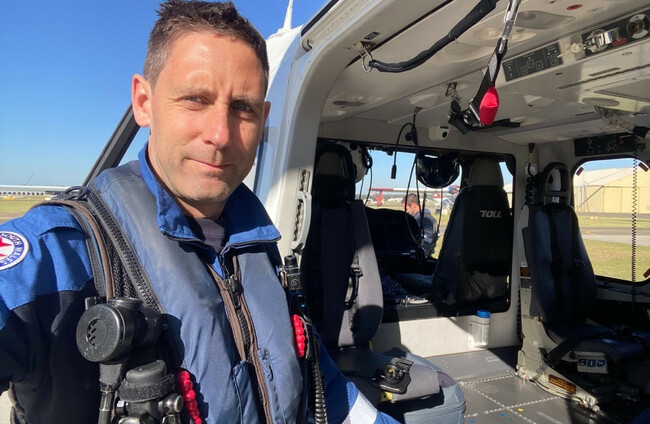

IRELAND DOES NOT have a helicopter emergency medical service (HEMS) up to the standard of its peer nations in the UK or the EU.
Starker still is that across the border in Northern Ireland, there is such a HEMS capability that has saved many lives since its inception.
As an Irish ex-pat doctor working in the trauma system in Sydney, Australia, both pre-hospital and in-hospital for the last 20 years, I’m dismayed that Ireland has been left behind when it comes to this key element in trauma system development.
Australia, although a massive country by comparison with Ireland, is similar in that the inverse care law exists: those in the most need are the furthest away from help.
This tyranny of distance has driven the health system in Australia to put in place a mantle of safety when it comes to acute care, be that severe trauma or illness.
Hence, in New South Wales where I work, when a severe trauma occurs there’s a cascade of responses that occurs to maximise that person’s chance of survival.
A Rapid Launch Trauma Coordinator working in the Sydney Control Centre of NSW Ambulance, monitors the system for a case that would benefit from a HEMS launch. That can be from the 999 caller or from the paramedics on scene.
Once launched, there is a convergence of care on that patient: the HEMS team en route liaise with the treating paramedics on scene and arrange a rendezvous point.
At that point, the patient receives the same treatment they would receive in the Emergency Department of a Major Trauma Centre (MTC). Following stabilisation the patient is rapidly transported to the MTC where further interventions to stop the bleeding are carried out – often directly from the helipad to the Operating Theatre.
Severe trauma does not respect time or geography. Injury affects the lives of young and old, urban and rural.
Furthermore, the rural population is overrepresented in severe trauma statistics and is the furthest from definitive care.
Life or death
There are time critical interventions and decision making that must occur early in that initial golden hour that makes the difference between life or death; the difference between return to family, friends and work versus severe long-term disability and lifetime care.
In other countries, that hospital resuscitation room level care is delivered by a doctor and paramedic team HEMS configuration. The combined skills of this team have a compound beneficial effect for the patient.
There is a shortage of emergency medicine (EM) consultants in Ireland. Advertising EM consultant jobs combined with a HEMS role will attract Irish ex-pats with prehospital expertise back to Ireland.
This will also retain those doctors and bring the advanced critical care skills that these doctors possess to Irish hospitals.
Furthermore, Irish patients will get those critical life-saving interventions earlier and closer to the point of injury, than in an often crowded and overwhelmed emergency department.
This will save lives. This strategy was done by the health service in Northern Ireland and it has worked.
I support the development of a trauma system in Ireland, bringing severely injured patients directly to a Major Trauma Centre, rather than to a local hospital that may not have the skills or services for definitive care.
To enable that to happen, a HEMS model must be in place.
If there’s a road traffic accident in rural northern areas of Ireland today and a teenager is critically injured, it is in my opinion unethical that the Northern Ireland Hems advanced trauma capability isn’t systematically tasked to resuscitate and stabilise that patient followed by rapid transport directly to the Major Trauma Centre in Belfast for definitive care.
These kinds of accidents, be it on the road or at a farm, are occurring regularly.
The status quo is that such cross-border co-operation occurs only on an ad hoc basis, rather than as part of a systematic all-island approach.
This is an area where an all-Ireland approach makes sense, and I would implore the Irish government to enable such an approach in conjunction with the Northern Ireland government.
As a precedent, a whole-island approach to paediatric interventional cardiology has been highly successful.
There are prehospital trained doctors in Ireland, UK and further afield who could be employed alongside paramedics to assist the Irish National Ambulance Service in staffing a highly functional HEMS in a relatively short period of time.
Lastly, clinicians such as myself are more than willing to assist in this and share governance structures and training that have been in place and proven over many years.
There is no time left to waste.
Dr Brian Burns is an emergency physician, prehospital and retrieval medicine specialist and trauma specialist. He works at the Aeromedical Operations of the New South Wales Ambulance and at North Beaches and Royal North Shore Hospitals, and is a Clinical Professor at the Faculties of Medicine and Health at the University Sydney and at Macquarie University.
To embed this post, copy the code below on your site














have your say