Sign in. It’s quick, free and it’s up to you.
An account is an optional way to support the work we do. Find out more.
Sign in. It’s quick, free and it’s up to you.
An account is an optional way to support the work we do. Find out more.


THE MAJORITY OF Ireland’s farmers receive subsidies known as basic payments. Averaging around €18,000 per year, these payments underpin many family farm incomes.
Generally speaking, the poorer the land, the more important the payment is to the recipient. One of the conditions farmers need to meet to receive these subsidies is to keep their land in what is known as Good Agricultural and Environmental Condition (GAEC).
In practical terms, the farmland must be suitable for grazing domestic animals or for growing crops. The Department of Agriculture (DAFM) assesses a percentage of farms every year to see that they are meeting these conditions using aerial photographs and inspections.
Land not considered to be in GAEC is circled in red and deducted from a farmer’s basic payments. Features that see farmers incur payment penalties or deductions include ponds, rivers, native woodland, and scrub.
As the presence of these features can directly affect income, farmers are not inclined to tolerate them and, in many cases, ponds are filled in, wetlands are drained, scrub is cleared, and heather is burned.
From a landowner perspective this is logical, but sadly it results in the repeated destruction of some of our most important wildlife habitats.
Inhibiting landowner potential
As well as damaging emerging habitat, GAEC rules act as a barrier to farmers wishing to create new habitats on their land.
A few years ago, a friend of mine dug out a farm pond. Soon enough it had attracted frogs, newts, swallows, bats and even trout brought in by a flood. The following year, the area was deducted from their basic payments.
The pervasive and deleterious impacts of the GAEC rules are obvious. Farmers – uncertain, frustrated and deprived of autonomy – carry out the works needed to comply with the rules, often against their own best instincts.
The cumulative impact of these actions place the farming community in unwanted conflict with environmentalists who are understandably fed up with what they see as the unnecessary destruction of biodiversity-rich habitats.
Basic payments are downstream of the EU’s Common Agricultural Policy, the traditional focus of which has been on food production across the bloc.
Subsequent agri-environment schemes focused on protecting habitats and biodiversity were not always well integrated, resulting in our current situation where one set of land use policies indirectly incentivise habitat destruction while others focused on habitat creation.
Contradiction in terms
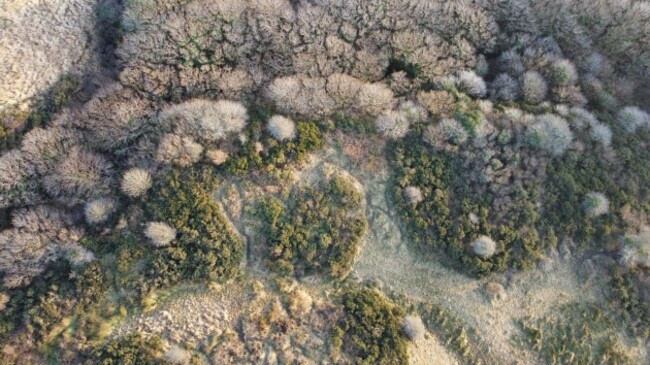
Take native woodland creation, for example. The Native Woodland Scheme is broadly seen as bureaucratic and unattractive and has a woodland creation target of just 300 hectares per year. At the same time, scrub – which is really just young or emerging woodland – is cleared or burned en masse on farms across the country.
A recent report by Woodlands of Ireland using data from the National Forest Inventory calculated a yearly loss of 672 hectares of scrub per year between 2012-2017.
As well as having the potential to become future forests, these tangles of gorse, hazel or briar are important habitat for nesting birds.
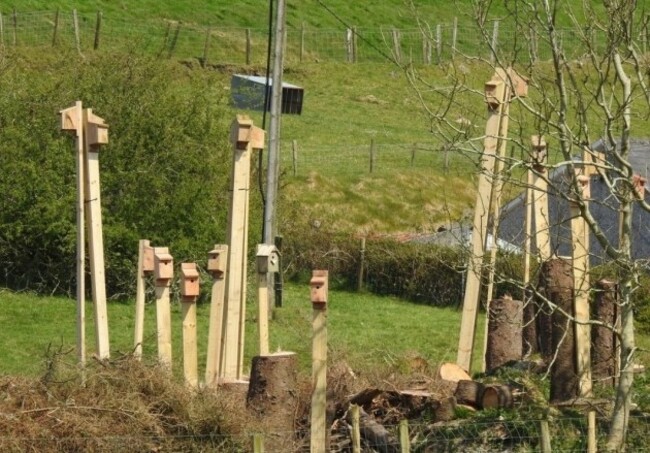
Again, while GAEC rules result in the destruction of scrub, another policy attempts to create substitute habitat for birds via the agri-environment GLAS scheme that includes paying farmers to erect bird boxes.
One picture doing the rounds on social media earlier this years shows a row of bird boxes erected on poles over recently cleared scrub or hedgerow, perfectly encapsulating the contradictory and sometimes bizarre nature of our current approach.
Another agri-environment initiative is designed to provide habitat for ground-nesting bees by paying farmers to create sand piles in field corners.
Many biodiversity experts agree that these efforts, while well intentioned, offer no real use to bees due to the lack of structure in the quarry sand – the exact type specified by the scheme.
Where do we go from here?
So, what are the solutions? First, we need cohesion between agricultural and environmental policies. This means reforming the contradictory and unpopular GAEC rules and related schemes.
Second, policy measures must stop incentivising actions regardless of the potential negative environmental outcome and instead incentivise the facilitation of natural processes with a focus on real-world results.
We must also ensure that habitats have value and that this value directly benefits the farmer. The concept of putting a monetary value on nature is an uncomfortable concept for some, perhaps understandably. However, in this instance, it is needed.
Ultimately, we must arrive at a place where farmers can look out on a wetland, an emerging woodland or scrub, and be satisfied that it is in his or her best interest to leave it as it is.
Although the details are still being contested it is hoped that the new wave of ‘eco-schemes’ promised by the next CAP reform will see big improvements on the current broken model.
For farmers, conservationists and our beleaguered wildlife, change can’t come soon enough.
Ray O’Foghlu is a Nuffield scholar investigating attitudes to trees in rural Ireland. He has worked for An Taisce’s Environmental Education Unit and for the land charity Hometree.
CASH COW Investigation

This opinion piece is linked to Noteworthy’s recently funded investigation to examine the role that agricultural subsidies play in Irish farming and the impact on biodiversity.
The team will speak to farmers opting for nature-friendly solutions and the financial cost, as well as looking at results-based funding schemes to enhance on-farm biodiversity.
If you have any information that you think would help this investigation, please contact us at information@noteworthy.ie.
To embed this post, copy the code below on your site












have your say