Sign in. It’s quick, free and it’s up to you.
An account is an optional way to support the work we do. Find out more.
Sign in. It’s quick, free and it’s up to you.
An account is an optional way to support the work we do. Find out more.
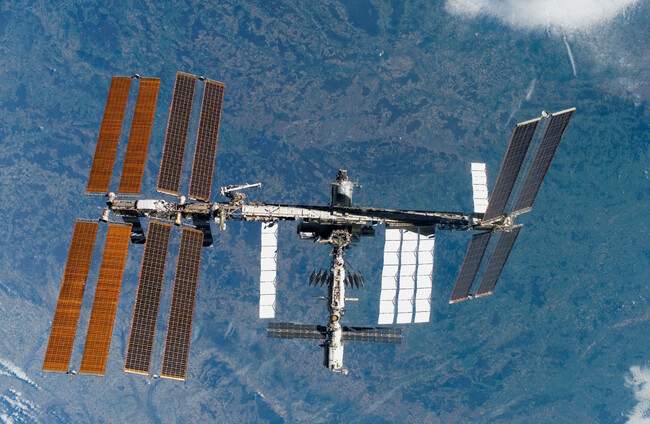
RUSSIA’S TOP SPACE official says the future of the International Space Station hangs in the balance after the US, EU and Canadian space agencies missed a deadline for the lifting of sanctions on Russian enterprises and hardware.
The head of Russia’s Roscosmos state agency told reporters this morning that the agency was preparing a report on the prospects of international co-operation at the station, to be presented to federal authorities “after Roscosmos has completed its analysis”.
Agency chief Dmitry Rogozin implied on Russian state TV that the western sanctions, some of which pre-date Russia’s invasion of Ukraine, could disrupt the operation of Russian spacecraft servicing the ISS.
He stressed that western partners need the ISS and “cannot manage without Russia, because no one but us can deliver fuel to the station”.
Rogozin added that “only the engines of our cargo craft are able to correct the ISS’s orbit, keeping it safe from space debris”.
Later today, he wrote on his Telegram channel that he had received responses from his western counterparts vowing to promote “further co-operation on the ISS and its operations”.
He reiterated his view that “the restoration of normal relations between partners in the ISS and other joint [space] projects is possible only with the complete and unconditional lifting” of sanctions, which he referred to as illegal.
Responding to western sanctions last month, Rogozin said that without Russia’s help, the ISS could “fall down into the sea or on to land”, and claimed the crash site was unlikely to be in Russia.
Space is one of the last remaining areas of co-operation between Moscow and western nations.
US-Russian negotiations on the resumption of joint flights to the ISS were under way when Moscow invaded Ukraine last month, prompting several sanctions on Russian state-linked entities.

To embed this post, copy the code below on your site











have your say