Sign in. It’s quick, free and it’s up to you.
An account is an optional way to support the work we do. Find out more.
Sign in. It’s quick, free and it’s up to you.
An account is an optional way to support the work we do. Find out more.
Updated 2.40pm
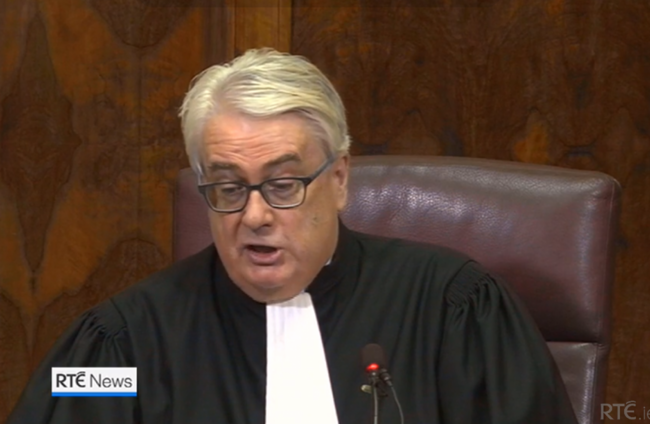
PROCEEDINGS OF THE Supreme Court have been broadcast live for the first time in the history of the State.
The decision to allow RTÉ cameras into the country’s highest court was taken after the chief justice Frank Clarke said he wanted to “demystify” what happens in the court.
Despite being allowed in for today’s proceedings, Clarke has said that the filming of criminal proceedings is still a long way off.
The court dealt with two cases; one concerning an appeal made by a man who was to be extradited to the USA for mortgage fraud offences. This was rejected.
The US had sought the extradition of Patrick Lee, to stand trial for 51 alleged offences of wire fraud, unlawful monetary transactions and aggravated identity theft. Lee had fought this in Irish courts.
The High Court and Court of Appeal had ruled that Lee should face extradition, but he brought the matter to the Supreme Court.
Today, the Supreme Court upheld that ruling. Clarke said that he “would propose that counsel be heard further on the precise form of order which should now be made to facilitate Mr Lee’s extradition”.
The other involved the case of a man who was looking for compensation for abuse he endured as a child in a residential institution. This was granted.
The applicant, referred to as Mr H, has previously been denied compensation because the residential institution he was in was not covered by the scheme set up to provide redress.
The Supreme Court looked at his case in relation to the Residential Institutions Redress Act 2002.
Mr Chief Justice Clarke said that the purpose of the legislation “is to adopt a generous or liberal approach having regard to the remedial nature of the legislation concerned”.
“I am not satisfied that the intention of the Oireachtas to exclude compensation in cases such as this is sufficiently clear that it would be unfair or inappropriate to adopt such a broad interpretation,” he said.
The court ruled that Mr H is entitled to compensation and referred the matter back to decide the appropriate amount to be granted.

To embed this post, copy the code below on your site













have your say