Sign in. It’s quick, free and it’s up to you.
An account is an optional way to support the work we do. Find out more.
Sign in. It’s quick, free and it’s up to you.
An account is an optional way to support the work we do. Find out more.
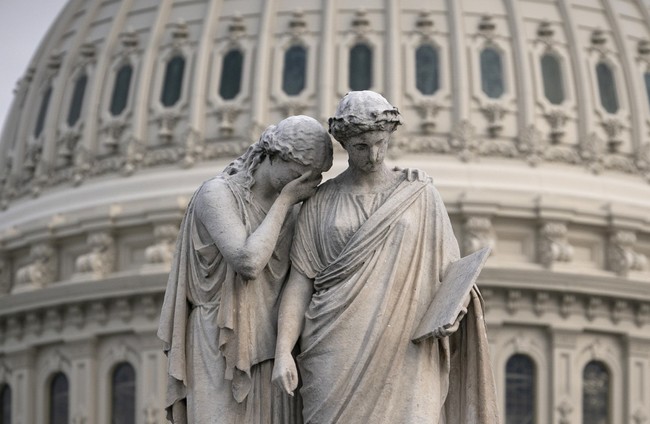
THIS WEEK, THE news agency AFP sent a number of reporters to non-descript places across the United States to see if ordinary Americans were engaged, were swayed, or even cared at all about the Senate impeachment trial into President Donald Trump.
Karl Kissner, a Trump voter who runs a diner in the Ohio town of Defiance, says there’s been more interest in the Weather Channel and the Food Network this week than watching events at Capitol Hill.
“The majority of what I’m seeing here is that people are ignoring it. Or they’re looking up at it, saying, ‘Oh, that’s on again,’ and moving on with their conversations,” he points out.
The TV is switched onto the impeachment at a packed barber shop in Pennsylvania and at an upmarket winery at Lake Erie, but many are looking away.
A poll from CNN published on Monday found that 51% of Americans wanted Trump removed from office, but other polls show a lukewarm reception for the impeachment in crucial swing states – the states Trump will need to win again to regain the presidency in November.
Similarly, viewing figures are way down on political events televised live in recent years, Intelligencer reported this week.
The impeachment process itself seems to be reaffirming what many already thought about the president. In Pittsburgh, 67-year-old Uber driver Terry McGill, told AFP all that’s happened has “absolutely bolstered [his] opinion of Trump”. For 51-year-old Tracey Ball, however, Trump’s behaviour is a “national embarrassment”.
The exchanges on the floor of the Senate this week have been no less partisan as the impeachment trial into President Trump over the Ukraine scandal got under way.
Opening gambit
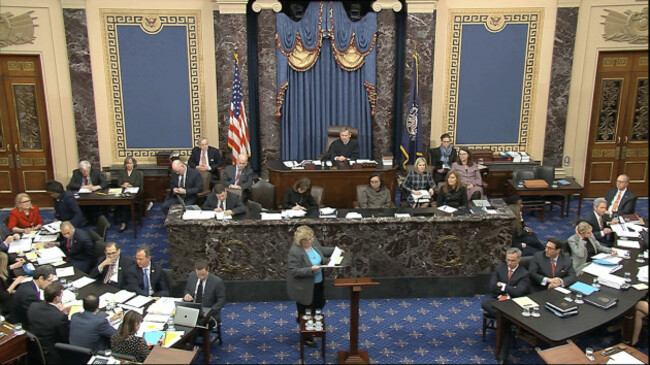
There have already been 12 key votes in the Senate related to the impeachment since Tuesday. There are 53 Republicans in the Senate. And there are 47 Democrats. Every single vote so far has gone the same way – 53-47.
The marathon first day of proceedings saw Senators clash during a 13-hour hearing with the two sides arguing over the procedures of the trial while the Democrats began to outline their case for Trump’s guilt on two counts of abuse of power and obstructing Congress.
For a witness to be called or new evidence to be admitted, a majority of the 100 Senators must vote in favour of it. All eyes had been on a few potential rogue Republican Senators, including former presidential candidate Mitt Romney, who might help the Democrats win a few key votes but that didn’t materialise on day one.
On Tuesday, Republicans voted to block:
The Democrat who’s leading the Impeachment trial, Congressman Adam Schiff, said the Republicans “don’t want a fair trial”.
“They don’t want you to hear these witnesses… they don’t want a neutral justice to weigh in,” he said.
Senate majority leader Mitch McConnell initially relented and gave in to Democrat demands to have three days to make their opening statements.
But any semblance of a consensus dissipated quickly as a series of bitter partisan exchanges marked the first day of the impeachment trial, setting the tone for the following days and weeks.
Chief Justice Roberts intervened at one point, admonishing both sides to “remember where they are”.
The Democrat case
For Trump to be impeached and removed from office, two-thirds of Senators have to vote in favour of it.
As pointed out above, getting that many Republicans to turn on Trump and change their vote looks very unlikely.
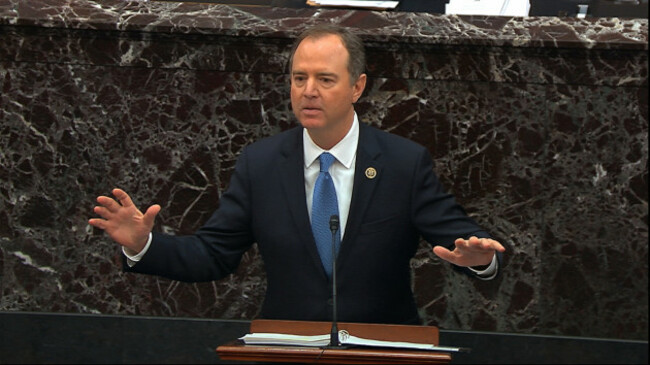
However, as Schiff and the Democrat impeachment managers (as they’re being called) began their opening statements, they appealed for partisan politics to be left aside in the interests of “protect[ing] our democracy”.
“Over the coming days, we will present to you – and to the American people – the extensive evidence collected during the House’s impeachment inquiry into the president’s abuse of power,” said Schiff, standing before the senators and appealing for them not to be “cynical”.
You will hear their testimony at the same time as the American people. That is, if you will allow it.
“President Trump withheld hundreds of millions of dollars in military aid to a strategic partner at war with Russia to secure foreign help with his re-election,” he said. “In other words, to cheat.”
Schiff’s fellow Democrat Jerry Nadler attempted to drive the point home on day two of the trial on Wednesday.
“No president has ever used his office to compel a foreign nation to help him cheat in our elections,” Nadler said today.
Prior presidents would be shocked to the core by such conduct, and rightly so.
The Republican senators, however, exhibited no shock.
In fact, Trump’s defence team aren’t disputing the conversation the president had with Ukrainian president Volodymyr Zelensky. They’re just rejecting that he did anything wrong or that he committed any crime.
In a clever move from the Democrats, they sought to use the words of Trump’s allies against him on Thursday.
They used footage of Lindsey Graham, a Republican Senator and ardent Trump supporter, and his comments back during the Clinton impeachment in 1999.
Graham said then: “What’s a high crime? How about an important person hurt somebody of low means. That’s not very scholarly, but I think it’s the truth. I think that’s what they meant by ‘high crimes.’ Doesn’t even have to be a crime. It’s just when you start using your office and you’re acting in a way that hurts people, you have committed a high crime.”
There was a similar clip played from one of Trump’s legal team Alan Dershowitz.
A key Republican defence is that Trump didn’t commit a crime, full stop. However, previous comments form the very people defending Trump suggested they’ve thought and said otherwise.
Another feature of the Democrats’ case so far is to try to highlight the role of former New York Mayor Rudy Giuliani. They said Trump was swept up by a “completely bogus” Ukraine theory pushed by Giuliani.
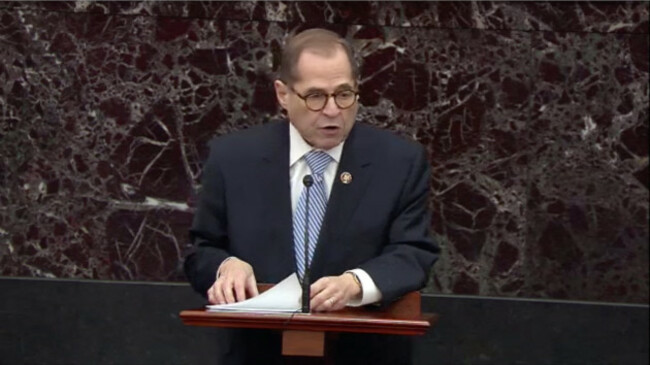
They scoffed at Trump’s claim he had good reasons for pressuring Ukraine to investigate his political foes.
Nadler said: “No president has ever used his office to compel a foreign nation to help him cheat in our elections. The president’s conduct is wrong. It is illegal. It is dangerous.”
Is Trump worried?
Despite the combative exchanges and the Democrats case that the president clearly abused his power, is it likely to get anywhere? They need a huge swathe of Republicans to do something that up to now looks impossible and switch their vote and their allegiances.
Whereas the Democrats say this is about the American constitution and American democracy, the Republicans aren’t being swayed.
And that’s certainly good news for Trump, but is he worried?
That’s harder to gauge, but Wednesday did see the president set a record for the most tweets he’s sent in a day since taking office.
He sent 142 Tweets that day – including those written by himself and retweets of those supporting him.
For anyone used to his favourite mode of communication, what he’s had to say in the last few days isn’t a surprise.
Here’s one comment from Trump regarding the impeachment proceedings in the House that preceded this week in the Senate: “The Democrat House would not give us lawyers, or not one witness, but now demand that the Republican Senate produce the witnesses that the House never sought, or even asked for? They had their chance, but pretended to rush. Most unfair & corrupt hearing in Congressional history!”
Whether or not tweeting more than usual means that he genuinely is concerned about what will happen over the next few weeks, Trump will certainly try to use these proceedings to boost his own support.
If – as expected – he is not removed from office, he will undoubtedly use these events as a stick to beat his Democrat rivals with ahead of the autumn’s presidential campaign.
What’s clear from the first week of proceedings is that the Democrats are facing an uphill battle to persuade Republican Senators – and the US public – that these impeachment proceedings are more than a partisan play and that, as Adam Schiff put it, they believe what’s of primary importance here is that “truth matters”.
“If not,” he said. “No constitution can protect us. If not, we are lost”.

To embed this post, copy the code below on your site















have your say