Sign in. It’s quick, free and it’s up to you.
An account is an optional way to support the work we do. Find out more.
Sign in. It’s quick, free and it’s up to you.
An account is an optional way to support the work we do. Find out more.
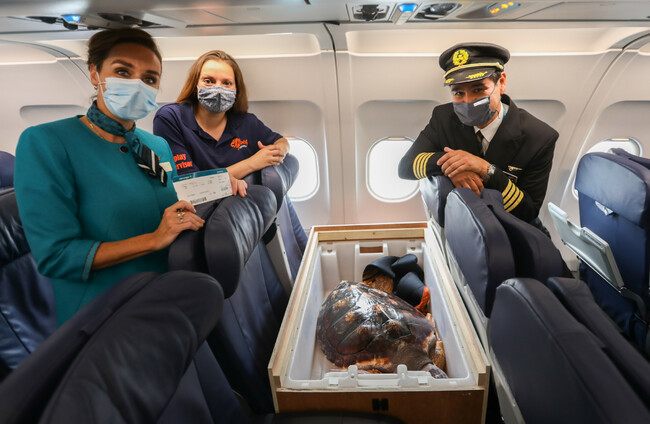
A RARE LOGGERHEAD sea turtle that washed up on a Donegal beach in January 2019 is finally heading home to Gran Canaria today – on board an Aer Lingus flight.
The turtle Julius Caesar, named for his fighting spirit, has been unable to get home since he washed up on Ireland’s coast two and-a-half years ago.
JC, as he’s known to friends, was suffering from hypothermia and weighed just a few hundred grams when he landed in Ireland at just nine-months-old.
Loggerhead sea turtles are an endangered species and thrive in a warm climate. It’s believed JC was caught in a current and swept along by the Gulf Stream.
Covid-19 restrictions prevented earlier repatriation efforts but the three-year-old will finally get back to his homeplace in the sun today.
The trip is a combined effort from the Exploris Aquarium, in Portaferry Co Down, and Aer Lingus, which is flying JC home in a specially designed waterproof crate.
The turtle, who now weighs 25kg, will travel south to the Canary Islands accompanied by his minder Portia Sampson, who will monitor his temperature at all times.
Since he was discovered by a local family in Donegal, JC has been living in a tropical tank in the Exploris Aquarium.
Upon landing in the Canary Islands he will be homed in the Tarifa Wildlife Recovery Centre (Centro de Recuperación de Fauna Silvestrede Tarifa) in Gran Canaria.
Vets at the facility will oversee JC’s acclimatisation to the warmer weather and monitor his behaviour, feeding and physical condition before releasing him back into the sea later this week.
“It is our pleasure to welcome aboard a very special passenger today and to ensure the safe transportation of JC the Turtle to Gran Canaria,” Aer Lingus pilot, Captain Peter Lumsden, said.
“Keeping the turtle’s temperature above 19 degrees is critical to his well being and he requires regular monitoring and shell lubrication so placing him in the aircraft hold was not an option. His specially designed crate will be securely strapped across a number of seats in the cabin,” Captain Peter Lumsden added.

To embed this post, copy the code below on your site














have your say