Sign in. It’s quick, free and it’s up to you.
An account is an optional way to support the work we do. Find out more.
Sign in. It’s quick, free and it’s up to you.
An account is an optional way to support the work we do. Find out more.
THIS WEEK HAS been a bad one for the UK pound.
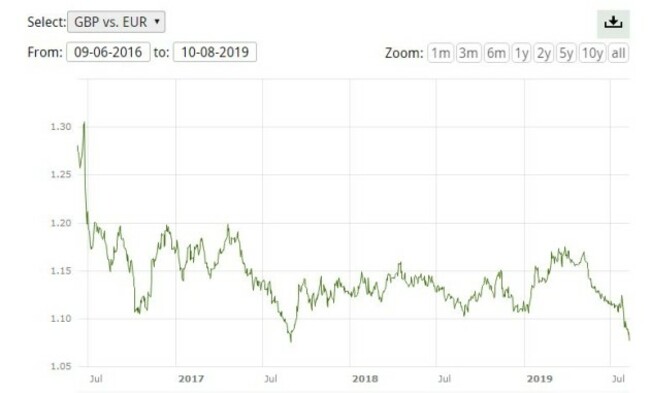
On Friday, the value of sterling dipped below €1.0792, marking the lowest value it has had in a decade against the single currency. That same day, it was announced that the UK’s GDP had fallen by 0.2% in Q2 of 2019, the first time it has contracted in almost seven years.
Data showed that if Britain’s economy shrinks again in the third quarter, it would put Britain in an official recession, just months out from a possible no-deal Brexit on 1 November.
“All in all, today’s disappointing GDP figure is set to raise alarm bells over Brexit dragging the UK economy deeper into the abyss,” said Lukman Otunuga, senior research analyst at FXTM.
This unfavourable scenario may prompt the Bank of England to cut interest rates sooner than anticipated, in an effort to revive the UK economy.
For the euro, despite concerns over the political crisis in the debt-laden Italy, sterling’s woes helped propel the European single currency to a two-year high at 92.72 pence.
Why is this happening?
Economies and markets like certainty, and Britain’s future right now is anything but.
In the past year, we’ve seen high-profile businesses like Dyson, Nissan, Sony and Panasonic move their headquarters out of the UK or cancel plans to expand.
Car manufacturer BMW and Airbus have warned that the uncertainty around Brexit is forcing it to reconsider its investment in manufacturing in the UK.
This is aside from the fact that post Brexit, the UK could lose access to the Single Market, a lucrative tariff-free arrangement that gives business wide-ranging access to businesses and markets within the European Union.
When Theresa May was Prime Minister, she promised to leave the Single Market and Customs Union, cutting off the free movement of people, goods, capital, and services.
What does it mean for Ireland?
The slump in sterling is, on the surface, a good thing for Irish consumers travelling to the North or to the UK.
For those going on holiday, €108 will get you £100, which is a pretty good deal.
There is a negative effect, however, for Irish businesses. Those that export to the UK are getting a raw deal – their product, for example Irish beef, is getting a poor price because of the devaluation of the sterling.
For those who work along the Irish border, Brexit can directly affect their take-home pay. If a person works in the North and is paid directly in sterling, but lives in the Republic, they’re losing money every time the markets react negatively to the latest Brexit uncertainty.
In the event of a no-deal Brexit, it’s very likely that people will travel to Northern Ireland to avail of the strength of the euro against the flailing sterling, but the negative effects of our close neighbour’s currency will have more dramatic knock-on effects elsewhere in the Irish economy.
https://soundcloud.com/the-explainer-podcast/what-is-the-irish-backstop

To embed this post, copy the code below on your site













have your say