Sign in. It’s quick, free and it’s up to you.
An account is an optional way to support the work we do. Find out more.
Sign in. It’s quick, free and it’s up to you.
An account is an optional way to support the work we do. Find out more.
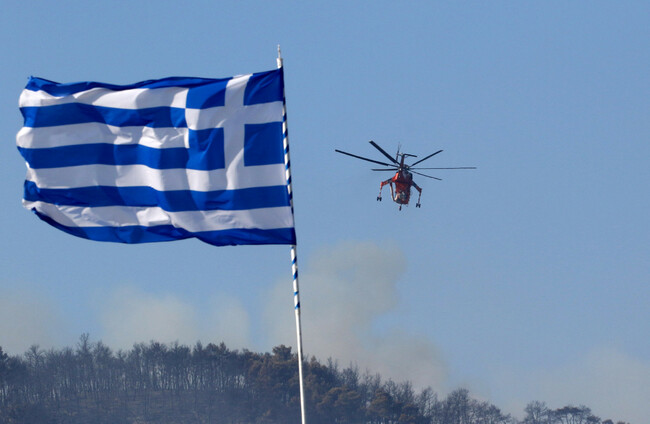
WHILE THE GREEK government has been quick to blame global warming for the summer’s devastating wildfires, some experts argue that poor planning is at least as much to blame.
This week, Prime Minister Kyriakos Mitsotakis told parliament that the fires that have burned across Greece are expected to destroy over 1500km2 of land.
The European Commission has said that the blaze in the Dadia national park, which has been burning for two weeks now, is the largest European fire on record.
So far, fires have claimed the lives of 26 people.
“Is the climate crisis the alibi for everything?” said Mitsotakis.
“No, it is not an alibi, but it is part of the interpretation.”
Climate change is a factor the government has returned to repeatedly in the context of the wildfires but, as Mitsotakis appeared to at least implicitly acknowledge, it is not the whole story.
This year’s fires are certainly stronger than those of previous years because of climate change, said Alexandros Dimitrakopoulos, head of Forest Protection and the Wildland Fire Science Lab at the Aristotle University of Thessaloniki.
But he said that does not fully explain the extent of the damage, pointing out that 10 percent of the country’s woodlands had gone up in smoke since 2007.
“Better planning in the fight against fires is needed, as well as better cooperation between the fire services and the specialists in geomorphology of wooded zones,” said Dimitrakopoulos.
Geomorphology is the scientific study of the form or shape of the land.
Kostas Lagouvardos, research director at the National Observatory of Athens, made a similar point, arguing that the emphasis should be on adequate measures to prevent forest fires.
But the recurring problem, he said, was the dysfunctional relationship between the state and scientific bodies.
The scientific tools exist and can help detect and prepare for difficult climatological conditions
These difficult conditions include the extreme drought that has struck the Evros region near the border with Turkey and other regions.
Opposition politicians took a similar line during a fierce parliamentary debate Thursday.
They accused the government of having been too slow to put preventative measures in place and of poor coordination between the various government agencies concerned.
Mitsotakis, hitting back, referred to the growing climate crisis, the summer’s extended heatwave in Greece and the hot dry winds that had fuelled the fires.
He pointed out that Greece was far from being the only country to suffer such massive wildfires, pointing to similar disasters this summer in Canada, Spain and the United States.
He argued that even those countries – “with greater financial capacity than Greece” – were unable to cope with the fires.
He also announced he would be recruiting more firefighters and buying equipment such as drones to help monitor future disasters.
Mitsotakis had sharp words for “certain scientists” who, he said, saw fit to publish their data on the wildfires in the news media – such as the extent of the terrain burnt – when the research that might have put the figures in context had not been completed.
However, the National Observatory of Athens defended itself in a statement issued on Friday.
“In a democracy and in the era of published data at the European and international level, science and the national research centres are obliged to inform society of the results of their activities and the natural conditions that affect the lives of citizens,” it said.
© Agence France-Presse

To embed this post, copy the code below on your site










have your say