TheJournal.ie uses cookies. By continuing to browse this site you are agreeing to our use of cookies. Click here to find out more »
Dublin: 10 °C Thursday 23 May, 2013

EPA clears way for field trials of blight-resistant GM potato

The Environmental Protection Agency has agreed to allow Teagasc carry out experimental field research in Carlow.

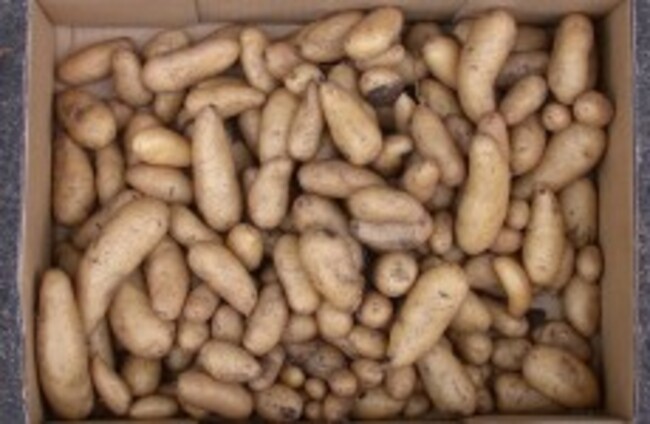
Image: graibeard via Flickr

THE SEMI-STATE body responsible for agricultural research and development has been awarded a licence to proceed with field research on a genetically modified strain of potato which is designed to be less vulnerable to blight.

Teagasc said this afternoon it had been granted the licence from the Environmental Protection Agency subject to eight conditions which have not been disclosed. It had applied for the licence in February.

The agency said it proposed to carry out the research over the next four years, in order to determine the impact that a blight-resistant potato could have on the Irish agricultural environment.

The study, to be undertaken at Teagasc headquarters in Carlow, will be isolated from the conventional potato breeding experiments.

Teagasc was keen to stress that the biotechnology industry had no connection to the experiment – meaning the research would have no regard for whether GM potatoes were commercially viable.

Research has suggested that the use of modified potatoes could reduce the amount of fungicide needed by potato farmers, though researcher Dr Ewen Mullins said the agency also had to weigh up the potential costs.

“We need to investigate whether there are long term impacts associated with this specific GM crop in carefully controlled conditions. We need to gauge how the late blight disease itself responds,” he said.

“This is not just a question being asked in Ireland. The same issues are arising across Europe.”

The agency is to launch an outreach programme with the general public in the hope of fostering what it called an “inclusive and impartial discussion” on its concerns about genetic modification of food.

An Taisce said it was disappointed with the EPA’s decision to grant the licence, saying that allowing the trials could damage Ireland’s image as “a green and pure country”.

The agency said it was concerned that an open-air trial of a GM potato could allow the cross-pollination of the modified crop with other, non-modified potatoes.

“The strong potential exists even at trial stage for the altered GM potato gene to move into the greater potato environment in Ireland,” it said.

Sinn Féin and the Green Party both also criticised the EPA’s decision.

Explainer: GM crop trials in Ireland

Read next:

Comments (32 Comments)

  • Watch ‘The World According to Monsanto” http://www.youtube.com/watch?v=-0uls507hvM
    and then ask is this a good idea

    There’s nothing they are leaving untouched: the mustard, the okra, the bringe oil, the rice, the cauliflower. Once they have established the norm: that seed can be owned as their property, royalties can be collected. We will depend on them for every seed we grow of every crop we grow. If they control seed, they control food, they know it — it’s strategic. It’s more powerful than bombs. It’s more powerful than guns. This is the best way to control the populations of the world. The story starts in the White House, where Monsanto often got its way by exerting disproportionate influence over policymakers via the “revolving door”. One example is Michael Taylor, who worked for Monsanto as an attorney before being appointed as deputy commissioner of the US Food and Drug Administration (FDA) in 1991. While at the FDA, the authority that deals with all US food approvals, Taylor made crucial decisions that led to the approval of GE foods and crops. Then he returned to Monsanto, becoming the company’s vice president for public policy.

    Thanks to these intimate links between Monsanto and government agencies, the US adopted GE foods and crops without proper testing, without consumer labeling and in spite of serious questions hanging over their safety. Not coincidentally, Monsanto supplies 90 percent of the GE seeds used by the US market. Monsanto’s long arm stretched so far that, in the early nineties, the US Food and Drugs Agency even ignored warnings of their own scientists, who were cautioning that GE crops could cause negative health effects. Other tactics the company uses to stifle concerns about their products include misleading advertising, bribery and concealing scientific evidence.

    Reply
  • Not a good idea to be giving total global food production to one company, Monsanto, especially one with a history such as theirs. Great article in Vanity Fair on them and the tactics they use to force farmers around the world to use their product plus the largest shareholder in Monsanto is also the largest shareholder in the biggest bank in the world, Goldman Sachs. And here i was thinking GM was meant to eradicate parasites.

    Reply
  • Paul 26/07/12 #

    The big deal is this country has so much to offer producing fresh, healthy and safe food. This is a monumental mistake from a marketing point of view for Ireland as a producer of quality food. Really really stupid.

    Reply
    • Agreed

      Reply
    • Spot on.

      Reply
    • Our neighbours are big potato growers. I know that they have to spray their crops on a weekly basis this summer due to the weather we’ve had. They have to use a different type of spray each time they spray the same field. Now the genetically modified potato would reduce the amount of spraying required. This would have a positive impact on the environment (less pesticide) and would reduce costs for the farmer.

      I think my main concern with this would be that we end up with a situation like that in the USA where corporations own the crop/seed. I’m thinking primarily about Monsanto and it’s monopoly on corn seed. That would not be a positive development.

      Reply
    • The potatoes defence may become stronger but so then do the bacteria and other stuff that kill it and well prob end up with ‘super bugs’ that kill the potatoes and have to keep modifying and modifying!!!

      Reply
  • My only concern about this is “ownership” of the GM seed potato varieties. Apart from that we have to realize that we cannot feed 7 Billion people on purely organic methods alone. The Haber Process developed back in the early 20th Century saved millions of lives by providing artificial fertilizer for crops. I accept the need to control the use of artificial pesticides/fertilizers for environmental reasons but there has to be an alternative if we are all to get the food we need. Any honest Irish organic grower will tell you that this Summer has been a disaster for food production, pest and disease resistance is the way forward whether through breeding or GM research.

    Reply
    • I don’t know Anthony – there is plenty of evidence to the contrary – even Olivier de Schutter, the UN Special Rapporteur on the RIght to Food (whose responsibility it is to ensure people have access to food) has said that agro-ecological farming methods – ie low or zero chemial input farming – is the only way to sustainably feed the world’s population.The IASSTD report set up by the FAO and World BAnk in fact made similar findings. The argument that GM or even a continuation of conventional farming is necessary to feed the world just doesn’t stand up – it is a PR campaign by biotech and agroindustry, nothing more.

      Another part of the problem is that biotech companies (and some farmers) think that “they” have to feed the world. The world is capable of feeding itself if the EU and US would stop dumping their cheap subsidized overproduction in other country’s markets. The globalization of agricultural trade has destroyed farms and farm livelihoods across the world and only provided profits for big big farms and plenty of middle men and agrochemical and seed companies.

      Reply
    • Spot on, Fergal.

      Reply
  • ”Beware the dreaded blight ?”
    ”Ban Raw Milk?”
    What a load of rubbish.
    Sounds similar to the big Pharma monopolies propaganda encouraging people to shovel their products down their throats because they are too lazy to eat rite.

    Reply
  • Reg 26/07/12 #

    Humans have been modifying fruits and vegitables for thousands of years. Now it’s done more scientifically, what’s the big deal?

    Reply
    • Scientifically?
      Ohh great.
      Pile up the Tates please.

      Reply
    • Ok, it appears that you don’t understand the difference between generically engineering crops and genetically modifying them.

      What we call wheat is actually a genetically engineered plant, a hybrid if you will. Two types of grass were cross pollinated to create a new, more hardy type of grain.
      Interestingly enough, wheat is one of our most common food intolerances, as it’s one of the last things to be introduced to the food chain, alongside milk and dairy.

      Genetically Modified crops are another thing altogether. For example, there’s GM strawberries with frog DNA in them. There’s GM potatoes with Spider DNA in them.. You will never manage to cross breed a frog with a strawberry, neither will you cross a spider with a potato – unless you mess around with the DNA in a lab.. It’s not food.

      No safety data in terms of what happens to humans who consume GM products has been carried out. Our bodies react badly to hybrid crops like wheat – what on earth do you think the side effects of pretty much alien DNA in your food might be? Considering those making GM crops have no connection to any sort of nutrition research whatsoever, it doesn’t really figure highly on their list of priorities.. The people in the US (where Monsanto are lobbying to have “GM free” labels banned) and other countries that have permitted their use ARE the safety trial..

      I’d really rather not take my chances, I appreciate how picky the human body is about its fuel. Pity these agritech companies don’t..

      Reply
    • JayK 26/07/12 #

      ” You will never manage to cross breed a frog with a strawberry, neither will you cross a spider with a potato – unless you mess around with the DNA in a lab.. It’s not food.”

      It is food. Nothing you said suggests otherwise. You just explains genetic modification then extended that arbitrarily to mean it’s not food. That’s not an argument.

      “No safety data in terms of what happens to humans who consume GM products has been carried out.”

      Yes there has, and all of them say its perfectly fine. What you mean to say is no safety data that agrees with your claims has been carried out.

      “Our bodies react badly to hybrid crops like wheat.”

      Wheat has existed for almost 12,000 years. No GM back then.

      “.. what on earth do you think the side effects of pretty much alien DNA in your food might be?”

      Two ways of looking at this. Firstly, everything you eat contains “alien DNA”. Cow DNA, pig DNA, carrot DNA. Ever eat two different foods? Then you’re getting two servings in alien DNA. Secondly all DNA, from bacteria to homo sapien, is identical. A,T,C and G in different orders, connected by the same pentose sugar. It’s all the same, no matter where it is.

      “Considering those making GM crops have no connection to any sort of nutrition research whatsoever, it doesn’t really figure highly on their list of priorities.”

      This doesn’t actually make any sense but none the less, here’s some “nutritional research” on GM crops from The American Society for Nutritional Sciences

      http://jn.nutrition.org/content/133/5/1490S.long

      “The people in the US… and other countries that have permitted their use ARE the safety trial.”

      Read the article title again.

      Finally, to quote http://www.ncbi.nlm.nih.gov/pubmed/12126808

      ” Using this approach in the evaluation of more than 50 GM crops which have been approved worldwide, the conclusion has been that foods and feeds derived from genetically modified crops are as safe and nutritious as those derived from traditional crops. The lack of any adverse effects resulting from the production and consumption of GM crops grown on more than 300 million cumulative acres over the last 5 years supports these safety conclusions.”

      There’s hundreds of possible links so I just chose a review.

      Reply
    • Reg 26/07/12 #

      Where can I get those spuds….I’m changing my name to Peter Parker!!

      Reply
    • Reg 26/07/12 #

      And Bear Grylis eats all kinds of crap and he’s action man. Get me some of those Strawberries and I’ll be leaping around like Bear!!

      Reply
  • Aidan 26/07/12 #

    I don’t think it’s about anything other than money. Some company owns the rights to these GM potatoes and you’ll have to buy from them. Once every caves in and the normal potatoes are nearly gone then companies control the basic necessity of life, food. Sure well sell our water soon too. Then what have we left.

    Reply
    • Only about the money? What about the extra billion people we have to feed in the next 20 years? It’s a newish technology that might get our asses out of the fire. Test away lads, increase our knowledge and we’ll see if it’s a solution or a problem based on independent scientific analysis not people’s opinions.

      Reply
    • Sadly, it’s not a solution. Thing about the blight is that it can evolve, and will evolve. All we are doing is pouring hundreds of thousands of euro down the drain and calling it “progress”.

      Reply
  • Oh lord god almighty. If these mutant potatoes get into circulation we’ll end up with ‘zombie spuds’ and ‘ghost mash’.

    Reply
  • I have no objections as long as they are they have a label on the potatoes when they go to sell them as I for one will stay with the ones nature provide, who wants a potato that has the dna. of a fish ?.

    Reply
  • Yer about 160 years late, lads

    Reply
  • There are blight resistant patatos already sounds like a waste of money to me

    Reply
  • Micheal 27/07/12 #

    Nature builds resistance to genetically engineered plants over time and mutates to protect all else that is nature and life on this planet. It is happening already with genetically engineered crops in the States where they have to spray even more than before to try and stop the mutation. This is grave mistake for the green image of Ireland internationally and is another example of humanity trying to play God…trying to control the wonder and miracle that is nature. Remember you are what you eat. Be prepared for natures war on humanity folks.
    An ongoing petition is available on my website to Get Teagasc, the EPA and all those who support Genetic Engineering aware that we the people have a voice and will organise with time and the truth as it is revealed on our side. http://www.ecohomesandgardens.ie/get-teagasc-and-epa-to-eat-gm-potatoes-sign-the-petition.html

    Micheál

    Reply
  • Here we go again selling out to the multi nationals. Please realise that around the world we are seen as producers of REAL food. That is food that actually nourishes the body! If blight is such a problem here why can’t we stop the production of potatoes altogether and just buy them in from countries that suit their growing. Let’s get back to full production of grass fed cattle etc. beautiful butter cream cheese etc. organic veg free range chickens etc, and generally well looked after animals. It’s possible to make lovely chips from turnip parsnip etc for those who think they can’t live without them. People of Ireland wake up before its too late. Don’t let this happen. And don’t be fooled by talk of been able to feed the world. It’s all about money. Don’t forget the parable of the loaves and fishes. When shared there is plenty of food for all in the world.

    Reply
  • Fergal, I don’t disagree with your argument per se. But, what you are ( I think) suggesting will require a massive shift in the way agricultural/horticultural AND global trading is undertaken. Can we realistically expect this to happen under the current capitalistic ethos which we have all become unaccustomed to?

    Reply

Add New Comment