We need your help now

Support from readers like you keeps The Journal open.

You are visiting us because we have something you value. Independent, unbiased news that tells the truth. Advertising revenue goes some way to support our mission, but this year it has not been enough.

If you've seen value in our reporting, please contribute what you can, so we can continue to produce accurate and meaningful journalism. For everyone who needs it.

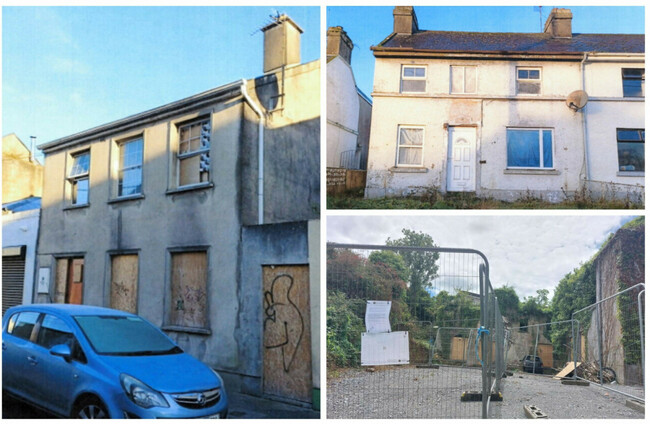
A selection of houses subject to CPO applications in September. Cork and Limerick County Councils

Why Ireland's most toothless housing crisis measure is finally getting an overhaul

Could we finally be doing something nationally about dereliction?

IRELAND HAS HAD many housing policies of suspect impact over the years.

But most at least arouse some kind of passion.

Whether it’s outrage for the money wasted, or despair for the unfulfilled promises, or (possibly!) even hope of improvement.

But then there are those which most people barely acknowledge. Even the officials tasked with enforcing them.

It’s into this bracket that the Derelict Sites Levy (DSL) neatly slots.

In theory, it’s a crucial piece to solve the housing puzzle.

Take a stroll through many a provincial town, and you’ll see boarded up buildings, left abandoned – often for years.

The most recent estimates put the number of derelict buildings in Ireland at about 20,000 - but it’s possible the real number is more than twice as high.

It’s often suspected that some owners preferred to leave buildings abandoned, betting on an increase in the underlying land value, rather than spend money on redevelopment.

For example, say you have a derelict site worth €300,000. As it’s derelict, whatever building is on the site will be worth very little. But house price increases could help quickly push up the underlying land value.

To stop these problems, Ireland introduced the DSL. Essentially, it’s a penalty for idle sites. The idea is that the fines will push the owner to do something with their asset, rather than just lose money.

Unfortunately, it has proved to be perhaps the most toothless housing policy of recent years. As part of the government’s new housing plan announced this week, it was confirmed that the DSL will be overhauled.

It’s also worth quickly noting – the DSL and the ‘Vacant Sites Levy’ (VSL) are two different things.

The DSL applies to any land or building that is derelict. That is, something which could be unsightly or unsafe – regardless of zoning.

Meanwhile, the VSL applies only to residentially zoned land that is vacant. Each levy is charged independently.

With that out of the way, let’s look at what went wrong with the DSL, and how the policy will (hopefully) be fixed.

The history of the DSL actually stretches back decades.

It was introduced all the way back in 1990, in response to the problems we mentioned. Namely, that speculative site owners were letting properties deteriorate rather than redevelop.

The Derelict Sites Bill gave local councils the power to charge owners up to 3% of the value of a site which was judged to be derelict.

This was an annual charge – so the hope was that penalties could quickly rack up and encourage building.

Unfortunately, this didn’t happen.

The charge ended up getting overhauled in 2018. This was as housing became a national issue, and there was a massive outcry over vacant sites.

Figures on how much councils collected in penalties from before the reform are not readily available, but some individual examples show the amounts were tiny.

For example, Cork City Council, overseeing the country’s second-biggest city, collected just €40,000 in derelict sites levies in 2017. Meanwhile, multiple local authorities – in Waterford, Limerick and Galway City - collected €0 in 2017.

Why collection was so poor is the source of some debate. 

A central issue looks to have been staffing. Most local authorities did not have enough staff to police the DSL, so there was never effective oversight.

Additionally, there were logistical problems. The head of Waterford City and County Council said in 2017 that the 3% levy was ‘non-functional’.

He told an Oireachtas committee that derelict properties are “generally in distress in terms of ownership or otherwise”, and said applying a penalty to them could make them even harder to develop.

On top of poor collection, it was also suspected that a 3% penalty wasn’t a big enough incentive, at a time when land values were rising rapidly.

With the housing crisis getting worse, the government decided the DSL needed an overhaul.

So in 2018, several changes were introduced, which were effective from 2020.

The central one was that the maximum penalty was raised from 3% of the site value, to 7%.

The idea was that this would prove to be a stronger deterrent, putting more pressure on owners to sell or repair derelict buildings.

Long story short – again, it didn’t work out that way.

Again, enforcement was the main problem. While the potential penalties were bigger, this didn’t matter in practice when there was no one following up on fines.

Take 2022, well after the new DSL regime was in place. Some 18 out of 31 local authorities received €0 in derelict-site levy payments that year.

This has proven to be a consistent issue – more recent figures show that 10 councils have never levied derelict sites owners in their areas.

Again, the same issues were raised - one TD noted that “local authorities also tell me that they do not have the staff or resources to do this work”.

It became clear to most observers that the DSL simply wouldn’t work if the councils were left in charge of collections.

Which is why the charge has been overhauled again.

The charge will now be called the ‘Derelict Property Tax’, instead of ‘Levy’.

And the main change this time is that it will be Revenue which will be in charge of collections.

While this may not sound like much of a difference, the effect could be dramatic.

Councils collected a measly 10% of the DSL penalties they handed out in 2023. By contrast, Revenue’s enforcement rates tend to be near-perfect. For example, it has a 95% collection rate for the Local Property Tax (LPT).

The hope is that this small change will have a two-pronged positive impact.

One, a working Derelict Property Tax will encourage owners to actually do something with idle properties, increasing housing supply.

Two, proper fine collection would give the state extra money from owners who insist on leaving derelict properties unused. 

Another easily-missed part is that the government now plans to publish a national register of derelict properties.

Previously, each council was responsible for their own register. As there are over 30 councils, it made it hard to get a central picture of the true extent of dereliction in Ireland. A central database promises to be a big improvement.

The new regime is set to come into force in 2027. It’s understandable that some time would be needed to get the new regime up to speed, but the wait is unfortunate.

The government has promised that in the meantime, “councils will work harder to collect unpaid levies”.

Given the history of the charge, don’t hold your breath. In Revenue we trust!

Readers like you are keeping these stories free for everyone...
A mix of advertising and supporting contributions helps keep paywalls away from valuable information like this article. Over 5,000 readers like you have already stepped up and support us with a monthly payment or a once-off donation.

Close
31 Comments
This is YOUR comments community. Stay civil, stay constructive, stay on topic. Please familiarise yourself with our comments policy here before taking part.
Leave a Comment
    Submit a report
    Please help us understand how this comment violates our community guidelines.
    Thank you for the feedback
    Your feedback has been sent to our team for review.

    Leave a commentcancel

     
    JournalTv
    News in 60 seconds