We need your help now

Support from readers like you keeps The Journal open.

You are visiting us because we have something you value. Independent, unbiased news that tells the truth. Advertising revenue goes some way to support our mission, but this year it has not been enough.

If you've seen value in our reporting, please contribute what you can, so we can continue to produce accurate and meaningful journalism. For everyone who needs it.

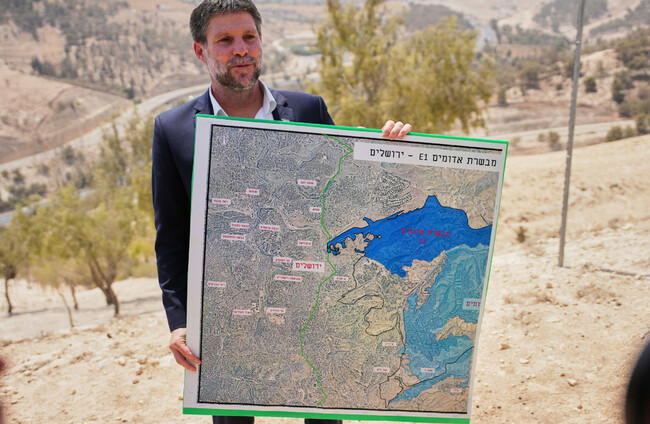
Israeli Finance Minister Bezalel Smotrich holds a map that shows the E1 settlement project during a press conference near the settlement of Maale Adumim, in the Israeli-occupied West Bank. Alamy Stock Photo

Israel approves plans for West Bank settlement that could destroy plans for Palestinian state

Israel’s finance minister Bezalel Smotrich said of the approval: ‘This reality finally buries the idea of a Palestinian state, because there is nothing to recognise and no-one to recognise.’

ISRAEL HAS GIVEN final approval for a controversial settlement project in the occupied West Bank that would effectively cut the territory in two, and that Palestinians and rights groups say could destroy plans for a future Palestinian state.

Settlement development in E1, an open tract of land east of Jerusalem, has been under consideration for more than two decades – but was frozen due to US pressure during previous administrations.

Today, the project received final approval from the Planning and Building Committee after the last petitions against it were rejected on 6 August.

If the process moves quickly, infrastructure work could begin in the next few months and construction of homes could start in around a year.

The plan includes around 3,500 apartments to expand the settlement of Maale Adumim, far-right finance minister Bezalel Smotrich said during a press conference at the site last Thursday.

Smotrich cast the approval as a riposte to western countries that announced their plans to recognise a Palestinian state in recent weeks.

“This reality finally buries the idea of a Palestinian state, because there is nothing to recognise and no-one to recognise,” Smotrich told reporters.

“Anyone in the world who tries today to recognise a Palestinian state will receive an answer from us on the ground.”

The location of E1 is significant because it is one of the last geographical links between Ramallah, in the northern West Bank, and Bethlehem in the southern West Bank.

The two cities are 14 miles apart by air, but Palestinians travelling between them must take a wide detour and pass through multiple Israeli checkpoints, adding hours to the journey.

The hope for final status negotiations for a Palestinian state was to have the region eventually serve as a direct link between the cities.

Peace Now, an organisation that tracks settlement expansion in the West Bank, called the E1 project “deadly for the future of Israel and for any chance of achieving a peaceful two-state solution” which is “guaranteeing many more years of bloodshed”.

Israel’s plans to expand settlements are part of an increasingly difficult reality for Palestinians in the occupied West Bank as the world’s attention focuses on the war in Gaza.

There have been marked increases in attacks by settlers on Palestinians, evictions from Palestinian towns, and checkpoints that choke freedom of movement, as well as several Palestinian attacks on Israelis.

More than 700,000 Israelis now live in the occupied West Bank and east Jerusalem, territories captured by Israel in 1967 and sought by the Palestinians for a future state.

The international community overwhelmingly considers Israeli settlement construction in these areas to be illegal and an obstacle to peace.

Israel’s government is dominated by religious and ultra-nationalist politicians with close ties to the settlement movement.

Smotrich, previously a firebrand settler leader and now finance minister, has been granted Cabinet-level authority over settlement policies and vowed to double the settler population in the West Bank.

Israel has annexed east Jerusalem and claims it as part of its capital, which is not internationally recognised.

It says the West Bank is disputed territory whose fate should be determined through negotiations. Israel withdrew from 21 settlements Gaza in 2005.

Close
JournalTv
News in 60 seconds