Sign in. It’s quick, free and it’s up to you.
An account is an optional way to support the work we do. Find out more.
Sign in. It’s quick, free and it’s up to you.
An account is an optional way to support the work we do. Find out more.
Updated 19.45pm
THE NEW YORK TIMES has said it never intended to blame the victims of the Berkeley tragedy in an article published earlier today.
The US paper admitted that some of the language it used “could be interpreted as insensitive” and apologised if it gave the impression of blaming the six victims of the balcony collapse in California on Monday night.
In a piece published overnight, the paper said the deaths “cast a pall” on the J1 visa programme, which the students were travelling on.
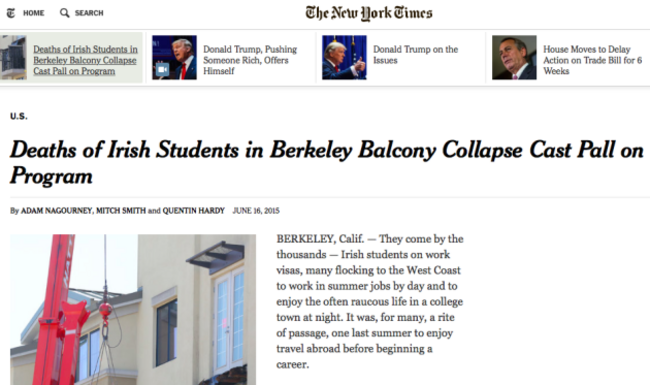
The piece draws links between the deaths and stories of Irish students destroying accommodation, saying the programme was an “embarrassment” for Irish people.
It sparked considerable anger online with junior minister Aodhán Ó Ríordáin calling it “a disgrace” on Twitter:

“It was never our intention to blame the victims and we apologize if the piece left that impression,” the paper ‘s vice president of corporate communications, Eileen Murphy, said in a statement to TheJournal.ie.
The statement in full reads:
This piece was a second day story following yesterday’s news story of the collapse. It was intended to explain in greater detail why these young Irish students were in the U.S.
We understand and agree that some of the language in the piece could be interpreted as insensitive, particularly in such close proximity to this tragedy.
It was never our intention to blame the victims and we apologize if the piece left that impression. We will continue to cover this story and report on the young people who lost their lives.
Six Irish students on J1 visas to the US died after a balcony collapsed at an apartment in downtown Berkeley, California.
The students had been celebrating a friend’s 21st birthday when the fourth-storey balcony gave way, collapsing to the street below.
Speaking in Dublin today, Health Minister Leo Varadkar said that while he hadn’t read the piece, the students’ behaviour was not unusual. He said:
People in their 20s having a house party is just what people do. I didn’t see the article, but I hope it doesn’t in anyway suggest that they are somehow responsible for a balcony collapsing.
“That’s not why balconies collapse, they collapse for structural flaws and other reasons, not because of what anyone has done.”
The Ambassador of Ireland to the US also wrote a letter to The New York Times, stating she found the article “inaccurate and insensitive”.
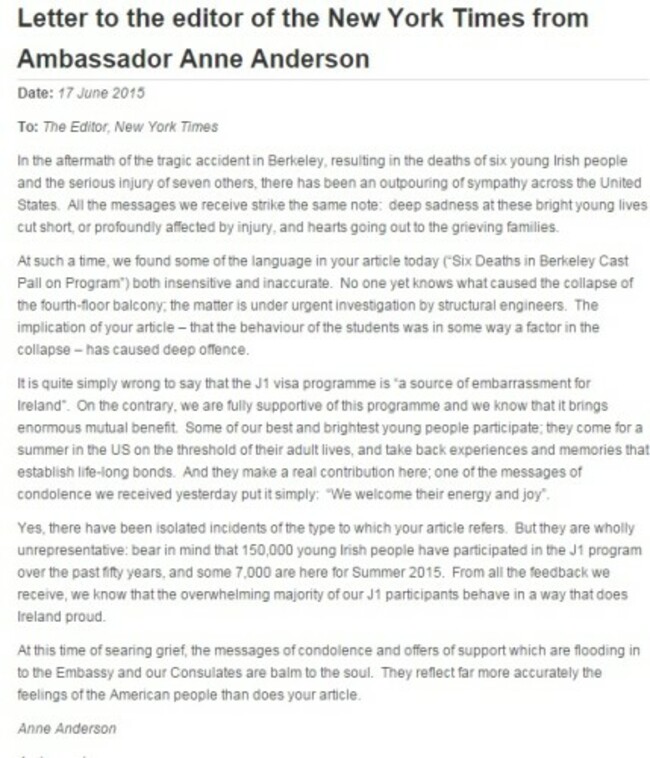
This afternoon, the New York Times public editor Margaret Sullivan tweeted that she was looking into the story:
Since her tweet, the Public Editor has written a response to the complaints.
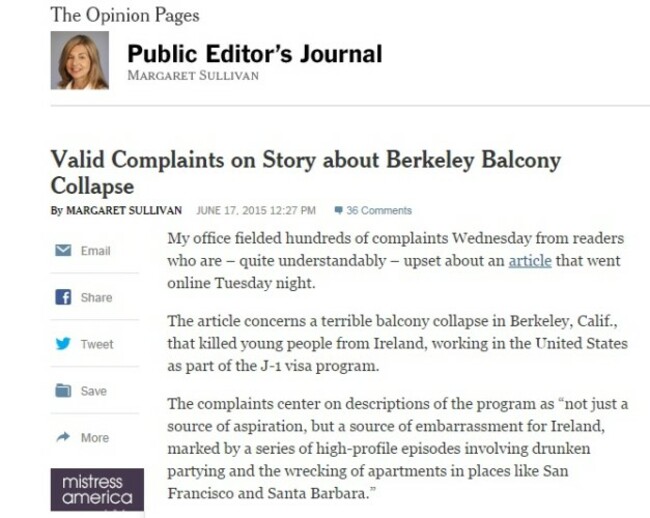
She said there had been hundreds of complaints about the article. Sullivan said the reaction from Ireland and from Irish-Americans and others was intense.
The anger against the article was felt online:
At home, the Irish Daily Star and the Examiner have been criticised for using pictures of body bags in their editions today.
Out of context
Cahir O’Doherty, a columnist for Irish Central, was quoted in the New York Times piece. He has since responded, saying that his quotes were taken out of context.
Additional reporting by Paul Hosford

To embed this post, copy the code below on your site














have your say