We need your help now

Support from readers like you keeps The Journal open.

You are visiting us because we have something you value. Independent, unbiased news that tells the truth. Advertising revenue goes some way to support our mission, but this year it has not been enough.

If you've seen value in our reporting, please contribute what you can, so we can continue to produce accurate and meaningful journalism. For everyone who needs it.

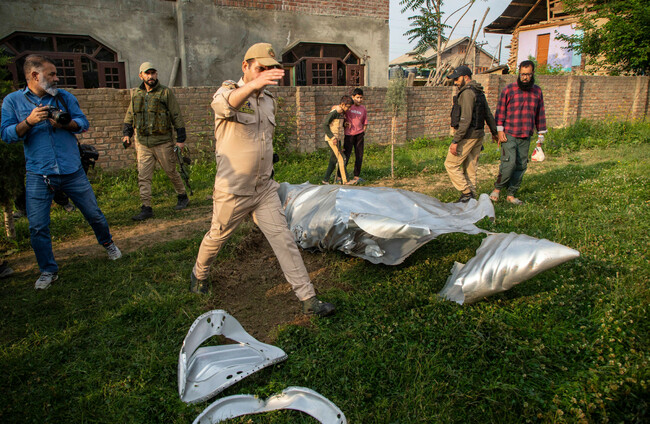
Indian policemen and people look at a part of an unknown crushed aircraft in Wuyan near Indian-administered Kashmir's main city of Srinagar. Alamy Stock Photo

DFA issues travel warning to citizens heading to India and Pakistan amid soaring tensions

It has reclassified both countries’ security status as ‘High Degree of Caution’.

LAST UPDATE | 7 May 2025

THE DEPARTMENT OF Foreign Affairs (DFA) has urged Irish citizens travelling to India and Pakistan to exercise a “high degree of caution” following deadly clashes between the two nuclear-armed states last night.

At least 26 people were killed after India fired missiles into Pakistani-controlled territory in several locations, in what Pakistan’s leader called an “act of war”.

Pakistani officials said the strikes hit at least two sites previously tied to banned militant groups, while India claimed to have destroyed “nine terrorist camps” in strikes.

The DFA has upgraded travel advice on its website for Irish citizens travelling to both countries, reclassifying their security status as ‘High Degree of Caution’.

In its section describing the situation for those intending to travel to India, it urges caution and to stay updated with local news.

“Following military activity by India and Pakistan on 6 and 7 May, Irish citizens are advised to exercise caution in public places, stay alert, monitor local news reports and to follow the advice of local authorities,” the website says.

It also warns citizens not to travel to Jammu, Kashmir, Manipur or anywhere along the India-Pakistan border. Describing the situation as “tense and unpredictable”, the DFA urges against virtually all travel in Pakistan, particularly any Pakistan-administered areas within Kashmir.

It also advises against going to the country’s border with Afghanistan, and to the province of Balochistan.

It says: “Avoid staying near the border areas and exercise caution. Stay up to date via the media, local authorities, your hotel, travel agency or airline. Always follow the instructions of the local authorities.”

One of last night’s missiles from India hit the Subhan Mosque in the city of Bahawalpur in Punjab, killing 13 people including a child, according to Zohaib Ahmed, a doctor at a nearby hospital.

Pakistan’s military said India damaged a hydropower plant in Pakistani Kashmir. “India also targeted Neelum Jhelum Hydropower project,” said Pakistan’s military spokesman Ahmed Sharif Chaudhry, adding that it damaged part of the dam’s structure.

“What international norms and war laws and customs allow this – that you target water reserves, dams and hydro power structures of another country?

“Until now 26 innocent civilians have been martyred in attacks,” said Sharif Chaudhry. At least seven civilians were also killed in Indian-controlled Kashmir by Pakistani shelling, the Indian army said in a statement.

India said it struck infrastructure used by militants linked to last month’s massacre of tourists in the Indian-controlled portion of Kashmir.

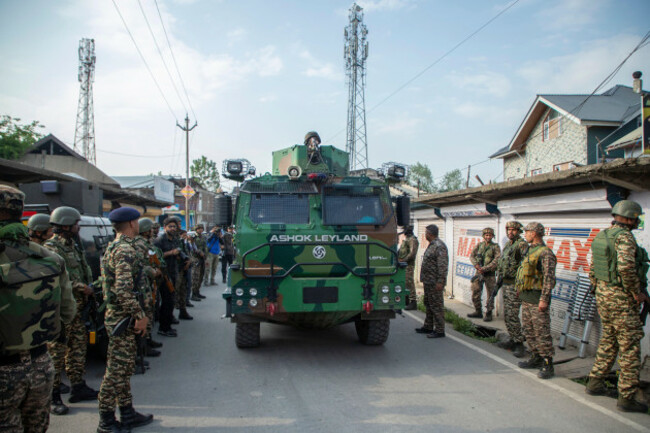
srinagar-jammu-and-kashmir-india-8th-may-2025-indian-paramilitary-soldiers-cordon-off-the-area-after-an-unknown-aircraft-crushed-in-wuyan-near-indian-administered-kashmirs-main-city-of-srinagar Indian paramilitary soldiers cordon off the area after an unknown aircraft crushed in Wuyan near Indian-administered Kashmir's main city of Srinagar. Alamy Stock Photo Alamy Stock Photo

Tensions have soared between the nuclear-armed neighbours since the attack, which India has blamed Pakistan for backing. Islamabad has denied the accusation.

Pakistan’s Prime Minister Shehbaz Sharif condemned Wednesday’s airstrikes and said the “deceitful enemy has carried out cowardly attacks” and that his country would retaliate.

“Pakistan has every right to give a robust response to this act of war imposed by India, and a strong response is indeed being given,” Sharif said.

Sharif has convened a meeting of the National Security Committee for Wednesday morning.

The missiles hit six locations in Pakistan-administered Kashmir and in the country’s eastern Punjab province, said Pakistan’s military spokesperson.

India’s Defence Ministry said the strikes targeted at least nine sites “where terrorist attacks against India have been planned”.

“Our actions have been focused, measured and non-escalatory in nature. No Pakistan military facilities have been targeted,” the statement said, adding that “India has demonstrated considerable restraint”.

The mosque in Bahawalpur is adjacent to a seminary that once served as the central office of Jaish-e-Mohammed, a militant group outlawed in 2002.

Officials say the group has had no operational presence at the site since the ban. Another missile hit a mosque in Muridke, damaging its structure.

A sprawling building located nearby served as the headquarters of Lashkar-e-Taiba until 2013, when Pakistan banned the group and arrested its founder.

The attack in Kashmir was claimed by a previously unknown group calling itself Kashmir Resistance.

Along the Line of Control, which divides the disputed region of Kashmir between India and Pakistan, there were heavy exchanges of fire.

The Indian army said seven civilians were killed and 30 wounded in Poonch district when Pakistani troops “resorted to arbitrary firing”, including gunfire and artillery shelling, across the Line of Control and their international border.

It said it was “responding in a proportionate manner”. Shortly after India’s strikes, aircraft fell in two villages in India-controlled Kashmir.

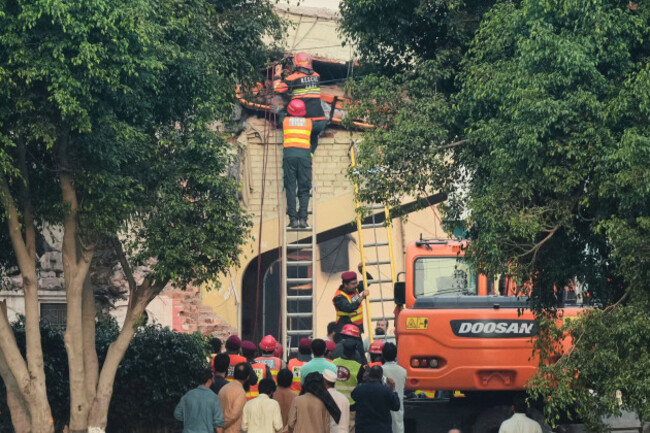
rescue-workers-recover-a-body-from-a-damaged-building-at-the-site-of-a-suspected-indian-missile-attack-in-muridke-a-town-in-pakistans-punjab-province-wednesday-may-7-2025-ap-photok-m-chaudar Rescue workers recover a body from a damaged building at the site of a suspected Indian missile attack, in Muridke, a town in Pakistan's Punjab province. Alamy Stock Photo Alamy Stock Photo

State-run Pakistan Television, quoting security officials, said the country’s air force shot down five Indian jets in retaliation but provided no additional detail.

There was no immediate comment from India about Pakistan’s claim.

Pakistan’s Foreign Affairs Ministry has said Indian forces had launched the strikes from inside Indian airspace.

The debris of plane parts were scattered across a village in the outskirts of the region’s main city, including in a school and a mosque compound, according to Srinagar police and residents.

United Nations spokesman Stephane Dujarric said in a statement late on Tuesday that Secretary-General Antonio Guterres called for maximum military restraint from both countries.

“The world cannot afford a military confrontation between India and Pakistan,” the statement read. Indian politicians from different political parties lauded the strikes.

“Victory to Mother India,” India’s defence minister, Rajnath Singh, wrote on X. India’s main opposition Congress party called for national unity and said it was “extremely proud” of the country’s army.

“We applaud their resolute resolve and courage,” Congress party president Mallikarjun Kharge said. Pakistan said India’s strikes posed a significant threat to commercial air traffic.

“This reckless escalation has brought the two nuclear-armed states closer to a major conflict,” the statement said.

Meanwhile, authorities in Indian-controlled Kashmir shut Srinagar city’s airport for civilian flights following directions from the Indian air force, senior airport official said Javed Anjum said.

Authorities in Indian-controlled Kashmir also closed all schools and other educational institutions in at least seven border areas and the area around Srinagar airport, officials said.

International response

France has called on India and Pakistan to show restraint as the worst violence in two decades flared between the two nuclear-armed neighbours.

“We understand India’s desire to protect itself against the scourge of terrorism, but we obviously call on both India and Pakistan to exercise restraint to avoid escalation and, of course, to protect civilians,” Foreign Minister Jean-Noel Barrot, said in an interview on TF1 television.

“I don’t think anyone has an interest in a lasting confrontation between India and Pakistan,” he said, adding that he would be speaking with his counterparts in India and Pakistan.

The UK is ready to support both India and Pakistan to de-escalate tensions, Trade Secretary Jonathan Reynolds said this morning.

“Our message would be that we are a friend, a partner to both countries. We stand ready to support both countries. Both have a huge interest in regional stability, in dialogue, in de-escalation and anything we can do to support that, we are here and willing to do,” he told BBC radio.

China, which shares land borders with both countries and is a close ally of Pakistan, said it expressed “regret over India’s military action this morning” and said it was “concerned about the current developments”.

“India and Pakistan are neighbours that cannot be moved apart, and they are also China’s neighbours,” a foreign ministry spokesperson said in a statement.

“China opposes all forms of terrorism,” they said. “We call on both India and Pakistan to prioritise peace and stability, remain calm and restrained and avoid taking actions that further complicate the situation,” the spokesperson added.

At a briefing today, Beijing also offered to play a mediating role in reducing tensions.

“We are willing to work together with the international community and continue to play a constructive role in easing the current tensions,” foreign ministry spokesman Lin Jian said. Russia has also called on both countries to exercise “restraint”.

Im Ireland, Sinn Féin’s spokesperson on foreign affairs, TD Donnchadh O’Laoghaire, said that the situation was “extremely worrying”.

“We are concerned at the escalation and the potential for further escalation as we see attacks between India and Pakistan today. This further raises concern that this could lead to a series of retaliations and escalations.

“It is crucial that the United States, the European Union and the United Nations use every leverage possible to bring India and Pakistan to a position of dialogue, discussion and de-escalation.”

He said that the Irish government must use its voice at the UN level to “push for dialogue” and attempt to make its position on the conflict known.

Additional reporting by Keith Kelly, Press Association and AFP.

Readers like you are keeping these stories free for everyone...
A mix of advertising and supporting contributions helps keep paywalls away from valuable information like this article. Over 5,000 readers like you have already stepped up and support us with a monthly payment or a once-off donation.

Close
JournalTv
News in 60 seconds