We need your help now

Support from readers like you keeps The Journal open.

You are visiting us because we have something you value. Independent, unbiased news that tells the truth. Advertising revenue goes some way to support our mission, but this year it has not been enough.

If you've seen value in our reporting, please contribute what you can, so we can continue to produce accurate and meaningful journalism. For everyone who needs it.

Around one in three hate incidents reported to gardaí are racially motivated

Anti-race hate crimes and incidents have risen by almost a quarter in just three years, according to data analysed by The Journal Investigates.

MORE THAN ONE in three hate attacks and incidents recorded by gardaí last year were racially motivated, analysis by The Journal Investigates reveals.

According to official data, the number of anti-race crimes and related incidents has risen by 24% since 2021 – making it the single most common motive for hate crime in Ireland.

Of the 676 hate crimes and reports recorded last year, around 264 (39%) were connected to race, according to An Garda Síochána.

That’s an increase from 213 recorded in 2021, when a total of 483 hate crimes and “discriminatory” incidents were logged – a 24% rise in just three years.

Collated via the gardaí PULSE system, hate crime or hate-related incident reports are  recorded with a specific discriminatory motive tag based on the victim’s or reporting party’s perception.

The rise comes against a backdrop of recent racist violence, with several high-profile attacks sparking alarm across the country.

Experts and trade union leaders have warned current hate crime legislation is not enough to tackle racism alone, and called for government action to tackle the scourge.

“It [racism] has got more aggressive, more obvious and more brazen,” Dr James Carr, associate professor of sociology at the University of Limerick, told The Journal Investigates.

“People are emboldened to take racist positions and ask questions that are dog whistles for racism, and there has been a failure to date to deal with this.”

Investigations like this don’t happen without your support… Impactful investigative reporting is powered by people like you.

‘A complete underestimation’

This year alone, a wave of high-profile racist assaults have taken place across the country, some of which have been documented and posted on social media.

In one widely condemned attack, a man in his 40s was viciously attacked by youths in the Tallaght area of Dublin.

The Indian national was falsely accused of inappropriate behaviour before being stripped of his clothing.

A video, taken by passers-by in the minutes after the July assault, showed the injured and half-clothed man walking helplessly through a residential area.

Less than a month later, Indian nurse Anupa Achuthan described how her six-year-old daughter Nia was physically assaulted and abused with racist slurs outside their Co Waterford home.

The attackers, believed to be aged between 11 and 13, told the child to “go back to India”.

Around the same time, a man seriously assaulted in Galway told RTÉ Prime Time he believed the attack was fuelled by misinformation and rising hostility towards migrants.

A garda spokesperson told The Journal Investigates that investigations are ongoing into the incidents.

The spike in violence directly led to the Indian embassy in Dublin issuing safety advice to its country’s citizens living in Ireland.

Carr, who has carried out in-depth research into Islamophobia and racism in Ireland, said the high-profile attacks are “the tip of the iceberg” when it comes to the true scale of the problem.

“I would say that the figures recorded by gardaí are a complete underestimation of what’s going on,” he said.

“We have, hopefully, more people reporting the incidents, because they feel something might happen.

“That’s a good thing, but it’s still reflective of an underreporting that’s out there in terms of racism as well.”

Screenshot 2025-09-10 at 11.27.55 Anupa Achuthan is pictured with her husband Naveen K.S and their children Nia and Nihan.

Carr described the “double-edged sword” of rising numbers, noting that while more victims may feel empowered to report, many continue to suffer in silence.

“Essentially what people do is they tolerate the racism, which, for me, as somebody working in the area, is horrible.

Because people are dealing with this as part of their daily lives.

“They’re getting up, and they’re experiencing it at work, on the way to work, when delivering care services, and in our State institutions. That’s the reality of it.”

Racially abused on the frontline

Healthcare staff and other frontline workers are among those most exposed to racism in Ireland.

Phil Ní Sheaghdha, president of the Irish Congress of Trade Unions (ICTU) and general secretary of the Irish Nurses and Midwives Organisation (INMO), said members are increasingly reporting incidents of abuse and attacks.

“Our members’ experiences indicate that the government’s response to racially motivated abuse and attacks is not keeping pace with the increase in anti-social behaviour and abuse,” she told The Journal Investigates.

Ní Sheaghdha said migrant healthcare workers, many of whom work night and weekend shifts, face particular risks.

She called on the Minister for Justice to introduce “effective and practical solutions” to protect workers, including the introduction of dedicated transport police to assist those travelling to and from work.

“The individual impact on our members’ wellbeing cannot be underestimated, and discrimination must not be tolerated for any reason,” she said.

The Journal Investigates asked the Department of Justice, which oversees hate crime legislation, about the increase in racist incidents and how it plans to respond to concerns for safety.

In response, it said the Justice Minister is “determined to stamp out hate-motivated crimes and to protect vulnerable communities”. 

“Ireland is, in general, a diverse and welcoming country, but regrettably there is a small minority who subject others to abuse or attack resulting from their own prejudice,” a spokesperson said.

The department added that incitement to hatred legislation has been in place for 36 years, and remains in force.

“The Government has committed to introducing amendments to modernise the 1989 Act, particularly in the context of modern online communications,” the spokesperson added.

The ICTU chief also stressed the vital role migrant workers play in Ireland’s health system.

“Of the new registrants in nursing and midwifery in 2024, more than 75% came from outside the EU, and every single one of these professionals was badly needed in our understaffed health service,” she said.

“The government must actively demonstrate to these professionals that they are valued members of our society, and that they will be protected and supported to continue building rewarding lives and careers in Ireland.”

image5 INMO General Secretary Phil Ní Sheaghdha speaking to protesters outside the Dail during a housing protest. Rollingnews.ie Rollingnews.ie

Online hate and offline violence

According to official garda data, anti-race has remained the “most prevalent discriminatory motive” for hate crime and related “non-crime” incidents in 2024.

It accounted for 39% of all motives – an increase from 36% the year previous. Anti-nationality increased to a quarter of all motives, compared to 18% in 2023, An Garda Síochána said.

Overall, the total number of hate crimes and reported incidents has increased year-on-year since 2021, rising from 483 reports to 676 in just three years.

In June, research published by the Central Statistics Office (CSO) revealed that half of those from a Black Irish/Black African/other Black background had “experienced discrimination of some form in the previous two years”.

The CSO said this was compared to just one in five respondents who identified as White Irish.

The EU’s Fundamental Rights Agency also found that Black children in Ireland face some of the highest levels of racist bullying and assault in Europe.

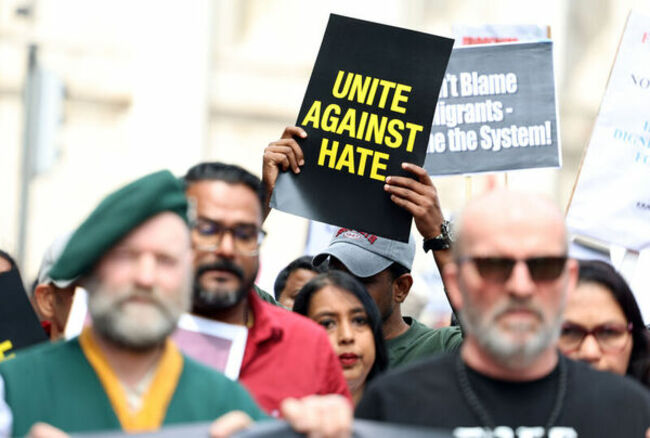
image2 Protesters hold placards as they march to the Dail to protest against a brutal assault on an Indian national in Tallaght, Dublin. Leah Farrell / RollingNews.ie Leah Farrell / RollingNews.ie / RollingNews.ie

The limits of hate crime law

Asked about the connection between online abuse and real-world discrimination and attacks, Carr described the link as “massive”.

In 2024, new hate crime legislation was passed by the State, a move that was widely welcomed by campaigners.

However, the final version of the legislation omitted hate speech provisions that had initially been proposed.

For Carr, this was a missed opportunity. “Hate crime is only one element of racism, and it’s important that we have that. But the hate speech element fell off. That’s something we should be challenging,” he said.

He said dehumanising language is often the first step on a pathway that can escalate into more serious harm.

“If you look at the old models, the psychological models about how racism can progress, it often starts with those comments that dehumanise people, and take that away.”

However, the academic argued that while laws matter, they cannot fully address the problem.

“We all have to pull together on it,” he said. “It’s important that we think about it in that sort of structural way, that systemic way.”

image4 Dr James Carr, Associate Professor of Sociology at the University of Limerick. Dr James Carr Dr James Carr

Deeper change needed

Carr stressed the importance of recognising the State’s history and the ways discrimination becomes embedded across generations.

“We’re brought up in a society that has the experience of anti-Traveller racism, and then we see racisms in their various forms manifest against different communities.”

However, he pointed to the National Action Plan Against Racism (NAPAR), which he hopes with implementation, will bring about change.

“For the State to take a stance against racism, meaningful change must happen beyond the sort of the tokenistic stuff around,” he said.

“A deeper change is what we really need, and that means we need to think about it beyond the incident, whether it’s a hate crime or an experience of discrimination.

“We need to support the people who are targeted, but we also need to take that broader society approach.”

In a statement, the Department of Justice said that as well as the NAPAR,  the Programme for Government 2025 provides a “commitment to developing a new Migration and Integration Strategy for Ireland”

A spokesperson said: “As part of the work to develop the new strategy, a public and targeted consultation on migration integration has been conducted.”

The Journal Investigates

Reporter: Patricia Devlin • Editor: Maria Delaney • Video Editor: Nicky Ryan • Social Media: Cliodhna Travers • Main Image Design: Lorcan O’Reilly 

Need more clarity and context on how migration is being discussed in Ireland? Check out our FactCheck Knowledge Bank for essential reads and guides to finding good information online.

Investigations like this don’t happen without your support...
Impactful investigative reporting is powered by people like you. Over 5,000 readers have already supported our mission with a monthly or one-off payment. Join them here:

Close
JournalTv
News in 60 seconds