TheJournal.ie uses cookies. By continuing to browse this site you are agreeing to our use of cookies. Click here to find out more »
Dublin: 19 °C Wednesday 19 June, 2013

Column: We won’t stop marching until the ECB returns Ireland’s money

Amid a national near-silence, the residents of Ballyhea in Cork protest against the bondholder bailout every single week. Diarmuid O’Flynn explains why he leads the march.

Diarmuid O'Flynn

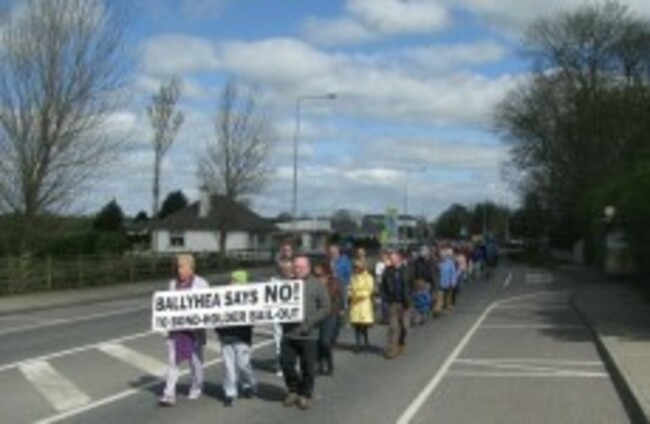
ON SUNDAY MARCH 6 2011, the weekend after the General Election, 18 of us took the first steps in this protest, in Ballyhea.

Enda Kenny hadn’t even begun to form his coalition government with the Labour Party but already he was reneging on one of Fine Gael’s most fundamental election promises, that there would be burden-sharing with the bank bondholders (apparently we hadn’t read the small print). It was time for direct action.

A few months later we were joined by Charleville and every Sunday since then, at 11.30am, alternating between Ballyhea and Charleville, we march. (Details of the next march are on Facebook here.)

It’s single issue – end the bank bondholder bailout. The ECB are the ones who dictated that all of Ireland’s banks – through us, the Irish people – should pay all their bonds in full, coupon and all; the ECB should now pick up that tab. Those were private interbank deals between consenting adults who trade on the risk/reward principle that underpins capitalism. In insisting that those failed bonds in failed banks be paid, the ECB undermined capitalism. (Or perhaps, as with us and the Fine Gael election promises, the mandarins in the ECB simply didn’t read the small print that accompanies such bonds: ‘Warning, your investment can fall as well as rise’.)

In September 2008, acting under misinformation, the true bank debts grossly understated, Brian Lenihan gave a blanket bank guarantee. The value to the banks of that guarantee?

  • Bond payments September 2008 to April 2012: €103.7bn
  • Bond payments April 2012 onwards: €40.6bn
  • Total bond payments (according to Michael Noonan): €144.3bn

Up to April 2012, again according to Mr Noonan, the bank recapitalisation – what we’ve put into the banks, mainly to enable them keep paying these bonds – is €62.8bn (Anglo/INBS €34.7bn; AIB/EBS €20.7bn; BoI €4.7bn; IL&P €2.7bn). That figure has since increased to €69.7bn, with an additional €5.6bn contributed from NAMA to the banks, and an extra €1.3bn pumped into IL&P.

Given that according to Mr Noonan himself those banks still have over €40bn to pay (we reckon the figure is closer to €55bn), there is a good possibility we will have to recapitalise again. Also, the above figure does NOT include interest lost on the money taken from the National Pension Reserve Fund, nor the interest we’ll have to pay on the borrowings needed to fund all that recapitalisation.

Human cost

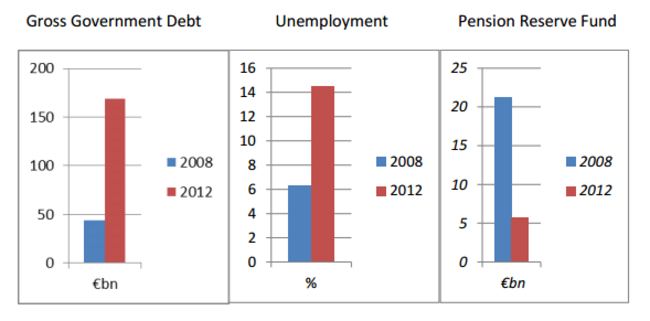
We were told all this was done for our benefit, that we had to ‘rescue’ our banks or our world would implode. Check the second table below – four years on from 2008 our debt has quadrupled, our unemployment has doubled, emigration is back with a bang, services cut back, our deficit is STILL there. The real cost though, in human misery and suffering – who has a measure for that?

Our banks are still there, all six of them (there have been amalgamations but no winding up), still functioning – but only if you’re a bondholder. They’re not lending to business but they are paying their bonds, with our money, sucking the lifeblood from our economy, the ECB-mandated transfusion to foreign banks.

As outlined above we have so far paid €69.7bn, there are (or will be) billions more in lost interest (NPRF), billions more again in accruing interest (loans from ECB to pay those billions), and yet more billions (probably) in further recapitalising if we stay on the current track. (You really think the six remaining banks can pay €55bn in bonds in four years? Oh, they’ll be back for more!)

Put all that money together, then ask yourself – what kind of lunacy is this? The moral issue aside (and believe me, when it comes to money the ECB has no problem brushing moral issues aside), what kind of government accepts a deal that imposes that entire debt burden on its people just to enable it borrow cheap money, much of which goes to paying that additional debt anyway?

TABLE 1: The bonds

(Michael Noonan says €40.6billion yet to pay; we say €55billion)

  • €109.7bn Bank Bond payments September 2008 to June 30 2012
  • €39.9bn Bank Bond payments June 30 2012 to end 2015
  • €149.6bn Total bank bond payments, September 2008 to December 2015
  • €44bn Possible future exposure (per Namawinelake)
  • €69.7bn Bank recapitalisation to date – what we’ve paid
  • €15,213 Individual bailout cost to date for every Irish resident

TABLE 2: The damage to our economy to date

Economy Charts

I say the damage to our economy ‘to date’ very deliberately, because with that bank debt now accumulating interest at an alarming rate, this is set to get a lot worse.

A couple of weeks ago Enda Kenny came back from a summit of the eurozone leaders trumpeting a seismic breakthrough (Mount Enda erupts) – he had negotiated on behalf of Ireland. Typical Enda; first, claiming credit where he was due none (he and Michael Noonan made similar claims in the aftermath of the interest rate reduction granted to Ireland as a direct result only of the Greek bailout negotiations); second, exaggerating what had in fact been agreed.

In the first place the breakthrough was due only to the fact that the Prime Ministers of Italy and Spain stood up to Angela Merkel and flatly stated, ‘No!’. Unlike what had been agreed to by Ireland’s negotiators in the past, they would not tolerate the bank bailouts in their countries being put through the sovereign books.

In the second place, what was agreed by the eurozone leaders was all notional. “We affirm that it is imperative to break the vicious circle between banks and sovereign” they said. “The Eurogroup will examine the situation of the Irish financial sector with the view of further improving the sustainability of the well-performing adjustment programme,” they added. Then, significantly: “Similar cases will be treated equally.”

Let no-one be under any illusion – we still have a major battle on our hands. The eurozone leaders have acknowledged that the policy forced on Ireland by the ECB was wrong. We must now fight to have returned to us, by the same ECB, the money they have forced us to pay out in pursuance of their failed policy.

Until such time as that has happened, in Ballyhea and in Charleville we will continue to march, every Sunday.

Diarmuid O’Flynn is a spokesperson for the Ballyhea bondholder bailout protest. You can follow the protest on Twitter at @ballyhea14; on Facebook; or through the blogs The Chattering Magpie and Bondwatch Ireland.

  • Share on Facebook
  • Email this article
  •  

Read next:

Comments (49 Comments)

  • Fight back and support the Anti household charge campaign 52% still not paying’ united we can win this fight your 100 euro is going straight into a German bank.

    Reply
    • The Household Charge/Tax is simply a foot in the door, will very quickly jump from €100/yr to upwards of €1,000/yr for an average house; this will have the very real effect (and I saw this in the USA) of forcing people from their own homes because they can no longer afford the tax.
      If we didn’t have the bank debt on top of our sovereign debt we wouldn’t need any of these measures. The anti-Houshold Charge movement is necessary but that is just a branch of the bloody big tree that overshadows us all, and at the root of that tree is the bank bailout, not just here but world-wide.
      THAT should be our first protest, our major protest, the bank bondholder bailout. At some stage, after our media stop being government propagandists and start doing their job on behalf of the people, the penny will drop here. Meanwhile we in Ballyhea and Charleville will continue our lonely protest.

      Reply
  • Fair play to them, first I heard of this, should be plenty more like it!

    Reply
  • Great to see such spirit alive and well in Ireland.

    Reply
    • Alive and well??? as far as I can tell these people are the only ones out marching about this, even if you include the whole population of these two areas then you’re still only talking about four thousand people. Based on the last Census figures for the population of Ireland, if you presume everyone in these two areas are marching then that works out at around 0.087% of the population marching for this very important cause. Hardly alive and well is it? The rest of the country should join them.

      Reply
    • Far from thousands. I live near by and come across them from time to time . Normal bout 10 ish ppl at tops with a lot of kids that have be dragged along

      Reply
    • Paul- I agree. Hopefully people will get off sites like this and go out onto the street. I am going to the protest today, and hopefully there will be a good turn out. I hope to see you there…

      Reply
  • It shoud be happening on the streets of all our major cities…and not only to have our money returned but to have our complete political system and mindset completely changed. As long as we accept incompetance we’ll get incompetance. Politicans in this country care about one thing only…de seat in de Dawl…however we are now seeing these guys for what they are and every word from Enda (scripted or not) is to be disbelieved. Keep protesting and let the rest of us take from their example.

    Reply
  • Fair play to Ballyhey!

    Doing more for Ireland’s interests than the govt themselves

    Reply
  • @ Paudy O’Brien – Not just a narrow and idiotic comment but untrue – proof here, a short video of our last three marches. http://www.youtube.com/watch?v=AZ9hzWqNX1s

    Even if what you said were true (only 10 people, kids being ‘dragged’ along, which I assure you, they’re not) our protest would have no less purchase – it would have more, if anything, to keep marching if we were getting no support whatsoever. But I’ve done a little exercise here, gone through all those from the parish who have marched with us at some stage or other over the last 16 months and it comes to over 200 – not bad in a parish with a population of around 1,000.

    I invite you now Paudy to come and talk to me, either at my place, where you’re welcome to a coffee, or this coming Sunday in Charleville (we alternate the veune – Ballyhea on Sunday week), 11.30am at the Library Plaza. Meet the people you’re insulting, tell us why you feel the need to do so, and perhaps hear what we have to say.

    Regards, Diarmuid O’Flynn.

    Reply
    • Diarmuid

      I can only applaud your & your community’s efforts in Ballyhea & Charleville.

      As you realise, what is happening is entirely wrong & counter to the interests of the majority ordinary people in Ireland (& elsewhere, especially in the Euro countries).

      It is not just policy decisions that are wrong but the Euro system itself and the very basis of macro & monetary economics thinking, as taught in Universities & offered as ‘advice’ by the entire mainstream of macro economists, including those working in Ireland.

      This is not a new phenomena. It has been developing & consolidating for over 30 years. It has been driven by ideological bias & ignorance from politicians & the vast financial power of the self-interested Financial Sector. It is the latter in fact where most economists work, so we should perhaps not be surprised as to their bias.

      But academe has also ruthlessly rooted out any challenges to the flawed orthodoxy of neo-liberal/neo-classical thinking, at least in the mainstream. We are living thru’ the results.

      The proof of this intellectual bankruptcy & bigotry lies in the fact that not one of the mainstream economic forecasting & modelling institutions (or mainstream economists) foresaw the crisis even mere weeks before the banking system began crashing. They employ many hundreds of economists & vast computing power. Despite such a massive failure & the crisis in the economy actually worsening in the Eurozone, the same flawed thinking prevails.

      Of course, the aggregate wealth of the top few percent has continued to grow even throughout the recession that impoverishes the rest of us. As you have realised, it is precisely this group, thru’ variously ignorance & self-interest, that political leaders have really represented, not us.

      It really is that bad, and more profoundly, it need not be this way at all for any fundamental macro economic or monetary system reasons.

      I have been studying the long standing work of those economists who +did+ see the crisis coming, predicted it correctly, & had a thoroughly developed methodology for doing so. I am in no doubt whatever that there are in fact ‘answers’ & diametrically better alternative policies that could be adopted to quickly recover our economies, solve unemployment & create a far more stable economy for all of us.

      I’m not too far away from North Cork. It’s been on my mind to come and join your protest one day, in solidarity.

      But I can do much better than that. If you & your group would like a talk on the macro economics & monetary policy that can solve the crisis (& explain why it continues), I would be happy to do so. Send a private message thru’ my facebook page if you would like this.

      Reply
    • Thank you Mike, we’ll take you up on that offer.

      Reply
  • you wont see this on rte…well done lads

    Reply
  • Saw the bloke on Vincent Browne. A true patriot and man of the people, we need a lot more like him.

    Reply
  • Bondholders took risks and invested without due diligence. If we did the same we would be pursued to the grave by the banks who lent the money. However when you are a senior Bondholders in a failed bank the citizenry pays for your failed investment. How sweet a deal is that. Denmark liquidated it’s insolvent banks, not in a bailout and still borrowing at low cost. We pay for German and
    French banks mistakes and guess what we are in a bailout.
    Where is the risk at the heart of this for capital. Liquidate the insolvent banks. Set up a new state owned bank and sell it once running and end this farce of paying people to make bad investments.

    Reply
  • An excellent article by Diarmuid Flynn outlining the campaign that has started. From small beginings the campaign has gathered some notable backers and has garnered much international coverage. the premise of the original campaign (stoping the payments to the bondholders ) has passed as most of the relevant bonds have been repaid at this point but there is still a valid point to be be made that Ireland should be recognised for doing what it did and that the current policy evolving of bond holders being burned to be retroactively allowed to Ireland be carried through. While it is unlikely that we will ever see all of the €100billion back a measure that would be useful would be the setting aside of the prom notes in total as opposed to a renogiation of rates and terms. Such a set aside would require a change in policy in the ECB to allow for a permanent increase in the money supply (the current prom notes and the ECB LTRO operations are only temporary increases insofar as the money has to be given back and is then “retired”). While the ECB have seemed reluctant to change policy maybe what we have seen this week is the first sign of a change and maybe just maybe the ECB might decide to increase the money supply as a means to acheive the application of the bondholder burning retroactively.

    Reply
    • Agree with you up to a point Sean about a lot of the damage having already been done to Ireland, the €69.6bn we’ve been forced to pump into the mostly rotting banking system, but in the four years 2012 to 2015 (inclusive) our banks will pay €55bn in bonds, that’s an average of €13.7bn/yr – this is STILL a very relevant issue. Granted, much of that €55bn falls now into the ‘guaranteed’ category but I would argue that those guarantees were given originally on false information, subsequently under duress.

      Agree totally with your take on the Promissory Notes – those should now be torn up. That €30.6bn was ENTIRELY to bail out two rotten banks and their failed bondholders (I don’t demonise those bondholders, by the way, they do what they do, should simply be made to suffer their own pain, as is the normal practice), WAS done under duress – the ECB should now write it off, accept it as a form of Quantitative Easing,

      The balance, the money taken from the Pension Reserve Fund, the money borrowed from the ECB, the interest lost and paid, ALL that money we should fight like dogs to get back, because NONE of it should have been paid. Any money thus returned I would see as merely justice being served, any money NOT returned I would see as money lost.

      Reply
    • Diarmuid, being realistic and I know I am splitting hairs here on a technical and boring subject I do not think in our wildest dreams that the ECB will give us everything back that we have paid into the banks regardless of the cirumstances under which the money was advanced first day to the institutions. The prom note issue outlined above is one way that it might happen but for us to arrive at that point it will need the ECB at least to really push the envelope on the evolving policy on granting retroactive releif to Ireland. Bankers are by nature conservative so that may be a push or to adopt a seperate limited QE policy to write off the prom notes. It would certainly be a great result. Up to the weekend comments by Draghi the best that seemed to be on offer was extending extenting the term/reducing the interest rate, so there is a chink of light there to really get a write down/off of the prom notes whether it can be exploited remains to be seen.

      The bonds payable up to 2015 would appear to not be covered by the current evolving policy as that seems to cover banks that are not of systemic importance. While IBRC is now only a run off vehicle and therefore not of systemic importance the same could not be said for the other albeit zombie banks so while with some twists and turns the evolving policy might be appled to the prom notes for IBRC it is probably a step too far policy wise at this point to apply it to the other banks thats not to say that as things evolve that the policy position might change but unfortunately as with much of this crisis any changes will be largely out of our hands. However, there is nothing to be lost by highlighting it as if it does to to pass then there is better chance to be included in the policy change.

      While it would be great to get all the money back realistically while now it is the sovereign (and us by extension) that are taking the pain a position where the pain is shared around is far better, I really don’t think we are ever going to get all of that money back, Even if we did we still have fundamental problems to deal with but that is in the words of a Winnie the Pooh story ” A completely different story for a completely different time”

      Reply
  • Some of the poor bondholders we are bailing out, €100b in total is €55,555 per working person plus interest:

    Allianz:Revenue €106.451 billion (2010)[1] Operating income €8.243 billion (2010)[1] Profit €5.053 billion (2010)[1] Total assets €624.95 billion (end 2010)[1] Total equity €46.56 billion (end 2010)[1]

    Axa:Revenue €86.107 billion (2011)Earnings Presentations Profit €4.324 billion (2011)Earnings Presentations AUM €1.103 trillion (2010)[1] Total assets €731.65 billion (end 2010)[1] Total equity €49.70 billion (end 2010)[1]

    Baloise Asset Management:Revenue CHF 9.485 billion (2010)[1] Operating income CHF 607.2 million (2010)[1] Profit CHF 433.4 million (2010)[1] Total assets CHF 65.39 billion (end 2010)[1] Total equity CHF 4.134 billion (end 2010)[1]

    Safra owns Banc Sarasin and is worth…The Group controls about 71.5 billion in assets of which 36.9 are client assets and it has 6.3 billion stockholders’ equity.[5][6]

    Barclays: Revenue £32.29 billion (2011)[1] Operating income £26.69 billion (2011)[1] Net income £3.95 billion (2011)[1] Total assets £1,564 billion (2011)[1] Total equity £55.6 billion (2011)[1]
    BBVA: Revenue €20.91 billion (2010)[1] Operating income €11.94 billion (2010)[1] Profit €4.606 billion (2010)[1] Total assets €552.7 billion (end 2010)[1] Total equity €37.48 billion (end 2010)[1]

    Goldman Sachs:Revenue US$ 28.811 billion (2011)[1] Operating income US$ 6.169 billion (2011)[1] Net income US$ 4.442 billion (2011)[1] Total assets US$ 923 billion (2011)[1] Total equity US$ 72.708 billion (2011)[1]

    BNP Parabas: Revenue €43.88 billion (2010)[1] Operating income €12.56 billion (2010)[1] Profit €7.843 billion (2010)[1] Total assets €1.998 trillion (end 2010)[1] Total equity €85.63 billion (end 2010)[1

    BrownShipley & co a subsidary of KBC worth: Revenue €8.378 billion (2010)[1] Profit €1.860 billion (2010)[1] AUM €208.81 billion (end 2010)[1] Total assets €320.82 billion (end 2010)[1] Total equity €18.67 billion (end 2010)[1]

    CNP Assurances:Revenue €44.79 billion (2010)[1] Operating income €1.425 billion (2010)[1] Profit €1.050 billion (2010)[1] Total assets €319.61 billion (end 2010)[1] Total equity €13.18 billion (end 2010)[1]

    Credit Suisse:Revenue CHF 25.43 billion (2011)[1] Profit CHF 1.95 billion (2011)[1] Total assets CHF 1.229 trillion (end 2011)[1] Total equity CHF 27.02 billion (end 2011)[1]

    DWS Investments is the largest investment trust company in Germany and manages €288 billion fund assets
    it is also one of the 10 largest investment trust companies in the world.

    European Credit Management Limited (ECM) is an independent asset management company specialising in European credit. Founded in February 1999, ECM manages assets worth over £11.5 b.

    HSBC: Revenue US$ 105.804 billion (2011)[7] Operating income US$ 45.215 billion (2011)[7] Profit US$ 17.944 billion (2011)[7] Total assets US$ 2.555 trillion (2011)[7] Total equity US$ 158.725 billion (2011)[7]

    ING Group:revenue €54.43 billion (2010)[2] Profit €3.220 billion (2010)[2] Total assets €1.247 trillion (end 2010)[2] Total equity €47.28 billion (end 2010)[2]

    LBBW: Revenue $21 billion (2010)

    Lombard Odier: is the oldest firm of private bankers in Geneva and one of the largest in Switzerland and Europe.
    AUM CHF 145 billion

    Nordea: Revenue €9.334 billion (2010)[1] Operating income €3.639 billion (2010)[1] Net income €2.657 billion (2010)[1] AUM €191.0 billion (2010)[1] Total assets €580.8 billion (end 2010)[

    Pioneer Investments: Revenue $312.4 Billion assets under management USD (2007)

    Royal London Asset Management: £45 billion assets under management. It is a wholly owned subsidiary of the Royal London Group, the UK’s largest mutual insurance company

    SEB : Revenue SEK 37.69 billion (2011)[1] Operating income SEK 15.35 billion (2011)[1] Profit SEK 11.144 billion (2011)[1] AUM SEK 1.261 trillion (end 2011)[1] Total assets SEK 2.363 trillion (end 2011)[1] Total equity SEK 199.16 billion (end 2011)[1]

    SNS: iNcome €116 million (2009)[1] Total assets €80 billion[1] Dutch bank

    Union Investments: The Union indicated that investment managed by a property about 165 billion euros (assets under management of ’31.12.2009).

    Universal-Investment-Gesellschaft mbH is an investment company based in Frankfurt am Main. With more than 126 billion Euro assets under management, 1,000 institutional funds and private label funds and more than 370 employees Universal-Investment is one of the leading German investment firms[1]. Universal-Investment offers primarily the administration of investment funds and securities for institutional investors.

    Being also one of the leading providers of private label funds in Germany, the company manages 350 such funds with a total volume of 14.5 billion Euro[2]. Private label funds are investment funds, which are launched together with an independent partner who manages and distributes them. Universal-Investment is one of the biggest administration platforms in Germany for institutional investors offering different fund vehicles as SICAV or UCITS. The company also belongs to the biggest providers of Master-Kapitalanlagegesellschaften (Master-KAG) in Germany[3].

    WGZ BANK is one of Germany’s largest banking institutions and the central bank for more than 220 Volksbanken and Raiffeisenbanken member banks in the state of North Rhine-Westphalia.

    Rothschilds are reputed to be worth 500trillion.

    Reply
    • My pension is with Axa, and my dad’s is with Alliance. He is due to retire next year. I’m pretty glad his pension wasn’t ‘burnt’.

      Reply
    • P Wurple, why should it affect your pension..Axa Profit €4.324 billion? i’m glad your pensions are fine but we only have 1.8million people working in this country..€100b to bondholders is €55,555 per working person. Plus the ridiculous amount of money we pay our politicans, some of the highest wages in Europe, also the cost of running the state/welfare education/health etc….not possible.I would rather the Rothchilds and Goldman sachs took the hit then see this country crippled!!!!!!

      Reply
  • I enjoyed the arcticle and like that re-emphasises the fact that we should be not paying back unsecured bonds – it is like going to a bookie and betting on a losing horse – do you get your money back in such a situation.

    I also find it funny that the ECB chose to intervene and hold the guns to our heads – their normal mantra is that they will only shout about inflation.

    Finally this article points to the very important fact that our politicians simply have no balls or negotiation skills whatsoever. So far any sign of a relief (as in “it will be reviewed at some point”, nothing has actually materialised yet) has not been due to them at all, but due to others (Greece, Spain and Italy). They have already received the benefits, whereas the “implications” for our crap deal will be looked at sometime.

    We are being viewed as soft touch / good puppies by the rest of Europe – other countries would have not let it come so far or happen at all.

    With our current leaders we are lost and the outlook is bleak (not that any of the other parties would make much of a different).

    Reply
  • dee 18/07/12 #

    Fair play to them, they appear to be the only ones making much sense these days. Pay attention, Enda – the people of Ballyhea and Charleville are what a spine looks like.

    Reply
  • Well done Diarmuid and Ballyhea. You’re a credit to yourself and Ireland.
    On a related but separate issue: The economist who predicted the 2008 crash predicts another worse crash in the US.
    http://www.moneynews.com/StreetTalk/economy-2008-crash-schiff/2012/06/15/id/442489

    Reply
  • Great work Diarmuid and Co, this is a very good article and thanks must go to the journal for publishing it. Everybody should print this off and give it to non journal users…. It should be published in all good newspapers. Brief, concise, no waffling summation of the last 4 years and you also describe with examples the ability of the FF/FG/Lab governments to bend over to the ECB and there inability in
    negotiating skills which in turn leads to severe punishment to the people on this great island for generations to come. It’s completely wrong what has happened and we need to be compensated…. What a bunch of idiots in charge of this country to let this happen in the first place….. Proves that Irish government think least about the Irish people…..

    Reply
  • Inspiring. This article illustrates perfectly the disconnect between the politicians and the people.

    Reply
  • Fair play to Diarmuid O’Flynn and Ballyhea. It’s good to see people standing up for themselves, and not just tugging the forelock.

    Reply
  • I have been on some, but not enough, of these walks mostly because of a part-time job that takes time on the weekends. However when I do go there I have asked some people to come along and to date I have had ZERO take up on my offer. What I cannot understand though is that FG keep going up in the polls. Are the sheeple of this country so thick? Really?

    Reply
  • Jim, Yes, the people are really that thick, and that is why this country is never going to be great.

    Reply
  • Who do they think the bondholders are? We are the bondholders. It’s our pensions they want to collapse. The levels of financial ignorance in this country are astounding.

    Reply
    • Ah, that ol’ soundbite.

      The list of bondholders has been published. Its a whos who of investors for the wealthy and casino capatilists. These blokes are the reason why pensions have lost so much money over the last few years, not the people making them accept their losses.

      Reply
    • No mostly German and the list is available online

      Reply
    • Even if it was us, whoever it is – they should be burnt.

      Reply
    • Speak for yourself – as written above, you can view the list and the majority is not based in Ireland.

      I too have a company pension fund and it has suffered due to current economic situations world wide, does this mean I am entitled to get money back? Based on my understanding, no as the money I put in is subject to risk.

      Your level of financial ignorance is even more astounding.

      Reply
    • Karl, I’m guessing you are youngish. Was your pension in high risk, or low risk funds? These investments were low-risk funds. Money “In-The-Bank” so to speak, for people at the very end of their careers for the most part, or drawing down from their pension. Go ask your parents or your grandparents if they want their pension wiped out.

      Reply
    • http://bondwatchireland.blogspot.ie/
      The bondholders are listed here but only on a week by week basis and only the next 12 due, the Dirty Dozen (will get around to updating this week’s later today but it’s been a hectic weekend, then two Munster U21 hurling championship semis to cover this week – the day job!).

      ‘We’ are not the bondholders, we are the people; the bondholders are the major financial institutions across Europe, Britain, the USA etc. who look around for places to invest their money. As I understand it, those who control pension funds are usually more restricted in where they can invest – their risk-taking is curtailed. They may have invested originally in our bank’s bonds but most of those funds will have got out of those bonds by now, sold on in the secondary marker where the bottom-feeders live.

      Your contribution to those bondholders so far, P Wurple, if you were one of those resident in this country at the time of the 2011 census, is over €15,000. If you’re happy to do that, God bless you.

      Reply
    • @ P Wurple – throughout the course of a pension fund you are usuallsy given a choice regarding strategy ranging from High to Low Risk. I would also prefer to have something stable to be honest, but this is just how it works (no idea what the status quo will be when I retire one day).

      As you confirm in your own statement, they are low risk i.e. not no risk.

      My grudge is purely against paying back unsecured bonds, as the name clearly states that you are taking a risk – garanteed bonds are a different matter altogether.

      So, no need for the lecture thank you very much – age does not always equal wisdom.

      Reply
    • censored 18/07/12 #

      “The levels of financial ignorance in this country are astounding.”

      Correct. Unfortunately you are not exactly illuminating things with your comment.

      Reply
  • The pensions you say that have lost so much…and the next step would wipe out the remainder Tootrue. Obviously you have only a Social Welfare pension to look forward to!

    Reply
    • Nope, I don’t actually. Plus I had a life assurance policy basically wiped out over the last few years. But I accept it and don’t expect ordinary folk to pick up the tab.

      Jeez Mick, you must get up pretty early in the morning to squeeze being wrong so much into your schedule.

      Reply
  • Are all the people in that picture from the Ballyhea area or are they the usual rent a crowd that follow everything around the country while the rest of us work hard and pay taxes

    Reply
  • As I said in my tweet to u . I must have passed on yer quite days . However I will.admit its been good fee months sense I.seen ye so maybe its picked up .

    Reply

Add New Comment