TheJournal.ie uses cookies. By continuing to browse this site you are agreeing to our use of cookies. Click here to find out more »
Dublin: 16 °C Sunday 19 May, 2013

Column: When is jailing a fraudster no cause to celebrate? When it’s in Ireland.

Our judicial system is selective and incoherent – and judges are so pampered they can’t even open doors for themselves, writes Aaron McKenna.

Aaron McKenna

NORMALLY THE CONVICTION and jailing of a tax fraudster is a cause for celebration, some well-deserved back patting and a national round of “serves him right.” Derek Floyd ripped off the state (and you and me) for €683,138 in VAT repayments he wasn’t owed and was convicted on some 40 counts relating to the fiddling of his returns, which he had pled not guilty to at the outset of his trial in Ennis.

The warm glow of watching a tight git led away to prison was marred on account of the fact that Floyd is suffering a massive injustice. The very same day as Floyd was sentenced the final cost estimate of the Mahon Tribunal was released; some €196 million creamed by the legal profession to turn up the grand and sum total of a sweet nothing in material terms, like the novelty of watching a few corrupt politicians incarcerated.

Poor old Floyd is going to spend the next five years working on his ornithology skills while the Director of Public Prosecutions reads the Mahon Report very… very… slowly.

Floyd is the casualty of a justice system that is selective in who and how it punishes. From violent crimes to petty ones, from fraud to corruption and in sentencing the justice system is an incoherent and expensive one that seems to leave us baffled as to its logic or its probity.

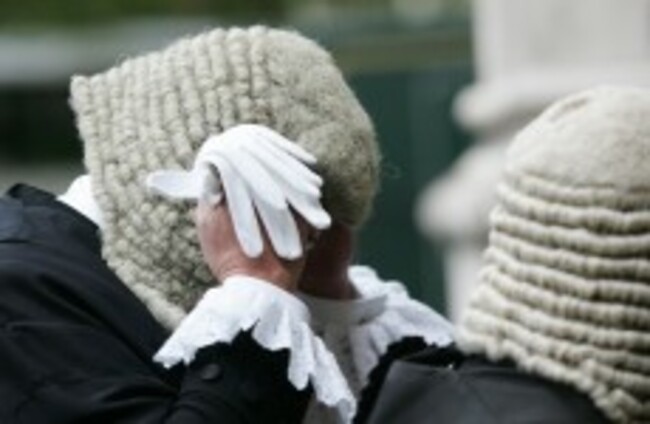
When we think of our legal system we likely conjure images of people in wigs and gowns. It would be great to say that it’s an image lost to time or that the comparisons to the good old days when Britannia ruled the waves ends there. For all the things our legal system can’t seem to do right, like put paedophiles away for more time than it’ll take for their victims to make it to college, it is very good at preserving its traditions.

If you happen to be standing in a courthouse corridor, you may encounter a judge. He (or she – but most likely he) will be preceded by his ‘tipstaff’, a staff member who clears the way in front. As they pass you’ll be expected to stand with your back to the wall and bow your head. This isn’t the court of Louis XIV, remember. This is the modern Irish legal system.

‘They don’t even have to open the door themselves’

Judges are such a pampered race that they don’t even have to open the door to their courtrooms by themselves: They just knock on the inside, and a court official will scurry down and open it for them.

In a nod to our republican breakaway from the monarchical justice system of the UK it’s no longer customary to refer to a judge as “my lord” nor the American “your honour”. A plain old “Yes Judge, No Judge, Three Bags Full Judge” will do should you ever find yourself in front of one and your only reference point is from TV.

Other less sartorial traditions from our time in the Empire have survived. Irish judges were taking the same amount of holidays in the 1800s as they do today: a healthy four months, presumably to allow them time to travel by horse drawn coach to their faraway retreats.

The legal system is steeped in its introverted traditions and is more resistant to change than most of the pillars of our state. The Courts Service is also a bureaucratic nightmare, the gridlock of which is exacerbated by the long meanderings of a legal profession that is billing by the hour. Comparatively poorly paid public servants in the Courts Service do a thankless job, running to and fro with more dead trees in their hands than ought to be seen in the smart economy.

‘You might as well be calling the 1980s’

When you call up an administrative office at our busier courts you might as well be calling the 1980s. The phone will ring and ring until someone picks it up, you’ll ask for a specific individual and they’ll grumble at you for not having their direct extension, and then it’s pot luck to actually get them. Sometimes you can show up to court in the faster moving commercial cases to be told that it has been delayed or otherwise put off, terribly sorry you didn’t get the memo (because we didn’t send it).

Our justice system is a convoluted, outdated and unaccountable leviathan that delivers timely and consistent justice in a distant third place to the activities it is most proficient at: making lots and lots of lawyers rich and maintaining its high status in the socio-economic pecking order.

The legal profession in Ireland is a closed shop; a largely self-regulating industry that jumps around screaming about the demise of democracy that would occur if any of its traditions, methods or – God forbid – fees were to be reformed in any meaningful fashion.

The well cultivated image of distance from the affairs of mere mortals, the aloofness from any human flaws and the influences of politics is just that, an image.

The ranks of the judiciary are stuffed by the government of the day with a good selection of their choice candidates, who by mere circumstantial coincidence happen to have a background rather close to said government. This is the same justice system that, for some darned reason, can’t seem to catch, prosecute and jail many corrupt politicians for their crimes. Odd, isn’t it?

Justice in Ireland is unresponsive to the will of the people to see certain crimes punished more harshly, and some crimes punished at all.

‘We should move to elect certain of our judges’

The current system of government-led appointments to the judiciary and also of the Director of Prosecutions is supposed to allow the justice system to maintain an aloof impartiality. I would say that it simply limits to a select and already powerful group those who can sway our justice system. Instead, we should move to elect certain of our judges and prosecutors and make independent from government the appointment of others.

Thomas Jefferson remarked that “Our judges are as honest as other men and not more so. They have, with others, the same passions for party, for power, and the privilege of their corps. Independence can be trusted nowhere but with the people in mass.” Indeed, Jefferson remarked once that if there was a choice between electing a legislature or judges he would choose the judges, as “the execution of the laws is more important than the making of them.”

Judges and prosecutors should be accountable to the people directly rather than appointed through a mysterious and disconnected process. An elected public prosecutor seeking to keep his or her job would likely be interested in topics such as political corruption, lest they be replaced by someone who is. Elected judges can stand on their record of sentencing those found guilty by juries. Appeals courts can be split 50-50 between elected and independently appointed judges, or even 60-40 in favour of those appointed, to ensure probity of decisions.

Eric Posner, a Professor of Law at the University of Chicago, has studied the impartiality of elected judges and found evidence that, in fact, elected judges “are more productive (meaning they produce more opinions), nearly as professionally respected (as measured by citations per opinion), and no less independent (as measured by their willingness to disagree with judges in their own party).”

The issues round partiality of judges tends to lay on campaign contributions. Ireland has quite strict campaign finance laws, that could be stricter for judicial elections, compared to the US. And if a judge is seen to be partial, they must face the electorate to answer why within a few short years.

Reforming the justice system must be done with caution, but it must happen nonetheless if we are to see justice done more often and to the satisfaction of the people, from whom our constitution is derived and to whom the pillars of our state are responsible.

Aaron McKenna is a businessman and a columnist for TheJournal.ie. You can find out more about him at aaronmckenna.com or follow him on Twitter @aaronmckenna.

Read next:

Comments (45 Comments)

  • I was delighted that Floyd got done, but flabbergasted that his crime was deemed greater than that of the Sean fitzpatricks who are uncomfortably close to power

    Reply
  • What this says is don’t pay your property tax and go to jail, bring down a country and live the high life. What’s the message to criminals, don’t rob corner shops for €50 do the banks for €5m, same risk. In the same way end up in court for no tax or nct but pay a minister for planning concession and even after €200m investigation you get off Scott free and laugh at the peasants in court.

    Reply
  • An online easily accessible record of cases and outcomes would help focus people’s attention on this and drive change.

    Someone in an opinion piece recently pointed out the people now got their news from a smart phone while sitting on the can, which is very true.

    An APP is needed which recounts closed and live cases along with the contact details of the justice minister and all involved. Make it easy to make your views known and shine a light on this legal nonsense.

    Politicians fear most an educated informed and mobilized electorate. It’s the kind of democracy they don’t want but espouse.

    Peace.

    Reply
  • I was at a trial (as a witness:) last Summer. After a little delay we were called in. The judge asked a solicitor how long he expected the case to last, ”An hour, maybe 1 and a half.” Judge said ”No that won’t do. That will cut into lunch time.” The case was postponed for 3 months. Seriously crazy.

    Reply
  • Elected judges.
    In a country where we elect the likes of Jackie Healy Rae to the Dail?
    Are ye mad?

    Reply
  • I think in assessing the propensity of state authorities for being selective in punishing those who are considered ‘well got’ we might have a look back on the saga of the Judge Brian Curtin Case.
    Curtin was a circuit court judge who had been active in Fianna Fail and later the PD’s and for whom he once stood for election to Tralee Town Council. His missus was a solicitor and one time mayor of Tralee.
    All’s going grand with the good judge ’till in 2001 those pesky sods in Interpol went nosing into credit card records for payments to a child porno website in Texas, unearthing some rather notable names in Irish life including our good friend Brian. Of course Interpol – not having the same regard for the niceties of Irish life as, well Irish life – got onto the Guards.Ooops. Now we must also remember that Michael McDowell of the PD’s was Minister for Justice at the time.
    Well with Interpol and what-have-ya knowing all about this, along come the Guards with a search warrant to seize Brian’s computer and find 273 naughty pics on the hard-drive and charged poor auld Brian. Brian gets sick and the case gets delayed but eventually he finds himself sitting in a less familiar part of the courthouse answering awkward questions about his surfing habits when a bright idea struck that the Guards might, just might have been a twincy wincy bit late in executing the search warrant and so our good friend Brian gets off!
    Of course now all hell breaks loose and Brian’s entitled to his job back dispensing justice to the miscreants of the land some who may, giving the habits of some of our clergy for instance, be prone to feeling up youngsters.
    There was a bit of swagger in the Dail about impeaching (sacking) Brian by Michael McDowell but they eventually settled on having an Oireachtas committee to look into the whole matter which, to make a long story short, too about two years till the good judge decided to resign himself after all, just a couple of days after he had completed the five years necessary as a judge – the minimum to allow him qualify for a pension!
    So there we have it justice Irish style…

    Reply
  • Agree with this article 100%. The money-grabbing legal profession is modern Ireland’s greatest scandal.

    Reply
  • Plenty of Law in this country not a lot of Justice…

    Reply
  • A well written article which sums up our judicial policies eloquently. Like politics, when you are in you are in, and we shall protect our own. Four months holiday and a ‘man’ to open the door. If we are going to get our national economics under control, let’s start with the politicians and the legal system please. Grrrr!

    Reply
  • Great article honest & direct. Now can we do something about this problem.

    Reply
  • While I am totally in favour of a complete reform of the legal system I have to put in a good word about my recent experience with the law. In a nutshell I was quoted €15,000 to be defended in a High Court Case. The normal outcome is that the other party would have succeeded because of a technicality. I decided to represent myself and quickly learned the procedures and wrote out a multi-page affidavit. I appeared in The High Court and was met with the utmost respect and patience by the Judge. I was treated very fairly and succeeded in my case. The Judge could not have been fairer and more balanced and carefully explained all nuances of the law. I recommend to anyone who cannot justify or afford professional representation to just prepare well, honestly and appear yourself.

    Reply
  • Mr aron mckenna,the first 3 lines said it all…..very good read…

    Reply
    • A very well written article! However we didn’t learn anything new! Ireland’s still run by the same gang. The elite have it sewn up watertight! People would have to elect a brand new set of politicians outwith the current parties if they wanted any sort of change! As long as we keep electing what we already have the elite will always live by their own laws!

      Reply
    • Have to agree, a very good well written article. But the problem is when we have this elite class who tend to ensure as few riff raff as possible can join their ranks, they have the reins, the power, and they’re not just going to change the rules and hand over that power because we, the people, ask nicely. So if we’ve basically established that the judges and the government have a very close relationship neither side are going to do anything to upset that like changing the laws as Aaron suggested, instead they’ll employ PR firms and media reps to give us the impression they’re doing exactly what has to be done and a fantastic job and when the dust settles, business as usual.

      Reply
  • In general the judiciary do seem to live on another plane in a bygone era. It’s all an act with goes and wigs and archaic language where the judges mind is usually pretty well made up anyway. Sentencing someone to jail for fraud and giving them a sentence similar to rape and murder offenders does seem wrong. People who present real physical danger must be incarcerated, a fraudster might on the other hand might be more appropriately employed in supporting local community initiatives under close supervision. Less costly, leave space in jail for violent criminals and will probably be a better citizen as a result.

    Great passionate piece of writing there Aaron.

    Reply
  • I saw the title of this piece, rolled my eyes and prepared myself for yet another leftie, hug-the-thug diatribe.

    I was pleasantly surprised to read an excellent article that echoes what I’ve been saying for years.

    They are a powerful lobby though, and Shatter has his work cut out.

    Reply
  • The training of barristers needs to be opened up to competition. There’s far too narrow a culture among them which discourages challenge from within.

    Reply
    • I don’t disagree that it’s quite inaccessible, but I’m not sure that’s enough in itself. So long as the barristers who are working the most hope to be promoted to the judiciary themselves, it’s hard to promote a change of culture.

      Reply
  • Excellent well written article. Can’t understand how the Legal profession doesn’t seem to get the same flack as the Bankers and politicians regarding fees and expenses. Doesn’t seem out of the norm for Senior counsel to be paid over 1m per annum for their services to the various tribunals??? I’m not anti capitalist but how can their exorbitant fees be justified??

    Reply
  • The system in norway where they have lay judges that sit on a panel with legal judges and preside over cases looked an interesting one…….

    Reply
    • Or indeed, aspects of the magistrates’ court in the UK, where the three magistrates are peers of the accused and injured parties with no legal background required and majority decision rules with a set tariff for sentencing…

      Reply
  • Well written article by Aaron McKenna. It seems that when referring to the judiciary in Ireland, not just for this particular incidence, a certain song springs to mind, lyrics along the lines of : “you’re out of touch my baby, my poor old fashioned baby….. out of time!”

    Reply
  • Excellent, informative article and quite right to point out that the working practices haven’t changed since the 1800’s. It is about we made that change come about – ever seen http://www.sli-nios-fear.com, maybe we have a chance to do something – at last!

    Reply
  • Judges in the lower District Courts are indeed called merely ‘Judge’ but I thought the ‘My Lord’ nonsense still prevailed in the higher courts?

    But on all levels, judges are a breed apart and often live in their own little worlds. When they have minions bowing, scraping and kowtowing to them every day, how are they supposed to keep in touch with reality? Such a healthy dose of reality is what would serve them and those they dole out ‘justice’ to best…

    Reply
  • Aaron, I would like to make the following observations on your comments:

    Mahon Tribunal
    The Tribunal of Inquiry Into Certain Planning Matters and Payments, commonly known as the Mahon Tribunal after the name of its last chairman, was a public inquiry in Ireland established by Dáil Éireann in 1997 to investigate allegations of corrupt payments to politicians regarding political decisions. It mostly investigated planning permissions and land rezoning issues in the 1990s in the Dublin County Council area. As a mere tribunal of inquiry, the Mahon Tribunal does not enjoy the power to impose criminal sanctions which function is reserved exclusively under our Constitution to the Courts of Justice.

    As a businessman, I am sure you appreciate the concepts of the provision of credit and opportunity cost. Legal services to witnesses appearing before the Mahon Tribunal were often provided on credit on the basis that the State, through its democratically elected politicians, has agreed to indemnify the cost of the same. Practising barristers and solicitors, who work in the private sector, would have suffered a significant opportunity cost of taking on other work due to the enormous time commitments of the Mahon Tribunal.

    As you take issue with the level of fees claimed for the last 15 years, bear in mind that it was the Government who set the terms of reference and the level of remuneration. Indeed, it was only as the Tribunal’s work started to turn towards the then current politicians in the Fianna Fail led Government that the level of fees became a pressing public issue.

    Sentencing
    Due to the separation of powers, enshrined in our Constitution, the Legislature is confined to setting maximum or minimum sentences. It is for the trial judge following conviction, based on the evidence before him and guided by the Court of Criminal Appeal’s case law, to impose an appropriate sentence within the parameters set by the Legislature. The lack of uniform sentencing guidelines by the Judiciary themselves leads to sometimes wide discrepancies in sentencing, especially at the (regional) District Court and Circuit Court level.

    Tipstaff
    Tipstaff are the equivalent of a Judge’s clerk in the US and perform general administrative tasks on behalf of a Judge. These are low paid positions in the public service which maintain the independence of the Judiciary by avoiding direct contact between a party and/or lawyer to a case with a Judge outside the courtroom.

    Selection of Judges
    I agree that the system of appointing Judges needs to be more transparent. Refer to the Judicial Appointments Advisory Board website http://www.jaab.ie for an explanation of how the appointment procedure works in Ireland. Personally, I think public confidence in judicial appointments could be enhanced through televised interviews of shortlisted candidates before a select Dail Committee in the same way as Judges are selected in the US. However, I don’t agree with your proposition that Judges should be directly elected as candidates may be appointed on the basis of popularity rather than ability. Furthermore, a directly elected Judge who is facing the electorate for a further term may be tempted into making populist decisions instead of applying the law to the facts irrespective of an unpopular outcome.

    Reply
    • Whats your view on the cost of legal services Barry? Do you feel it is at the same rate it would be in a more open market?

      Reply
    • The cost of legal services problematic. Due to the competition law, the Law Society and Bar Council cannot recommend any scale of costs to its members for the provision of typical legal services. Consequently, each lawyer is free to negotiate his own fee with his own client. Section 68 of the Solicitors (Amendment) Act 1994, and the equivalent provisions of the Code of Conduct for the Bar of Ireland, require lawyers to inform their clients at the outset of the actual costs, if that’s not possible an estimate of the costs, and if that’s not possible the basis of charge (e.g. an hourly rate). Unless the work is extremely straight forward, it will not be possible to give details of the actual cost before such work is undertaken. Similarly, an estimate in a litigation case can be difficult as costs can be affected by court procedures and the position adopted by the other party. The problem with time-based costing is that it is effectively a race to the bottom as the least efficient and able lawyer is paid the most by reference to the time he expends on the work. Consider the situation where a client instructs a lawyer on a novel point of law. That lawyer spends 10 hours researching the law and providing advices to the client. He charges a fee based on the time he spends on the matter. Subsequently, a new client instruct the same lawyer with an identical issue. Arising from the work done for the first client, the lawyer is able to deal with the new matter in 1 hour. Should the second client be charged 10% of fee paid by the first client? If so, is that fair to the first client? In the US, they get around this problem by permitting lawyers to charge as a percentage of the value of the case. However, that is illegal here and lawyers can only charge on a percentage basis in respect of non-contentious business (i.e. non litigation work with exception of debt collection). Consider the situation where a client is engaged in settlement talks before his case goes to trial. Under the US system, he knows exactly what his legal costs will be (i.e. a percentage of settlement) and can make an informed decision to settle his claim. In contrast, not even the lawyers know what costs are payable in Ireland as each case is assessed on an individual basis by the Taxing Master of the High Court or County Registrar, as appropriate. In these circumstance, the Irish client will have to settle his claim without the benefit of knowing how much of the proceeds he will actually receive following a taxation of costs (assessment of costs payable by other side).

      Reply
    • Barry
      On the issue of the 10% if it is an area of work where an opinion is easily available but just not by that practitioner he ought to advise his client that he can refer the matter and save costs rather than have the client pay for his education, if it is a completely novel area then the first client pays for the 10hrs and the latter one benefits obviously, are you suggesting that everyone should be charged the 10 hr rate regardless from then on! The main issue with cost’s in Ireland is the charade of Senior, Junior Counsel and Solicitors, you should be able to retain an advocate without any of these imposed distinctions and let their reputation and skill dictate their eminence and compensation. The distinction between Junior and Senior does not always mean senior is more competent as anyone can with experience can attest and the distinction between Barrister and Solicitor is neither a guarantee that the Barrister is a better advocate. I’m sure you will tell me that Solicitors have rights of audience however as anyone with experience (im sure yourself included) can attest it would be a brave litigant that would have his solicitor argue against senior counsel in the High Court as the common inference is that it would affect the partiality of the outcome. Cut out the uncompetitive demarcations of legal services and costs will come down as more capable but currently systemically restrained counsel will soon show that hanging around the law library for 15 years does not always, the best possible advocate make, once that reality is exposed costs will come down for all and those genuinely brilliant will still earn a substantial income.

      Reply
    • @ economicopoly what you are touching on is the distinction between general practitioners and specialist practitioners. The former will always need time to read into a specialist subject. The latter are usually found in large commercial law firms which command large fees by virtue of that very expertise. If a client has a particular legal issue he may go to his local general practitioner who will expend more time in arriving at the answer than the specialist practitioner. The specialist’s hourly fee is likely to be greater than the general practitioner, but the general practitioner will need to spend more time due to his lack of specialism. Furthermore, the specialist may not be able to act due to a conflict of interest in acting against an existing client (e.g. a customer wants to sue his bank for breach of banking law – those lawyers specialising in banking law may well already act for that particular bank so cannot take the case). The most compelling reason for retaining the distinction between the legal professions of solicitor and barrister is the protection of the ordinary person. If you merge the professions, as you suggest, the best junior and senior counsel will be exclusively retained by the large commercial law firms. Accordingly, ordinarily people will not be able to afford the cost of legal services. The great advantage of the current system is that the client of the rural general practice firm of solicitors has access to any barrister in the country due to the taxi-rank system of accepting work employed by the Bar. The merger of the professions inevitably leads to greater specialisation and even in countries where they have abolished the distinction between solicitor and barrister, like in the US, you will find the same distinction arises indirectly as law firms will farm out work to other law firms who specialise in trial law.

      Reply
    • Thanks for your comments Barry. We’ll agree to disagree.

      Reply
  • Any reason why d journal are one of d only need agencies to ignore d
    Story about d murdered Garda from Donegal who’s memorial was destroyed?? Maybe I’m wrong but I didnt see any story relating to it. Fair play to rte and bbc

    Reply
  • Vote in some judges? Are you insane? We’ll have Dustin in the high court.

    Reply
  • The legal garb is from the colonial past of course but I am not suggesting that there is something wrong with appropriate identification of counsel in a courtroom. There is no reason why a lead advocate would not be attired in some distinguishing fashion so as to denote their role in proceedings. The judge wears a rob to denote their position and accordingly leading advocates for the parties before them often dress in a customary manner to identify their role, this occurs almost everywhere but the US and there is no reason in and of itself why it in any way reduces the integrity, transparency or accessibility of the legal system.

    Reply
  • those tribunals were kangaroo courts only only the kangaroo had no bounce to the detriment of the taxpayer anybody who tries to defend or side with the powers that be on them, is an idiot

    Reply
  • An extraordinarily biased, largely ignorant and hopelessly poorly researched article. Shame on the Journal.ie for posting such utter nonsense. The author demonstrates no comprehension of how the separation of powers functions in a democratic society (i.e. the interaction between the three branches of government: the Executive, the Judicial and the Legislature). There are simply too many statements of fact in this article which are plain wrong to take issue with. However, if the author wishes to debate them I would be happy to reply.

    Reply
    • Barry, it’s extraordinary that you claim that the article is full of factual errors and not to point out a single one. Please do. Perhaps start with the most important one.

      Reply
    • Clearly the legal system is in need of significant reform in the interest of the citizens of this State, in consideration of the service it provides it is highly inefficient and many of those supplying such legal services in this inefficient system are vastly overpaid relative to the complexity (and lack thereof) of the work they do. The need to hire a legal firm who bill by the hour, and then in addition often two senior advocates and one junior advocates at astronomical rates of pay relative to the hours worked to litigate relatively straight forward issues as is common the case in the high court is a shame on the integrity of the legal profession as a whole. In a comparative common law jurisdiction like the US, one lead advocate usually part of a the retained firm suffices and our learned friends have yet to show why in a small country like Ireland, there is a need to have the current amount of mouths feeding off single non complex legal proceedings.
      Go to the High Court and see how many barrister in a 21st century republic still use the term “My Lord’, they don’t have to of course but are they ever corrected or inquired of as to why a person charged with an impartial adjudication of a civil or criminal matter in a liberal democracy would be referred to in feudal terms. The wigs are gone but the frilly cape, I mean its beyond ridiculous. On the other hand most barristers struggle and earn very little, the view is if you put up with that for years you are entitled to the largess when it finally arrives, a similar system was in place in boys boarding schools in England and Ireland you put up with being exploited and bullied by the elders in exchange for doing the same yourself when you get there, or Irish emigrants on building sites who made sure the lads starting out were treated like dogs until they earned the right to treat the new recruits like dogs themselves, clearly reform is in the interest of the aspiring barrister as anyone else. The need for political alliances is par for the course, every aspiring barrister will need to form alliances in exchange for political patronage without this the probability of progress to the bench or attorney generals office is virtually impossible. They way those who are finally in deman work is that they take on more work then they have time to do properly and are rarely properly prepared for cases as they get briefs the night before, is it ever reflected in the fee, is it heck. The relationship between the bar and our political parties is completely behind closed doors and who knows the extent of the decisions influenced by such interactions. This legal reform bill probably just won’t happen don’t expect any public debate or big announcements as to why, it just won’t but I hope I’m wrong.

      Senior judges however are not as well understood in my view, regardless of how they are appointed it is also very easy to see that they are surrounded by assistants and sit for 4 hrs a day when they do appear and get 4 months off a year, earning the salaries and pensions that they do. The reality is not as simple, any good judge works incredibly hard for those 4 hrs, listening attentively to every utterance of all before them and often dealing with the need for quick instructions on many separate matters, that is very taxing to the brain and energy levels if done right. Secondly when they sit they hear evidence and legal argument, outside of the courtroom they must organise all that they have heard and witnessed and come to an explained decision consistent with the law on which their reputation presides, to do that to a consistently high standard every time across many separate matters takes countless hours and often consume a lot of their 4 months off. Not all judges perform to this standard but those that do deserve every penny they get in my view as the perform a vital function for our democracy and in comparison to far higher fees senior members of the bar charges for a lot less work, Judges are not overpaid.

      For a profession charged with imposing scrutiny on the lives and motivations of parties involved in their proceedings, many lawyers get very emotional and offended at the idea that any such scrutiny could ever imposed on them, as some comments here in the past can confirm. No honest independent assessment of the cost of Irish legal services could legitimately suggest anything other than the fact that it is a completely overpriced and often extortionate charade imposed on the citizens of this (sadly now insolvent) state in exchange for access to justice. Fortunately it appears that in an age of information and hopefully continued scrutiny that the need for necessary reform will become exponentially more apparent to the average Irish citizen and finally confront those so emotionally charged in defending such avarice.

      Reply
  • Rubbish.

    Reply

Add New Comment