TheJournal.ie uses cookies. By continuing to browse this site you are agreeing to our use of cookies. Click here to find out more »
Dublin: 13 °C Sunday 19 May, 2013

Explainer: Why energy prices are rising and what you can do to save money

With price hikes announced by Airtricity, Bord Gáis and Electric Ireland recently. We tell you why your gas and electricity is going up and what you can do to save money. Plus share your tips with us.

Image: Yui Mok/PA Archive/Press Association Images

IN THE PAST few weeks millions of energy customers in Ireland have been informed of impending price hikes in the cost of their electricity and gas.

On Friday, Airtricity announced that it was to raise its electricity prices by 4.7 per cent and its gas prices by 8.5 per cent from 15 October, affecting its 370,000 electricity customers and 110,000 gas customers.

Before that, Bord Gáis Energy (BGE) announced a price rise of 8.5 per cent for its 400,000 gas customers from the beginning of October while just last week Electric Ireland said that its bills for its 1.3 million customers will also increase.

For Electric Ireland (better known to most of us by its old ESB name) customers’ electricity prices are to increase by 5.9 per cent while gas prices will rise by 8.5 per cent, also from 1 October. The move will affect the company’s 1.3 million electricity customers including 60,000 of whom also get their gas supply from the company.

In a time when consumers are already being squeezed by rising inflation and with another harsh Budget weeks away this was not the news they needed to hear.

So, who decides to put prices up?

The Commission for Energy Regulation (CER) in Ireland is responsible for regulating the gas and electricity sectors and effectively determining by how much utility companies can raise their prices.

Though it is Bord Gáis Energy that is the only supplier whose prices are actually subject to oversight from the regulator, it is more often than not the case that the other suppliers in the market adjust their prices in accordance with what it does, effectively meaning that the word of the regulator is key.

The CER states on its website: “We promote competition in the electricity and natural gas sectors so that customers can ultimately benefit from competitive pressures on prices and services.”

Typically when the regulator releases a statement confirming a price hike it will note about having to do so with regret and outline a number of reasons for the rise as well as encouraging consumers to shop around for the best price.

So what are the reasons for the price rises then?

Well one of the main reasons is that the regulator itself has increased charges for the use of the State’s electricity networks which the utility companies make use of and which distribute power to homes across the country.

The increased charges are to pay for the new electricity interconnector with Britain that you may have heard about. This interconnector is designed to link electricity supplies between Ireland and Britain by laying a 260 kilometre underground cable with a 500 megawatt capacity between Meath and Deeside in northern Wales.

The link will facilitate the import and export of energy between Ireland and Britain and is being built by EirGrid, the state-owned electricity company which runs the electricity network and which has budgeted that this will cost some €600 million.

On top of this, energy companies must also pay for an increase in the public service obligation charge which is added to all utility bills and which is used by the CER to buy peat generated electricity as well as pay for the the output of renewable forms of energy such as wind power.

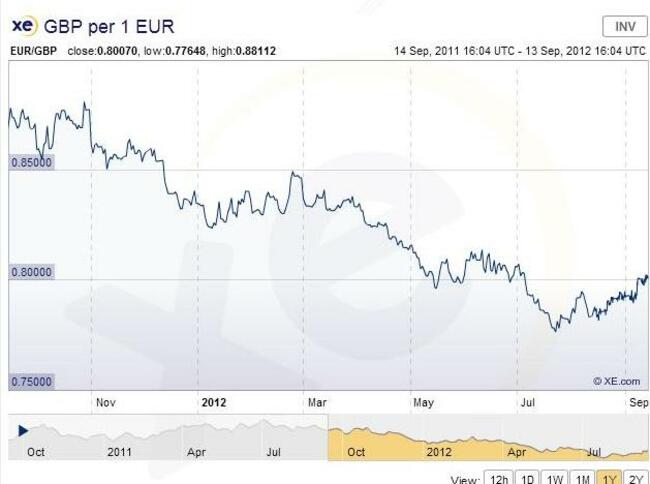
Another factor is the weak value of euro against the sterling. Ireland imports most of its natural gas from Britain and so this is paid for in sterling. This graph shows how a euro has been worth less and less in sterling over the past year, increasing the amount which must be shelled out for imports:

Sterling Euro

One other factor aside from the currency issue is the rising price of gas on the wholesale market which can be caused by a number of factors, both economic and political, on the world stage.

As BGE’s power trader John Heffernan told us in June this can be anything from the EU trade sanctions on Iran – which can affect the vitally important Strait of Hormuz as Iran threatens to cut off access to it – to the economic growth of the world’s big economies like the US and China.

So the prices are going up but is there anything I can do to save money?

The short answer is of course yes.

The first thing you can do is shop around for the best deal as advised by the energy regulator. Not easy when they’re all putting up their prices but a good place to start might be a price comparison website like Bonkers.ie which is accredited by the CER.

But given the widespread price rices, it is obviously that no matter what you do you are still more than likely going to end up paying that bit more for your use of gas and electricity at home.

Human beings are creatures of habit but habits can be changed. Will changing habits impact significantly on how much it costs for your gas and electricity each month? Well, of course, that depends on how much your habits change.

If it’s a cold winter there’s not much you can do about that. You could reduce your heating costs by just lashing another jumper on. But you could also turn the heat down by a few degrees on your thermostat. For example, switching from 21 degrees celsius to 20 degrees can reduce your bill by as much as 10 per cent, say the experts.

You could also buy a radiator booster which works like a fan that you install on top of your radiator and pushes warn air through the room faster meaning you might not have to have your heating on as long as you intended.

You can buy these from the likes of Bord Gáis, which claims that for a running cost of around 60 cent you could save on average around €160 on your heating bill annually.

Another recommendation would be to not use a tumble dryer if you have one. But then if you have one you’re probably using it and it’s particularly handy if you’ve a big household and a lot of washing to get through. So, you could use dry cubes which, according to Purchase.ie, could reduce drying time by about 30 per cent, saving on electricity.

Another electricity saving measure is using energy-saving light bulbs which are increasingly popular and replacing the traditional light bulbs as we reported on in July. They last longer and use less electricity.

There’s also the simple energy-saving measure known as ‘turning-the-lights-and-appliances-off-when-you-leave-the-room-or-are-not-using-them’ which is by far the most effective way of saving energy and thus money. But it’s not always easy to remember, we’ll grant you that.

Now when it comes to heating water we all know about the immersion and while Des Bishop may take the mickey out of us (see below), we fret like no other nation for a damn good reason as often heated water does not get used but still costs money for the electricity expended.

One recommendation from the folk at Purchase.ie is to install an instant hot water tap or water-saving shower heads on your, er, taps and shower heads. Such products can be found here.

Now, watch this funny Des Bishop while we think of other ways to make you feel bad about your wasteful use of gas and electricity:


YouTube:

Now that was funny. So what else can I do?

There are practical things you can do in the kitchen like ensure that the coils in your refrigerator are cleaned and ensure that both the fridge and freezer are at the right temperature.

Generally these two appliances can be adjusted in winter as its colder anyway so be sure to adjust their settings in line with the time of year.

There’s lots more too with lots of tips and ideas on the Sustainable Energy Authority of Ireland website as well Bord Gáis too.

But ultimately it’s all about changing your habits, getting into the habit of shutting the doors of rooms to keep heat in, turning off all appliances when you leave the house or go to bed, turning the lights off in rooms your not using and of course, for god sake, turning off the immersion.

Have you any special energy-saving tips to share with us? Let us know in the comments section below

Explainer: What’s happening to traditional light bulbs?

High tech homes: the smart technology that helps you run your home

Read next:

Comments (32 Comments)

  • Pani 16/09/12 #

    Led bulbs. Expensive to buy but brighter, longer lasting and lower wattage than energy savers. 6w replaces a 50w. 9w replaces 100w. Do the maths. It’s roughly 18 cents per kw per hour. After shopping around I Spent 350e on led bulbs earlier this year. It took 70e off a 2 month 200e bill. Have the money back over 1 year.

    Reply
  • I usually do a play for the missus instead of watching telly three evenings a week, or read her a story

    Reply
  • So basically this article is saying, the corrupt monopoly system that rules our power supply can increase rates anytime and there isn’t much anyone can do about it, but it’s obviously because of Iran and the weak Euro? Such BS, all the power suppliers have different names but realistically they are under one control to fool people into thinking there is fair competition. No mention of alternatives such as retro-fitting your homes with e.g. insulation, solar panels or a wind turbine, sure they cost money to install but once you do they don’t increase your bills you end up breaking even first then saving huge amounts. Yet the government and monopoly system would rather you stay on their grid and keep paying for overpriced services, there is FREE clean energy in the sky and air, why is this not constantly mentioned?

    Reply
  • What to do with a wasteful flatmate who has no concept of energy saving regardless of numerous conversations about it?

    Reply
  • Where can you get dry cubes? And how do they work? Genuinely never heard of them and use the tumble dryer almost daily.

    Reply
    • @Luca….Drycubes available here http://purchase.ie/energy-saving/dry-cubes

      Reply
    • Thanks

      Reply
    • Paul 16/09/12 #

      The tumble dryer uses heat to dry a big ball of clothes, not the most efficient use of energy but at least it uses less space, those drying balls help by creating gaps for the hot air to penetrate the ball of clothes. Instead of using the tumble dryer we hang the clothes up to dry. If the clothes take ages to dry, we use a fan on low to create an air flow to speed up the drying time and stop that studenty stinky jeans thing happening. Also, hanging clothes means less ironing.

      Using draft excluders and quality heavy curtains around doors and windows helps a lot. Test by putting a tea light near your windows and doors and see how much it flickers, that’s crap construction and insulation standards there letting your heat out and the cold wind in. Couldn’t believe how expensive curtains were but the reduction in gas bills over a couple of winters easily paid for them.

      Reply
  • mick k 16/09/12 #

    A sales man from Electric Ireland called to my house a few weeks ago trying to sell me cheaper gas; his selling point was that they were 8% cheaper than Bord Gais. A few weeks later they announce that they are raising their prices by 8.5%!!!!!! Son of a b………!

    Reply
  • i leave immersion on, on the “sink” setting, this actually saves money (have experimented) as the only electricity being used is when it initially heats up, by leaving on the thermostat kicks in and it stays warm but does not heat any more, always have hot water and it never as to use as much power by heating from cold, have tried both ways and it definitely works out cheaper for me, i have token meter so have to watch every penny,

    Reply
  • Airtricity claims to have increased its electricity prices by 4.7%, but according to their own press release that figure is exclusive of the increase in the PSO levy. In contrast, Electric Ireland’s 5.9% increase includes the rise in the PSO levy. Just something to bear in mind when switching providers. Personally I would only jump between ESB/EI and Bord G?is, and Flogas for gas – Airtricity’s sneaky way of doing business is enough to turn me off them.

    Reply
  • If I leave the house, the only things left powered on are the fridge, freezer and UPC box. Leaving anything else on is a waste. My bills have always been low as a result!

    Reply
  • I hear the British and US navy are on their way to the straits of Hormuz on the back of Israeli threats of unilateral action against Iran. Could this have any current and/or future implications for price rises in gas/oil?

    Reply
  • You missed something. In the last month Bord Gais discussed the redistribution of resources into the establishment of a new subsidiary; Irish Water.

    I believe that this is the main reason the gas prices are going up; to proactively pay for water surveys, meter installations and so on, all of which will be handled by Bord Gais, its resources and its employees.

    Reply
  • Sack the energy regulator or better yet stick them on low wages or welfare for a few months and see can they afford the price increases that’s given out like presents for the money hungry energy companies still can’t believe the country is broke but semi state bosses still cream in half a million euros plus a year

    Reply
  • only boil the amount of water you need for a cup of tea or coffee or fill a flask of hot water for the day. fit draught excluders and pull curtains. plug your laptop through a plug in timer to switch from mains to battery. replace outside sensor lights with 10w led flood lights . use remote control sockets to power off tv and all sitting room appliances. why give your money away ?

    Reply
  • Jim Daly 16/09/12 #

    Hold on. I’m lost here.

    What’s this nonsense about the cable? The link will facilitate the import and export of energy between Ireland and Britain and is being built by EirGrid, the state-owned electricity company which runs the electricity network and which has budgeted that this will cost some €600 million.

    The interconnector is already built according to Eirgrid. See http://www.eirgridprojects.com/projects/east-westinterconnector/projectactivity/

    Plus it has already been financed:

    This project has been part funded by the EU TEN-E Initiative.

    The East West Interconnector will represent an investment of €600 million. EirGrid were granted a loan of up to €300 million from the European Investment Bank.

    The balance of the EirGrid East West Interconnector will be funded by a combination of further capital investment from commercial banks, EirGrid equity and a €110 million grant from the EU Commission for interconnection.

    Why don’t they just come straight out and say customers are picking up the repayments? They could have said that ages ago.

    Reply
  • Am i wrong, or is that 60 cent per radiator per day for a booster, so say 10 rads in an average house so €6 per day total, so only efficient if you have your heating on less than 26 days a year?

    Reply
    • There are a lot of stupid mistakes of fact in that article. One example is in relation to regulation. The author seems to think the CER regulates the retail price of electricity. It does not.

      Equally the author implies that a radiator booster fan will save you money on your heating bill. It won’t.

      And again, there is the claim that you can save money with an instant water heater. You might but you probably won’t.

      Reply
  • Bord Gais and Tesco have teamed up so with every 5 euros of Tesco vouchers you have you get 10euro off your Bord Gais bill. You also get clubcard points for paying your Bord Gais bill.

    Reply
  • Susan 16/09/12 #

    I leave the immersion on most of the time. Reason being is it cost more to heat it from cold than it does to keep it warm, cos when it reaches a certain temperature it turns its self of anyway. And after it drops below a certain temperature is starts heating again. I’ve found it cost less.

    Reply
  • Did the firms in question get what they asked for , or more?

    Reply
  • Falling value of euro against sterling, I think. Weak euro = sterling imports cost more. I wonder what else the article has got wrong?

    Reply

Add New Comment