Sign in. It’s quick, free and it’s up to you.
An account is an optional way to support the work we do. Find out more.
Sign in. It’s quick, free and it’s up to you.
An account is an optional way to support the work we do. Find out more.
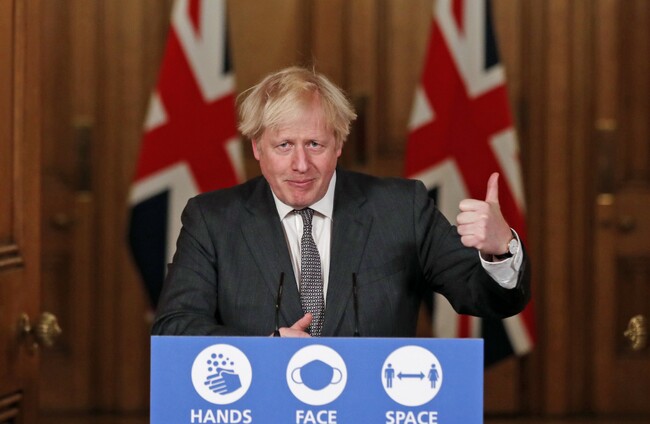
UK PRIME MINISTER Boris Johnson said he has “no doubt” that schools are safe and parents should send primary-age children back to classrooms this week where schools remain open.
Johnson said he understood people’s concerns about children returning for the new term but said education is “a priority”.
Speaking on The Andrew Marr Show on BBC One, the Johnson said: “Schools are safe. It is very, very important to stress that.
“The risk to kids, to young people is really very, very small indeed.
“The risk to staff is very small.
“I would advise all parents thinking about want to do, look at where your area is, overwhelmingly you’ll be in a part of the country where primary schools tomorrow will be open.”
He added: “I understand people’s frustrations, I understand people’s anxieties but there is no doubt in my mind that schools are safe and that education is a priority.”
Gavin Williamson confirmed on Friday that all London primary schools will remain shut to most pupils next week – rather than just those in certain boroughs as set out earlier in the week – but teaching unions say all schools should close for the next two weeks.
#Marr: Will students' GCSE and A-level exams have to be cancelled this year?
— BBC Politics (@BBCPolitics) January 3, 2021
PM Boris Johnson: "In principle it's a good thing to keep schools open… we've got to be realistic about the pace in which this new variant has spread"#Coronavirus https://t.co/2Q2DldF3ji pic.twitter.com/ym2vOb7H3G
On Saturday evening, the Department for Education said remote learning was “a last resort” and classrooms should reopen “wherever possible” with appropriate safety measures to help mitigate the risk of transmission.
“As we’ve said, we will move to remote education as a last resort, with involvement of public health officials, in areas where infection and pressures on the NHS are highest,” the spokesperson said.
Hundreds of new vaccination sites are due to be up and running this week as the NHS ramps up its immunisation programme with the newly approved Oxford University and AstraZeneca jab.
Some 530,000 doses of the vaccine will be available for rollout across the UK from Monday and more than a million patients have already had their first dose of the Pfizer/BioNTech vaccine which was the first to be approved by the Medicines and Healthcare products Regulatory Agency.
But Ofsted chief inspector Amanda Spielman, writing in the Sunday Telegraph, said: “It is clear that children’s lives cannot just be put on hold while we wait for vaccination programmes to take effect, and for waves of infection to subside.
“We cannot furlough young people’s learning or their wider development. The longer the pandemic continues, the more true this is.”
Children’s Commissioner Anne Longfield told the newspaper that schools should be the last to close and first to open, when safe to do so, adding: “I hope, for children and parents’ sake, that is measured in days not weeks and I would be particularly keen for primaries to stay open if at all possible.”
Under the UK government’s initial plan, secondary schools and colleges were set to be closed to most pupils for the first two weeks of January, while primary schools within 50 local authorities in the south of England, including 23 London boroughs, were also told to keep their doors shut until January 18.
Confirmed cases were higher than 50,000 for the fifth day in a row when UK figures were released on Saturday with a record-high of 57,725 lab-confirmed cases and another 445 deaths within 28 days of a positive test.
In Ireland, the Labour Party has called on the National Public Health Emergency Team to carry out a public health risk assessment on reopening schools.
Labour’s education spokesperson, Aodhán Ó Ríordáin has said that his preference is that schools open as long as it can be done safely.
Ó Ríordáin welcomed the decision to delay the reopening of schools, but said as the virus is rampant in the community there needed to be an assessment of health risks to staff, students and the wider community.

To embed this post, copy the code below on your site











have your say