Sign in. It’s quick, free and it’s up to you.
An account is an optional way to support the work we do. Find out more.
Sign in. It’s quick, free and it’s up to you.
An account is an optional way to support the work we do. Find out more.
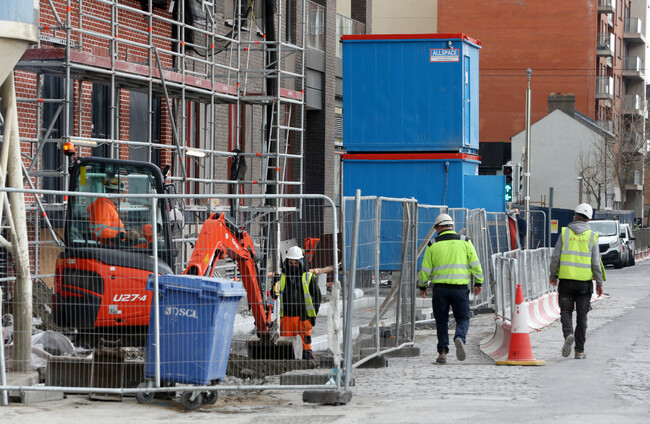
DUBLIN CITY COUNCIL is “confident” it will meet its target of delivering 895 new build units this year, an Oireachtas Committee will hear today.
The Joint Committee on Housing will meet at 3pm to discuss implementing the Housing for All Plan with representatives of Dublin City Council and Dún Laoghaire-Rathdown County Council.
Dublin City Council chief executive Owen Keegan will tell the Committee that the council has a “strong pipeline” with designated sites for the delivery of over 15,000 social, cost rental and affordable sale homes, which it plans to deliver in the coming years.
“In 2022, we are confident of meeting our delivery target of 895 new build units,” Keegan is expected to say in his opening statement.
He will tell the committee that the Council has “diversified” its delivery methods, which now include “direct build, public private partnerships, the Housing Land Initiative, Competitive Dialogue, partnerships with Approved Housing Bodies and the Land Development Agency, turnkey acquisitions and Part Vs”.
“The environment for new housing delivery, both public and private, is difficult at present. The main issues are access to labour, construction inflation, global supply chain issues and in respect of the housing market affordability and restricted access to construction capital,” Keegan will say.
Vacant properties
He will also speak to the Committee about the issue of vacant and derelict properties in the city.
According to the latest CSO figures, as recorded in the census this year, 166,752 properties were recorded as vacant in the State – a fall of 9% on 2016 numbers.
The CSO emphasised that the categories for vacancy were broad and not indicative of long-term vacancy.
35,000 vacant homes were vacant because they were up for rent, while the property owners of 27,000 dwellings had passed away, and a further 23,000 were under renovation.
The CSO states that properties that are classed as vacant in the census may only be vacant for a short period of time.
More than 30% (48,387) of the dwellings vacant in 2022 that could be linked were also vacant in 2016. And of these 48,387 dwellings, nearly half (23,483) were also vacant in Census 2011.
Keegan is expected to tell the Committee today that it is “fully recognised that vacant/derelict properties are a source of great frustration to everybody who sees them”.
“It is important to recognise that every derelict home is vacant but not every vacant home is derelict,” he will tell the Committee.
“There is significant confusion in people’s minds between legislation dealing with vacant sites and derelict sites and the powers local authorities have to deal with vacant housing units that are neither derelict nor a site.
“Dealing with vacant/derelict housing units must be seen as a social intervention rather than a purely economic intervention,” Keegan will say, adding that “there are significant complexities and costs in acquiring and redeveloping these housing units”.
The Committee will hear that the use of vacant commercial and retail units for housing is being investigated by Dublin City Council.
The Council has identified approximately 650 vacant homes with potential for redevelopment, of which 48 have been redeveloped and returned to use to date, Keegan will say.

To embed this post, copy the code below on your site


have your say