Sign in. It’s quick, free and it’s up to you.
An account is an optional way to support the work we do. Find out more.
Sign in. It’s quick, free and it’s up to you.
An account is an optional way to support the work we do. Find out more.
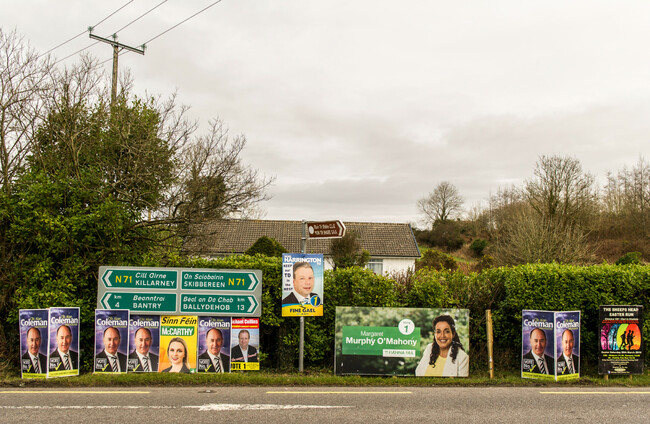
POSTERS FOR CANDIDATES contesting the European and local elections on 7 June have begun to pop up all over Ireland as today marks the first day that they’re officially allowed to be erected.
Some candidates and their teams were out in the early hours of this morning erecting their posters in order to get prime real estate on lampposts.
The posters, which are a staple of any Irish election, are only allowed be erected 30 days before the polls open and must be taken down within a week after the election ends.
Presumably to stop people from super-glueing their faces to the Spire in Dublin city centre and causing residual damage, posters must be fastened by plastic zip-ties only. Metal fixings, such as screws and nails, or adhesives such as glue or blue-tack are not permitted.
There are also a list of places where candidates’ posters are not permitted:
Posters should also have a 2.5 metre clearance from any footpath and 3.2 metre clearance from any cycle lane. At the same time, posters should be no higher than 6.5 metres from the ground.
Lastly, political party affiliation or the individual responsible for the poster must be clearly indicated on all material.
Local councils have the ability to remove any posters that break these rules or do not meet the requirements. Additionally, if the council incurs costs as a result of removing the poster, the party or individual responsible will have to pay those costs.
If you’d like to find out more about each candidate, you can do so on The Journal‘s Candidate Database, which gives an opportunity to every candidate to inform readers about their campaign’s main points and what they hope to bring to the European Parliament.
—
This work is co-funded by Journal Media and a grant programme from the European Parliament. Any opinions or conclusions expressed in this work are the author’s own. The European Parliament has no involvement in nor responsibility for the editorial content published by the project. For more information, see here.
It’s a busy year for elections around the world. Before you head out to vote, check out our FactCheck Knowledge Bank for essential reads and guides to finding good information online.

To embed this post, copy the code below on your site







have your say