Sign in. It’s quick, free and it’s up to you.
An account is an optional way to support the work we do. Find out more.
Sign in. It’s quick, free and it’s up to you.
An account is an optional way to support the work we do. Find out more.
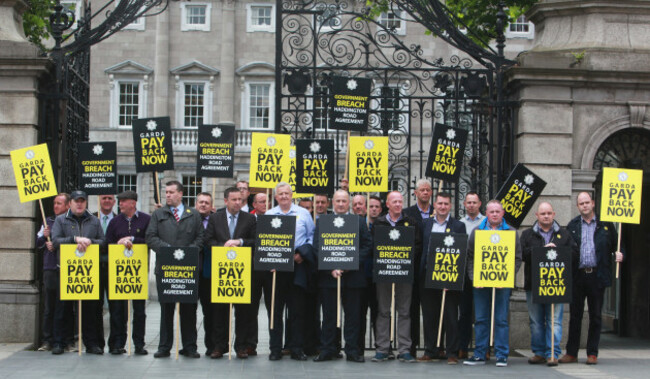
DISCONTENT AMONG MIDDLE and lower ranking gardaí has seen them taking to the streets to protest in recent months.
Representative associations say their members bore the burden of harsh cuts to their pay in the years after the recession and now it is time to pay them back.
Both the Association of Garda Sergeants and Inspectors (AGSI) and the Garda Representative Association (GRA) have said they would not rule out industrial action including a strike to achieve their goal.
However, commentary around a potential garda strike has always referenced the illegality of this kind of action.
Speaking to TheJournal.ie in March this year, the GRA’s Sligo/Leitrim representative Ray Wims said:
While striking is illegal, it is going to be hard for us to contain the members.
Similarly, in a statement to the Sunday Independent in April, AGSI General Secretary John Jacob said:
Although striking is illegal, there is a mood within the garda organisation to take this action and suffer the consequences. I do not know where things will end up.
Media reports surrounding threats of strike by members of An Garda Síochána also frequently point out that this action would be illegal.
(Remember, if you hear an argument about facts over the airwaves, emailfactcheck@thejournal.ie or tweet @TJ_FactCheck).
Claim: It is illegal for gardaí to go on strike.
Verdict: Mostly true
We asked both the Department of Justice and the Garda Press Office to point to legislation that specifically outlaws a strike by members of An Garda Síochána.
The Department of Justice said that “while there is no single specific prohibition on striking by members of the Garda Síochána, a combination of provisions in law, including the Industrial Relations Act 1990, as well as Garda discipline regulations, effectively precludes strikes.”
In a similar response, the Garda Press Office said: “A combination of provisions in law, including the Industrial Relations Act 1990, as well as Garda discipline regulations, The Garda Síochána Act 2005 effectively precludes industrial action by members of An Garda Síochána.”
Between them, they cited three pieces of legislation which they claim cover the prohibition on garda strikes:
They both also referenced Garda Síochána (Discipline) Regulations 2007.
So, let’s look at the legislation.
It is an offence under Section 9 of the Offences Against the State Act 1939 for any person to encourage a person employed by the State to refuse, neglect or omit to perform their duty in a manner calculated to dislocate the public service or a branch thereof.
And it is an offence to encourage any person so employed to be negligent or insubordinate in the performance of their duty.
Section 59 of the Garda Síochána Act 2005 also makes it an offence for any person to induce a member of the Garda Síochána to withhold his or her service or to commit a breach of discipline.
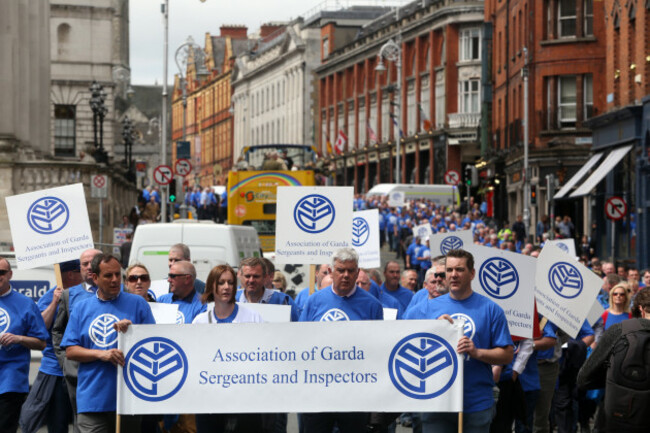
A number of legal experts TheJournal.ie spoke to said these pieces of legislation would certainly make it an offence for representative associations, such as the GRA or the AGSI, to organise a strike or encourage members to withdraw their labour.
However, neither of these acts makes it an offence for the individual garda to go on strike.
“The only certain thing is that it is a criminal offence to encourage a member of the garda not to discharge his or her duty,” Professor Dermot Walsh of Kent Law School explained.
This would not put them at risk, however, of prosecution, merely internal garda disciplinary procedures.
Most of this claim actually centres around the Industrial Relations Act 1990. In its definitions section, the act defines the term ‘workers’ but excludes members of An Garda Síochána and the Defence Forces from that term.
It then goes on to define the word ‘strike’ as:
A cessation of work by any number or body of workers acting in combination or a concerted refusal or a refusal under a common understanding of any number of workers to continue to work for their employer done as a means of compelling their employer, or to aid other workers in compelling their employer, to accept or not to accept terms or conditions of or affecting employment.
In essence, the act says a strike is something ‘workers’ do – but gardaí are not ‘workers’.
The purpose of this legislation is to provide statutory defences, or immunities, to workers taking industrial action. It protects them from actions that might be taken against them for offences like conspiracy, inducing breach of employment contract or intimidation.
Gerry Whyte, Trinity College School of Law said the act does not “confer a positive right to strike on workers covered by it”. Rather, it assumes that the taking of strike action may, in the absence of the act’s protections, result in workers incurring civil liability.
In his opinion the failure of the act to apply to the gardaí really “does not tell us anything about whether they have a right to strike”.
It could be argued that the gardaí, like other workers, have an implied constitutional right to withdraw their labour. Unfortunately, this point has never been addressed by the courts, hence the uncertainty in the law. If the gardaí had such a right, I think that it might still be open to the Oireachtas to legislate to regulate it in the public interest.
Expert in employment law, Patrick Walshe, said a lot of legal commentators pointed to this exclusion from the act as the reason for the ‘blue flu’ epidemic in the late 1990s:
There was a protracted pay dispute at that time and because gardaí couldn’t take industrial action in the traditional sense, large numbers called in sick – you could definitely argue that this amounted to de facto industrial action.
“I don’t think it’s legally accurate to describe gardaí striking as “illegal” in the sense of it being a criminal offence etc. To my mind, it’s more of a practical point – gardaí (and soldiers) have been deliberately excluded from the provisions of the Act of 1990.”
However, Michael Doherty of the Department of Law at Maynooth University, said that while it is “difficult to say yes or no” to whether striking is illegal, individual members could face prosecution if they did go on strike – just not for the actual act of going on strike.
“You can’t then be liable for things that happen when you’re on strike that would otherwise be unlawful,” he explained.
This includes conspiracy against their employer, interfering with the employer’s right to conduct business or breaching their employment contract.
“Inevitably, they’re going to do something that is a criminal or civil wrong, but it would be up to the authorities to prosecute or sue them.”
A number of the legal experts TheJournal.ie spoke to referenced rights under the Constitution that may cover strike action.
Under Article 40, the State is required to respect and defend the personal rights of the citizen. The Constitution also guarantees liberty for the exercise of the right of citizens to express their opinions freely, to assemble peacefully and to form associations and unions.
However, this article states laws may be enacted for the regulation and control of this right in the public interest. And it is extremely unlikely in the event of a challenge to the Constitution that a garda’s right to strike would be deemed more important than public safety.
Following a complaint by AGSI, the Council of Europe found in 2014 that the Irish government breached the European Social Charter, which it had signed up to.
The council upheld the complaint, finding the government was in violation of the agreement by denying gardaí the right to engage in union action and negotiate their pay.
This decision is not binding, however, it is merely a light slap on the wrist for the government and a suggestion that they should change legislation.
As the Department of Justice has not taken any action in relation to this decision – and is not likely to – it would not have any bearing on action taken in the event of a garda strike.
It is not clear, however, whether or not the act of going on strike would be illegal for a rogue group of individual members of An Garda Síochána. Even the Department of Justice admits there is “no single specific prohibition” to cover this, and unlike for the above offence, there are no defined penalties.
Because a strike has never happened, it is difficult to say what kind of action would be taken, but individual gardaí would definitely open themselves up to both civil and criminal liability as well as disciplinary measures because the legislation does not protect them like other workers.
Taking into account the uncertainty about individual members going on strike, this claim is MOSTLY TRUE.
Send your FactCheck requests to factcheck@thejournal.ie

To embed this post, copy the code below on your site
















have your say