Sign in. It’s quick, free and it’s up to you.
An account is an optional way to support the work we do. Find out more.
Sign in. It’s quick, free and it’s up to you.
An account is an optional way to support the work we do. Find out more.
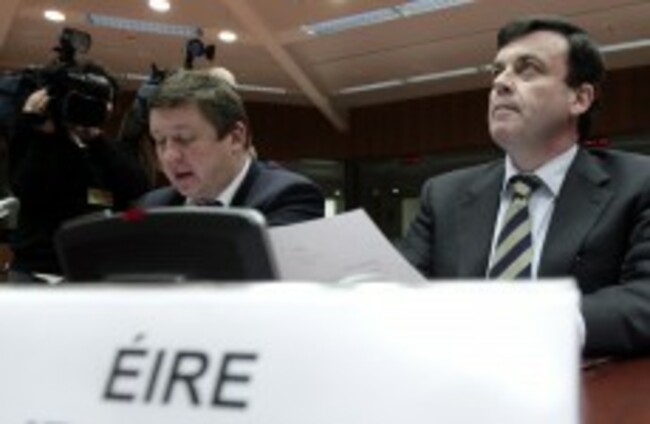
THE GOVERNMENT has committed to aggressively raising taxes within the next year, selling off the nationalised banks as soon as possible, and passing next week’s Budget in exchange for the €85bn in emergency funding being received from the European Union and International Monetary Fund.
The memoranda of understanding between the parties were published this afternoon, and essentially watermarks the terms of the government’s four year economic National Recovery Plan announced last week.
Circulating the plan in the Dáil earlier, finance minister Brian Lenihan said the programme was a vital one, as the “sometimes hysterical and contradictory reaction” had ignored the reality that the plan was required in order to continue to fund social welfare and the wages of public servants.
Though the deal promises that legislation on dealing with subordinated bondholders in the country’s banks will be published by the end of the year, Lenihan said there was “simply no way that this country, whose banks are so dependent on international investors, can unilaterally renege on senior bondholders against the wishes of the ECB. Those who think we could do so are living in fantasy land.”
Lenihan told the Dáil that the plan meant “we have every reason to be confident about the future of this economy.”
The memorandum outlines the schedule of quarterly reviews being undertaken by Brussels and Washington as part of the funding deal, and establishes that the Department of Finance will also be required to give the bodies monthly updates on its income and expenditure.
The National Treasury Management Agency will be asked to offer a weekly update on the government’s cash position, and the Central Bank will provide weekly breakdowns of its assets and liabilities, as well as monthly updates on the assets and liabilities of the domestic banks and estimates as to the capital they may need.
The memorandum clearly states, however, that the release of the first bailout funds – a €10bn payment expected to be used for the recapitalisation of Ireland’s banks – will not take place unless the government passes the Budget, which will have to include €6bn in adjustments.
Ireland has also committed to raising €945m by lowering the PAYE income tax bands, with a further €260m to be raised by the abolition of several of the PAYE tax credits.
The reduction of the minimum wage by €1 an hour, to €7.65, is also listed as a condition of the payments, though it is not stated whether the initiative for the cut came from the Irish side or the European one.
Employers will now be able to claim the ‘inability to pay’ exemption clause in respect of the minimum wage more than once, lifting a previous one-time cap on such claims.
By the fourth quarter of 2011, the government also commits to introducing a new property tax (which the government says will take the form of a ‘Site Value Tax’) and the doubling of the current carbon tax.
From an expenditure point of view, the government commits to introducing a Fiscal Responsibility Law which will set spending ceilings for the government departments
The government also commits to selling off the banks in which it has a majority ownership – currently including Irish Nationwide and AIB, and potentially including Bank of Ireland – as soon as possible.
Furthermore, it confirms that NAMA will be increasing the scope of its operations with AIB and Bank of Ireland to acquire loans valued under €20m, and that NAMA will have finalised the entirety of its purchases by March 2011.

To embed this post, copy the code below on your site















have your say