Sign in. It’s quick, free and it’s up to you.
An account is an optional way to support the work we do. Find out more.
Sign in. It’s quick, free and it’s up to you.
An account is an optional way to support the work we do. Find out more.
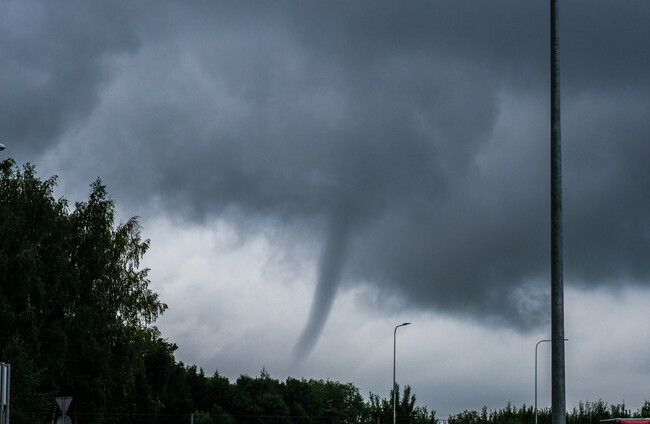
A CLEAN-UP IS underway in Leitrim after the village was hit with a “localised tornado” yesterday afternoon, resulting in damage to businesses and houses.
There were a number of weather warnings in place over the weekend as Storm Fergus crossed over the country, but Leitrim was the area worst affected.
Thankfully no serious injuries were reported.
Tornadoes are generally associated with the midwest or south of the United States and Bangladesh where they often cause loss of life.
Five of the top 10 deadliest tornadoes on record occurred in Bangladesh, including one in 1989 where around 1,300 people were killed. The death tolls are often higher there due to poor infrastructure and warning systems.
Around 200 to 300 tornadoes occur in Europe every year, mainly in low countries such as Germany, southern Scandinavia, parts of Italy and central England.
In contrast, Ireland does not get many tornadoes – about 10 a year.
Summertime is “marginally more conducive to the formation of tornadoes”, but they can happen at any time of year, according to Met Éireann.
While some can a lot of damage, most tornadoes here are weak and many occur without being noticed.
Tornadoes in Ireland are sometimes referred to as mini-tornadoes to separate these weather events from the larger ones recorded in the US and other countries.
‘Localised’ tornadoes
Liz Walsh, a meteorologist with Met Éireann, said that while tornadoes are rare here, they can happen in “localised” settings as was the case yesterday.
“Small tornadoes are something that can occur and are associated with thunderstorms. It’s a risk with thunderstorms and is unusual in Ireland but it does happen,” Walsh told The Journal.
Often it’s caused by the change in wind direction up in the cloud. That can cause rotation to happen and you can get these things called funnel clouds, or tornadoes if they hit the ground.
“Another feature that’s like a tornado are straight line gusts of wind and they cause plenty of damage as well.
“We usually don’t get them but obviously Storm Fergus has released some very unstable conditions over Ireland,” she said.
Funnel clouds and landspouts
The strongest tornadoes are generally caused by supercells.
A supercell is a type of thunderstorm characterised by the presence of a mesocyclone – a deep and persistently rotating current of rising air.
Supercells are extremely rare in Ireland, we tend to get funnel clouds and landspouts instead.
Funnel clouds consist of a strong rotating column of air that does not touch the ground. Below is a video of a funnel cloud that passed over Dublin in June of this year.
Another video of the funnel cloud near Dublin Airport in last hour.
— Carlow Weather (@CarlowWeather) June 20, 2023
This was recorded by Matt Fitzsimons who reported seeing a few funnel clouds forming and this was the largest of them. pic.twitter.com/XpSssO4dEv
Landspouts are associated with cumulus clouds and form from the ground up, rather than from a mesocyclone.
They are less destructive than supercells and narrower. They are often 20-100 metres in diameter and have wind speeds of 60-180km/h.
In contrast, supercells up to 4km wide with wind speeds of 500km/h have been recorded in the US.
Another suspected tornado passed through county Wexford in November 2022.
Ireland’s first documented tornado occurred near Rosdalla, Kilbeggan, Co Westmeath, on 30 April 1054 and is documented in the Annals of the Four Masters, Chronicon Scotorum.
Contains reporting by Eoghan Dalton

To embed this post, copy the code below on your site












have your say