Sign in. It’s quick, free and it’s up to you.
An account is an optional way to support the work we do. Find out more.
Sign in. It’s quick, free and it’s up to you.
An account is an optional way to support the work we do. Find out more.
Updated: 9 July
IRELAND HAS SEEN a steady flow of news reports and varying claims about hospital waiting lists over the past decade or so.
And yesterday, Fianna Fáil leader Micheál Martin used his primetime slot in Leaders’ Questions to attack what he called “dramatic increases in waiting times” since 2011.
More specifically, he told Taoiseach Enda Kenny that waiting lists had risen by 45% in the last two years.
That’s some increase. But is it true?
(Remember, if you hear a scary statistic that you want us to look at, email factcheck@thejournal.ie).
Claim: Hospital waiting lists have increased by 45% in the last two years
Verdict: Mostly True
What was said
You can watch the discussion in full, above, but the most significant claim made, and our focus in this article, is this statement by Micheál Martin:
No progress has been made over the last number of years in terms of waiting lists. In fact the situation has become dramatically worse.
The waiting lists are now up 45% in two years.
We asked Fianna Fáil for evidence to support that and other claims made by the party leader.
They sent us extensive and detailed data on inpatient and outpatient waiting lists, all taken from the National Treatment Purchase Fund (NTPF).
To support the claim that waiting times were up 45% in two years, the party provided figures which appeared to show that the total number of individuals waiting for inpatient procedures in May 2014 was 50,689, and in May 2016 it was 74,986.
That’s a 47.9% increase, so Micheál Martin actually slightly understates the purported increase, based on those two points of comparison.
However, we requested all available figures from the NTPF, and found there is a significant problem with the data used by Fianna Fáil for this claim.

The 50,689 people on Inpatient waiting lists in May 2014 and 74,986 in May 2016 excludes those waiting for a Gastrointestinal Endoscopy.
This is due to the way the data is laid out on the NTPF website, with GI Endoscopy figures contained in separate files.
The real total for May 2014, according to NTPF data, and as confirmed by an NTPF spokesperson, is 60,447.
And the real number for May 2016 is actually 94,410. So the actual increase in the number of those waiting for inpatient procedures between May 2014 and May 2016 is 56.2%.
When it comes to the outpatient waiting list, the number was 343,412 in May 2014 and 415,584 in May 2016 – a 21% increase.
When we combine inpatient and outpatient waiting lists, the number has risen from 403,859 in May 2014 to 509,994 in May 2016 – a 26.3% increase.
Let’s look a bit more closely at this.
As we have pointed out before with trolley numbers, which vary significantly from day to day, figures for hospital waiting lists can also change from month to month, although not as erratically as daily trolley numbers.
For this reason, politicians and activists from all sides in Ireland have a bad habit of manipulating the statistics by cherry-picking dates that suit their argument.
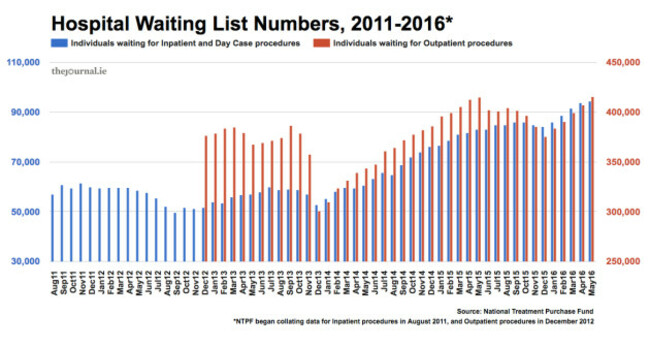
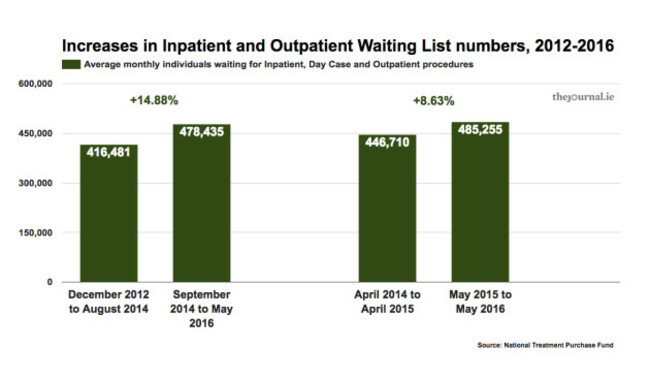
So we’re going to look at overall numbers and average monthly figures to get a broader picture of how things have been changing. Here’s the trend since 2011:
You can check the waiting list figures on the NTPF website, broken down in detail by hospital, type of procedure, child/adult procedures, and so on.
However, that data only goes back as far as December 2014, so we had to request figures for 2011-2014 directly from the NTPF.
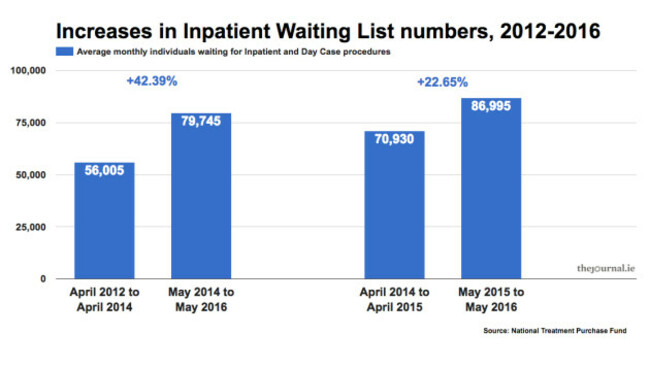
Based on those figures, we found that the average monthly number on inpatient waiting lists had increased by 42.4% in the last two years, as compared to the two years before that.
And the average number in the last year was 22.7% higher than the year before.
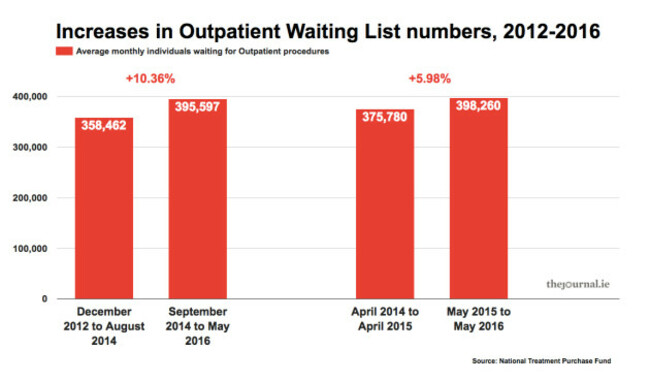
The average monthly number waiting for outpatient procedures increased by 10.4% in the last 21 months, as compared to the 21 months before that.
(The NTPF only began collating outpatient figures in December 2012, so this is as far back as the comparison can go).
In the last year, there was a 6% increase on the 12 months before that.
And if we combine inpatient and outpatient numbers, the increase in the last 21 months was 14.9% on the previous 21 months, and the increase in the last year was 8.6% on the year before that.
There has clearly been a significant increase in waiting list numbers over the past two years, whatever measure you use.
Micheál Martin’s claim of a 45% increase, as stated in the Dáil, could be interpreted a few different ways. Here’s a reminder of what he actually said:
If you took that to mean all waiting lists, inpatient and outpatient, then it would be False, and a significant exaggeration, whether you were comparing the last 21 months to the 21 months before that (a 14.9% increase), or May 2014 to May 2016 (a 26.3% increase).
But Fianna Fáil, in response to queries by FactCheck, provided evidence referring specifically to inpatient waiting lists.
And although he neglected to stipulate this in the Dáil, he also didn’t contradict it. So we view this as a clarification of his claim, and a fair basis on which to test it.
As we’ve shown, when you compare inpatient waiting list numbers from May 2014 and May 2016 (which Fianna Fáil did), you get a 56.2% increase.
And when you compare average monthly inpatient waiting list numbers over the past two years with the two years before that, you get a 42.4% increase.
Therefore, on the whole, we rate this claim Mostly TRUE.
This FactCheck analysed data that was the most up-to-date available at the time of Micheál Martin’s claim, and at the time of writing.
On 8 July, the NTPF released waiting list figures for June 2016. Although we’re not including them in our assessment of the claim (because they weren’t published when the claim was made), it’s worth having a look at how they affect some of the trends discussed above.
Send your FactCheck requests to factcheck@thejournal.ie

To embed this post, copy the code below on your site
















have your say