Sign in. It’s quick, free and it’s up to you.
An account is an optional way to support the work we do. Find out more.
Sign in. It’s quick, free and it’s up to you.
An account is an optional way to support the work we do. Find out more.
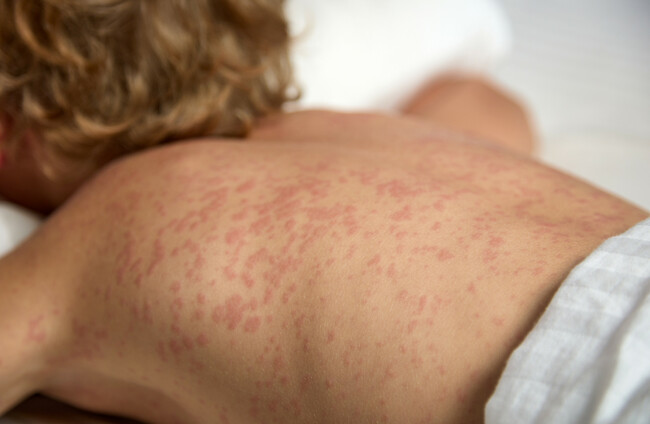
NINE SUSPECTED MEASLES cases have been reported in Ireland as of 3 February.
The figures are included in the latest report by the Health Protection Surveillance Centre (HPSC).
These cases are currently under investigation and need to be tested in a laboratory before being confirmed as measles.
Seven of these cases have been defined as ‘possible’ measles, while two are listed as ‘probable’ measles.
The suspected cases, all involving children aged nine and younger, were reported between 28 January and 3 February.
Two or more cases of measles are classed as an outbreak.
Yesterday it was confirmed that a man in Leinster died after contracting measles – the first measles death in Ireland in over 20 years.
According to the HPSC figures, the breakdown of the suspected cases is as follows:
Seven of the reported cases are in children aged four years or younger, and two cases are in children aged five to nine years.
Five cases were among boys, two were among girls, and the gender in the other two cases is listed as ‘unknown’ or ‘not specified’.
The man who died is the only confirmed case of measles in Ireland to date this year.
There have been relatively few confirmed cases of the disease in Ireland in recent years.
There were four confirmed cases in 2023, two confirmed cases in 2022, no cases were confirmed in 2021, and five cases were confirmed in 2020.
No deaths were reported in any of those years.
Amid a large increase in cases in Europe and a decline in vaccination rates, the HSE has recently been warning of a potential outbreak here.
A taskforce has been set up to monitor and respond to the situation.
There was a nearly 45-fold increase in measles cases in Europe last year, according to the World Health Organisation (WHO). Around 42,200 people were infected with the disease in 2023, compared with 941 during 2022.
What is measles?
Measles is a highly infectious viral illness. It typically starts with cold-like symptoms that develop about 10 days after a person gets infected. The person will get a rash a few days later.
The illness usually lasts for seven to 10 days.
What are the symptoms?
Many people with measles also develop small greyish-white spots in their mouths. These appear before the rash and usually last for a few days. A rash appears around two to four days after the first symptoms. It fades after about a week.
If you have these symptoms, you should seek medical advice. People are advised to phone prior to attending their GP, Emergency Department or other healthcare provider to inform them they have these symptoms.
People should also alert medical staff if they have been in contact with someone who has measles or if they have recently travelled to an area where there is a measles outbreak.
MMR vaccines
The MMR (measles, mumps and rubella) vaccination is the best way to protect people from measles.
Two doses of the MMR vaccine are necessary to be considered fully vaccinated. The first dose is given by a GP when a child is 12 months of age.
The second dose is generally given by school vaccination teams when the child is in junior infants.
Parents are encouraged to check that their children’s vaccines are up-to-date. If their child has missed either or both of their MMR vaccines, you are advised to contact your GP practice to arrange a catch-up vaccine.
Uptake of both doses of MMR vaccine has been below 90% in Ireland for some time – lower than the recommended level of 95% – which is “of great concern because of the serious and infectious nature of measles”, the HSE said.

To embed this post, copy the code below on your site















have your say