Sign in. It’s quick, free and it’s up to you.
An account is an optional way to support the work we do. Find out more.
Sign in. It’s quick, free and it’s up to you.
An account is an optional way to support the work we do. Find out more.
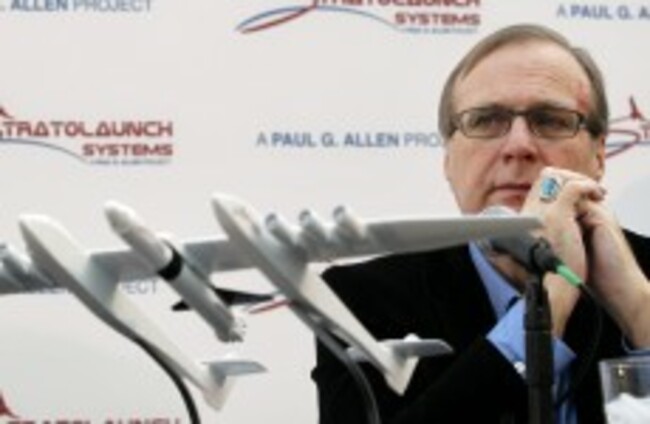
MICROSOFT CO-FOUNDER Paul Allen and aerospace pioneer Burt Rutan are building the world’s biggest plane to help launch cargo and astronauts into space, in the latest of several ventures fueled by technology tycoons clamouring to write America’s next chapter in spaceflight.
Their plans, unveiled yesterday, call for a twin-fuselage aircraft with wings longer than a soccer pitch to carry a rocket high into the atmosphere and drop it, avoiding the need for a launch pad and the expense of additional rocket fuel.
Allen, who teamed up with Rutan in 2004 to send the first privately financed, manned spacecraft into space, said his new project would “keep America at the forefront of space exploration” and give a new generation of children something to dream about.
“We have plenty and many challenges ahead of us,” he said at a news conference.
Allen bemoaned the fact that government-sponsored spaceflight is waning.
“When I was growing up, America’s space programme was the symbol of aspiration,” he said. “For me, the fascination with space never ended. I never stopped dreaming what might be possible.”
Allen and Rutan last collaborated on the experimental SpaceShipOne, which was launched in the air from a special aircraft. It became the first privately financed, manned spacecraft to dash into space in 2004 and later won the $10 million Ansari X Prize for accomplishing the feat twice in two weeks.
Sir Richard Branson’s Virgin Galactic licensed the technology and is developing SpaceShipTwo to carry tourists to space.
The new plane will have a wingspan of 380 feet — the world’s largest. The plane will carry under its belly a space capsule with its own booster rocket; it will blast into orbit after the plane climbs high into the atmosphere.
This method saves money by not using rocket fuel to get off the ground. Another older rocket company, Orbital Sciences Corporation, uses this method for unmanned rockets to launch satellites.
Allen and Rutan join a field crowded with Silicon Valley veterans who grew up on “Star Trek” and now want to fill a void created with the retirement of NASA’s space shuttle.
Several companies are competing to develop spacecraft to deliver cargo and astronauts to the International Space Station.

To embed this post, copy the code below on your site













have your say