Sign in. It’s quick, free and it’s up to you.
An account is an optional way to support the work we do. Find out more.
Sign in. It’s quick, free and it’s up to you.
An account is an optional way to support the work we do. Find out more.
LAST UPDATE | 19 Sep 2022
MINISTER FOR HOUSING Darragh O’Brien has told the launch of a housing report that the State will build more social homes this year than any other year in history, with the number of new homes set to reach approximately 25,000.
The new report reviewing Ireland’s approach to homelessness has recommended the adoption of a “broader definition of homelessness”.
The report has been drafted by leading international experts and was launched by Minister O’Brien at Buswell’s Hotel this morning.
O’Brien said the government’s target is to build 300,000 new houses from now until 2030, 90,000 of which would be social housing.
Families are “struggling in a dysfunctional private rental sector right now,” he added, calling the private market “untenable.”
“I’m not here to say everything is grand because it’s not.”
“Right now, we do need good landlords in the market too. And let’s be very honest, we have had a situation in public discourse over the last number of years that’s led to a near demonization of that phrase.”
A key initiative alongside the increase of new builds would be to increase the amount of landlords as 44,000 tenancies and 8,000 landlords have left the market since 2016, O’Brien stated.
“We now have cost rental in place in Ireland for the first time and legislated for it at a national level through the Affordable Housing Act. We have hundreds of tenancies in place where yes, we do need thousands, but to say that we can just switch thousands on overnight frankly just isn’t true.”
He added that he is considering measures in next week’s budget to stop the exit of landlords from the rental market.
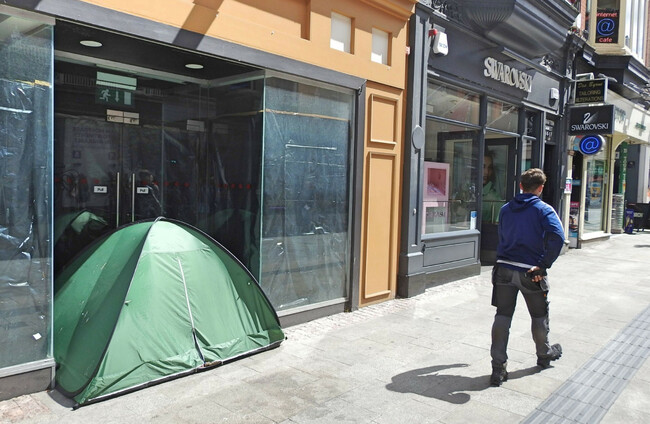
The report comes at a time when the number of people in emergency homeless accommodation reached an all-time high of 10,588 in July, three times the level in when the first figures were published in 2014.
The minister acknowledged this historic level and the fact that homelessness was increasing but said the increase in homeless was slowing down.
“Those who do not have a home now are at the foremost of my mind everyday when I start work on your behalf,” O’Brien concluded.
The report launched today notes that “the most effective homelessness strategies in Europe use a wide definition of homelessness”.
As well as people who are sleeping rough without a shelter of any kind, this broader definition also includes those:
The report says “broader definitions tend to de-emphasise individual factors” and “challenges political, media and other narratives that present homelessness as being the result of individual choice, addiction, mental illness, and traumatic experiences”.
The report, “From Rebuilding Ireland to Housing for All: international and Irish lessons for tackling homelessness,” draws on lessons from practice elsewhere in Europe and in North America.
It was commissioned by six of the leading organisations tackling the housing and homelessness crisis in Ireland.
The report points to the shortage of affordable and social housing supply as the primary cause of homelessness and that this housing shortage limited existing policy in preventing and ending homelessness.
While the report acknowledged that progress had been made in responding to this, it adds that more affordable homes are needed.
The report found that “internationally, no level of coordination, evidence-led practice or comprehensiveness of response has been found that counteracts the effects of insufficient affordable, adequate homes with security of tenure”.
It adds: “Prevention, housing-led and Housing First services will either be limited, or fail, if there are not enough suitable homes with which to prevent and end homelessness.”
Lead researcher Professor Nicholas Pleace said that “in undertaking this work, we took the took the stance of ‘critical friends’ in reviewing the Rebuilding Ireland strategy and its successor Housing for All”.
The report found that people who experienced homelessness reported that services here were uncoordinated and “in need of improvement”.
Information about those services were also described as “ inconsistent”, while strategies in Finland, Scotland and Wales were pointed to as responses that “may be useful in addressing this issue”.
The distinct needs of women who are homeless has also been highlights, with the report noting: “Much ‘family’ homelessness is women lone parents and dependent children at risk of domestic abuse and the relationship to this to domestic violence”.
The report warned that “much service provision is still built on an assumption that homelessness is mainly experienced by lone men”, and also recognised the “distinct needs of young adults and LGBTQI+ people”.
Other recommendations include the need for integrated services and that Housing First and other services should not be stand-along programmes.
The need for governance to be “clear, focused, and stable” has also been noted.
The six organisations which commissioned the report are COPE Galway, Focus Ireland, the Jesuit Centre for Faith and Justice, the Mercy Law Resource Centre, the Simon Communities of Ireland, and the Society of Saint Vincent de Paul.
In the preface to the report, the commissioning organisations said the “document can make a major contribution to shaping the strategies and practices needed to confront our current crisis and bring us towards our goal of bringing an end to homelessness”.
With reporting from Jamie Mc Carron

To embed this post, copy the code below on your site












have your say