Sign in. It’s quick, free and it’s up to you.
An account is an optional way to support the work we do. Find out more.
Sign in. It’s quick, free and it’s up to you.
An account is an optional way to support the work we do. Find out more.
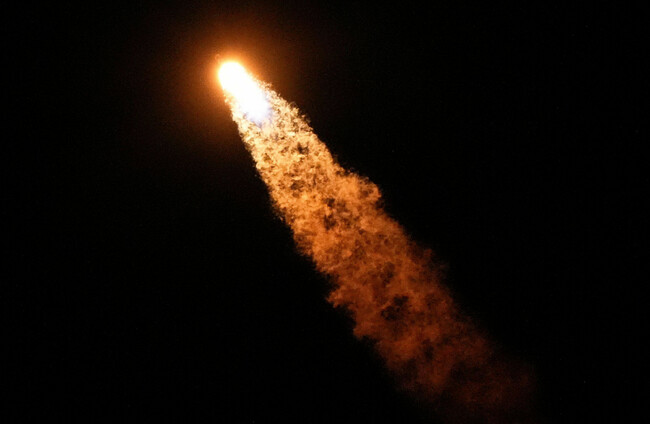
THREE AMERICAN ASTRONAUTS and a Russian cosmonaut blasted off last night from the Kennedy Space Centre in Florida for a six-month mission on the International Space Station.
The SpaceX Falcon 9 rocket lifted off at 10:53 pm (03:53 Irish time), lighting up the night sky with a long, bright plume of orange flame.
Just minutes after the launch, as the rocket soared over the Atlantic, it was moving at a speed of 6,000 miles per hour, NASA TV commentators said.
It took about nine minutes for the capsule to settle into orbit as it prepared to dock with the ISS and relieve four other crew members.
Liftoff of Crew-8! pic.twitter.com/wqTFNNDGR9
— SpaceX (@SpaceX) March 4, 2024
A first attempt to launch the mission Saturday was scrubbed due to high winds.
Endeavour, the capsule that carried the three men and one woman into orbit, has already been launched four times by Elon Musk’s SpaceX.
The company has been providing astronaut launch services for NASA since 2020 under the US space agency’s Commercial Crew Program, with rival contractor Boeing yet to finish its certification.
Matthew Dominick, leader of the Crew-8 mission, is making his first spaceflight, as is fellow American Jeanette Epps.
It will also be the first time for Russian Alexander Grbenkin.
Michael Barratt, a physician, is making his third visit to the ISS and is the mission’s pilot.
Crew-8 on the importance of human spaceflight and making life multiplanetary pic.twitter.com/r65bgUJtW9
— SpaceX (@SpaceX) March 4, 2024
Barratt said these missions increase knowledge and reduce risk of future spaceflight, as well as helping us to understand how the human body works.
Epps meanwhile explained that the mission will carry out experiments on how to grow plants in space and help the human body to last longer “outside of Earth’s protection”.
Grbenkin remarked that while “the Earth is the cradle of humanity, humans cannot stay in their cradle forever.
And Dominick, the leader of the crew, said that “if we want to continue the light of consciousness further, we need to make ourselves multi-planetary”.
Space remains a rare area of cooperation between the United States and Russia since its 2022 invasion of Ukraine.
The United States last month imposed fresh sanctions on 500 Russian targets, seeking also to exact a cost for the death of Russian opposition leader Alexei Navalny in an Arctic prison.
Seven people are currently aboard the ISS.
After an overlap of a few days, four members of the current ISS crew – an American, a Dane and one person each from Japan and Russia – will return to Earth in their own capsule.
The refreshed crew will carry out experiments including using stem cells to create organoids (artificially grown masses of cells resembling organs) to study degenerative diseases, taking advantage of the microgravity environment to enable three-dimensional cell growth not possible on Earth.
Joel Montalbano, ISS program manager at NASA, told reporters last week that the United States was keeping a close eye on a small leak on the Russian side of the research platform, the latest of several recent issues on the Russian side.
A hatch is currently closed to isolate the leak from the rest of the ISS.
-With additional reporting from - © AFP 2024

To embed this post, copy the code below on your site











have your say