Sign in. It’s quick, free and it’s up to you.
An account is an optional way to support the work we do. Find out more.
Sign in. It’s quick, free and it’s up to you.
An account is an optional way to support the work we do. Find out more.
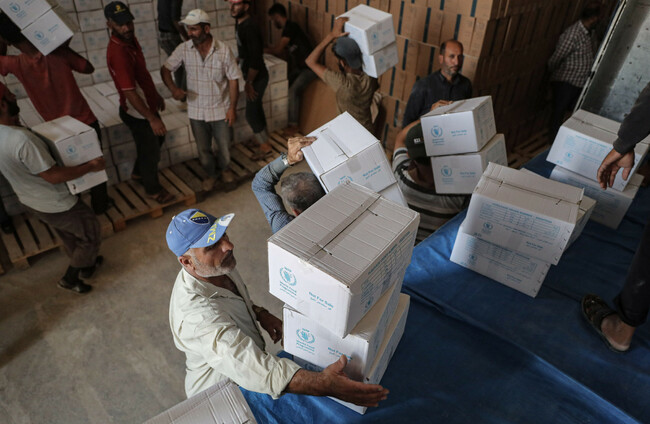
DAMASCUS WILL LET humanitarian aid flow through Syria’s main border crossing into rebel-held areas, reopening a conduit that had closed after a UN Security Council stalemate, the country’s UN ambassador has said.
The Damascus government has made a “sovereign decision” to let aid move overland from Turkey through the Bab al-Hawa crossing in northwest Syria for six months starting Thursday, ambassador Bassam Sabbagh told reporters.
The UN largely delivers relief to northwest Syria via neighboring Turkey through the Bab al-Hawa crossing.
But a deal allowing for this mechanism to work — without the authorisation of Damascus — expired on Monday.
The UN says more than four million people are in need in northwest Syria, which has been beset by civil war since 2011. The aid arrangement brings them food, water, medicine and other essentials.
On Tuesday, Russia vetoed a nine-month extension to the agreement, and then failed to muster enough votes to adopt just a six-month extension, during a vote at UN headquarters in New York.
One of five Security Council members with veto power, Russia had been against the resolution’s adoption last summer but Irish and Norwegian diplomats managed to achieve a compromise on the aid programme.
Ireland was a temporary member of the Council last year and at the time sources told The Journal that Irish diplomacy had played a decisive role in getting the resolution over the line.
Tánaiste Micheál Martin earlier expressed deep concern over the UN Security Council decision.
Martin, who is also Minister for Foreign Affairs and Defence, took to Twitter to express his disappointment, saying: “I am deeply concerned about the impact of this decision”.
He added: “Ireland & Norway worked tirelessly to renew the cross-border resolution in 2021 and 2022.
I am deeply concerned about the impact of this decision. Ireland & Norway worked tirelessly to renew the cross-border resolution in 2021 and 2022.
— Micheál Martin (@MichealMartinTD) July 13, 2023
I urge the Security Council to find a solution quickly. Humanitarian assistance to the 4.1m people who depend on it must continue. https://t.co/ZSF0RITuwX
“I urge the Security Council to find a solution quickly. Humanitarian assistance to the 4.1m people who depend on it must continue.”
After the Syrian concession Thursday, Secretary-General Antonio Guterres’s spokesman said the UN had just received a letter from Syria to this effect and is studying it.
Even as the Bab al-Hawa crossing closed, two other crossings remained operational. President Bashar al-Assad opened them after a devastating earthquake in February that killed tens of thousands of people in Turkey and northwest Syria.
But 85% of the aid reaching rebel-held areas went through Bab al-Hawa.
Damascus regularly denounces the aid deliveries as a violation of its sovereignty, and Russia has been chipping away at the deal for years.
Moscow is a major ally of Damascus, and its intervention in Syria since 2015 helped to turn the tide in the regime’s favor.
Since the civil war began, millions of people have been displaced by the fighting between rebel groups and the government headed by Bashar al-Assad.
The situation has been further complicated by interventions from foreign powers, including Russia who back the Assad regime and have supplied it with military equipment, fighters and logistical support.
Janez Lenarčič, the EU’s commissioner for crisis management, said on Twitter that the UN’s decision would have “devastating consequences for millions of most vulnerable Syrians.”
“The EU calls on the SC (Security Council) to undertake every effort to find a solution that will enable cross-border assistance to continue.”
The Eu’s diplomatic service also condemned the decision yesterday.
“The European Union deplores the veto by the Russian Federation in the UN Security Council,” a statement read.
“As there is no adequate alternative to the UN-coordinated mechanism, the halting of cross-border delivery will lead to the loss of the only lifeline for more than 4 million people living in Northwest Syria, including almost 3 million internally displaced persons.”
With reporting from © AFP 2023

To embed this post, copy the code below on your site














have your say