Sign in. It’s quick, free and it’s up to you.
An account is an optional way to support the work we do. Find out more.
Sign in. It’s quick, free and it’s up to you.
An account is an optional way to support the work we do. Find out more.
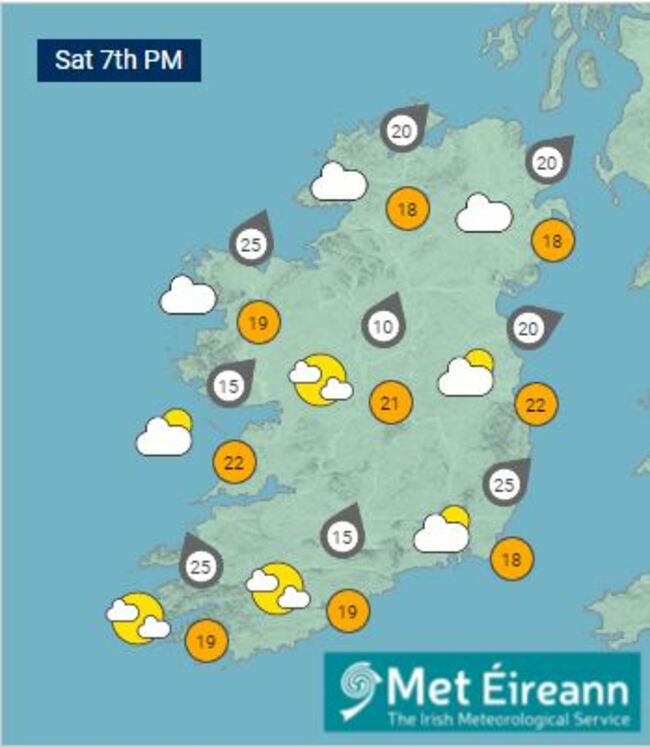
TEMPERATURES IN THE low 20s are forecast for the weekend, with Met Éireann predicting highs of 23 degrees on Saturday.
That would fall short of the current highest October temperature, which was the 25.2 degrees recorded in Clongowes Wood College in Co Kildare on 1 October, 1906.
However, it would be a stark increase on the highest temperature recorded last October of 19.5 degrees in Shannon Airport in Co Clare on 3 October, 2022.
Met Éireann forecasts a dry day on Saturday, with just a little cloud building from the west during the afternoon.
There’ll be highest temperatures of 18 to 23 degrees, with overnight temperatures of 12 to 15 degrees.
It will stay dry on Sunday, with slightly lower daytime temperatures forecast of between 18 and 22 degrees, and night-time temperatures of 13 to 15 degrees.
There’s also a warm start in store next week, with current indications suggesting Monday will be dry, with the best of the sunshine in southern areas and highest temperatures of 17 to 22 degrees.
Alan O’Reilly of Carlow Weather said the increase in temperatures will be due to “unusually warm air moving up over us from tomorrow”.
He added that this warm air will bring the Saharan dust with it but that the mainly dry conditions will mean it won’t be brought down to the surface.
O’Reilly said this “could make for some colourful sunsets and sunrise if we get breaks in the cloud”.
The warm air pushing up over us will also bring Saharan dust with it. As it will be mainly dry from Saturday it won’t get brought down to surface as much. Could make for some colourful sunsets and sunrise though if we get breaks in the cloud. pic.twitter.com/wtS0o3hxgi
— Carlow Weather (@CarlowWeather) October 5, 2023
Saharan dust is a mixture of sand and dust from the Sahara, which is a vast desert area that covers most of North Africa.
Winds can blow strongly over deserts, which whips dust and sand into the sky.
Once lifted from the ground, the clouds of dust can be carried for thousands of miles and end up in countries like Ireland.
However, in order for the dust to get from the sky to the ground, rain is needed.
As raindrops fall, they collect particles of dust on the way down.
When the raindrops evaporate, they leave behind a layer of dust.
With dry weather forecast, this could be replaced with “colourful sunsets and sunrises”.
To embed this post, copy the code below on your site
have your say