Sign in. It’s quick, free and it’s up to you.
An account is an optional way to support the work we do. Find out more.
Sign in. It’s quick, free and it’s up to you.
An account is an optional way to support the work we do. Find out more.
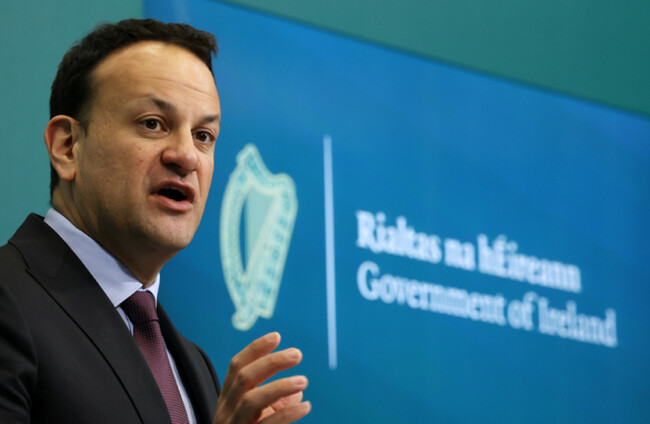
TÁNAISTE LEO VARADKAR has described Russian President Vladimir Putin as the “Hitler of the 21st Century” as he says that sanctions against Russia will have an impact on Ireland’s economy.
Speaking on RTÉ Radio One this evening, Varadkar said that Ireland is “not neutral” on the conflict, but added that there would be no military engagement by Ireland.
Russian forces first advanced over the Ukrainian borders yesterday morning, with bombing attacks across major cities in Ukraine.
Varadkar says that the EU is united on the situation and that he believes a third package of sanctions, following sanctions on Putin and Russian Foreign Minister Sergei Lavrov, will include measures like barring Russian banks from the Swift banking system.
“I do, and I think it should,” said Varadkar, despite the potential impacts on the Irish economy.
“It may have an impact on our economy and our banking sector but we’re not in that space anymore. This is an atrocity.”
I don’t think we’re in that space where we can be concerned about the economic impact on Ireland when a democratic country in the European Union is being invaded and the attempt is being made to overthrow a democratic government there.
“The last time I can think of that happening in Europe is in the 1930s and I think we should see this conflict in that context.
“We knew that Putin was a bad man, we’ve known that for a long time now, but we didn’t think that he would be the Hitler of the 21st century and I think he’s putting himself into that space.”
Ambassador expulsion
There have been calls by multiple Irish politicians for the expulsion of the Russian Ambassador to Ireland, Yuriy Filatov.
This includes Sinn Féin leader Mary Lou McDonald, Fianna Fáil MEP Billy Kelleher and TDs from Labour and the Social Democrats.
However, Varadkar said it was not something the Irish government currently planned to do, but that it wasn’t being ruled out.
“It’s not something that we plan to do at the moment, it’s not something that we’re ruling out either.
“As is often the case, these things are done on an EU coordinated level.
“It is the kind of thing we can do.”
Varadkar says that expelling the ambassador would not change much and that it would be a symbolic move.
Foreign Minister Simon Coveney also addressed the potential expulsion of Filatov, saying that EU foreign ministers decided against it, but that it remains on the table.
“Following consultations with my EU Foreign Minister Colleagues today, we have decided as a bloc not to expel Russian ambassadors. This and other possible diplomatic measures remain on the table,” Coveney said in a statement.
On RTÉ’s Six One, Filatov addressed the calls for his expulsion from Ireland.
When asked, he said: “That’s a good question, you might ask that of your government, it’s up to them.”
RTÉ Six One interview with Russia’s Ambassador to Ireland Yuriy Filatov | Live updates: https://t.co/65zqcDbQ9X pic.twitter.com/1y7QfJUkh7
— RTÉ News (@rtenews) February 25, 2022
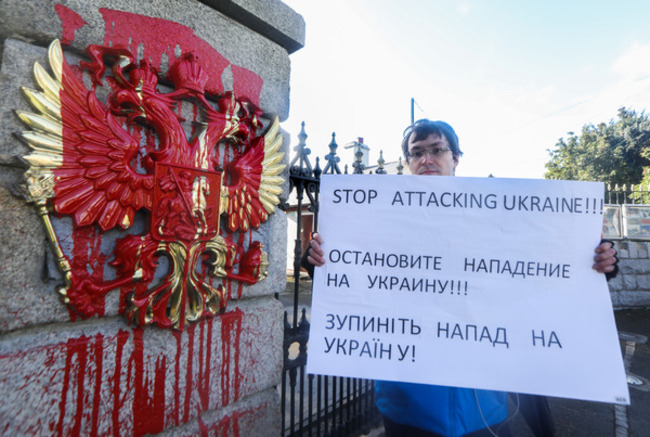
Earlier today, hundreds of protestors gathered outside the Russian embassy in Dublin for a second day protesting the invasion of Ukraine.
The crowd sang and chanted slogans in opposition to the Russian invasion.
Chants included: ‘Military help, for Ukraine’ and ‘Shame, Shame, Shame’ in the direction of the embassy.
Yesterday, red paint was thrown against the wall of the embassy after Russia began the invasion of Ukraine.

To embed this post, copy the code below on your site







have your say